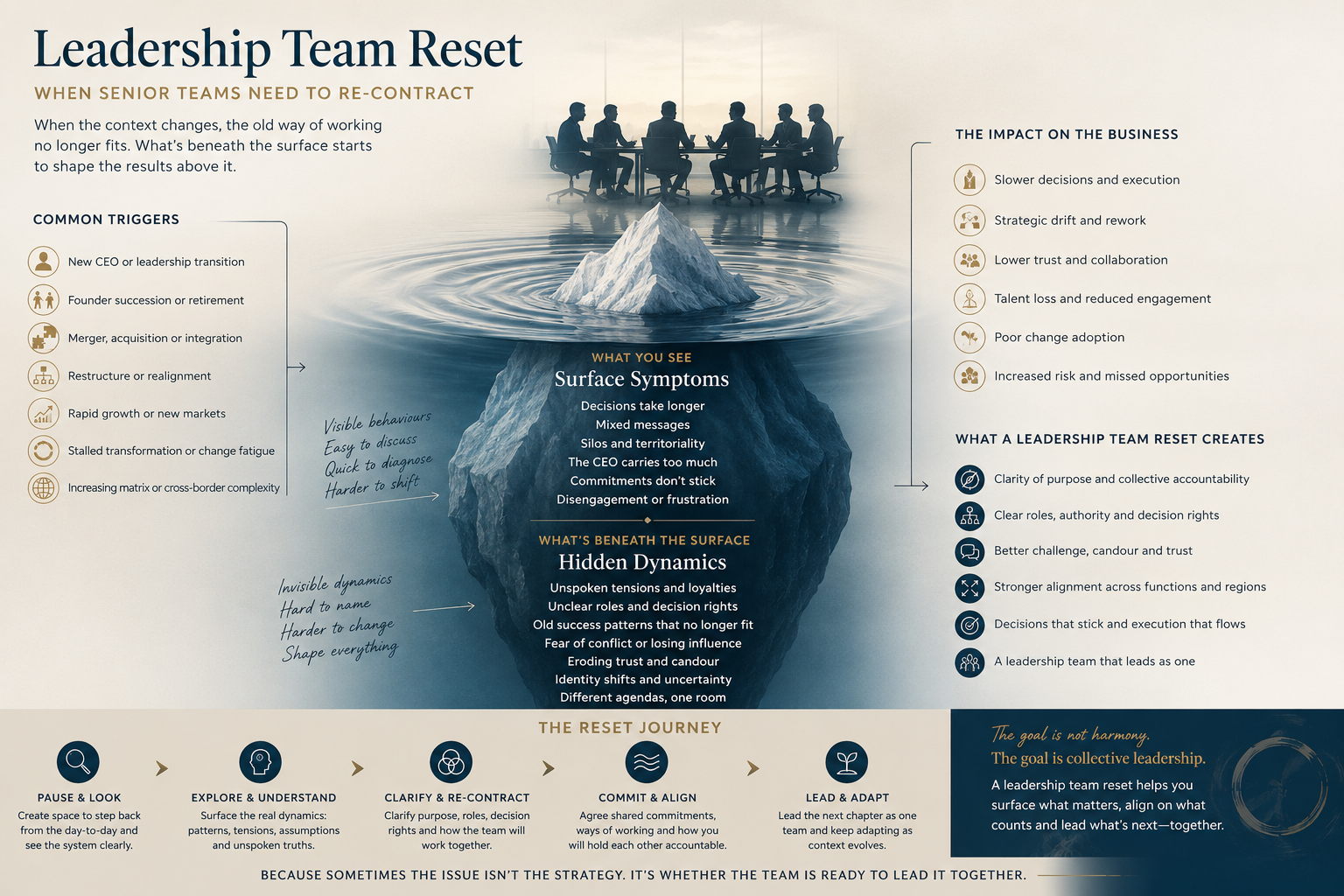
Why Are Teams Trickier? What Changes When Capable Leaders Work Together
One of the oddest things about leadership teams is that you can put six highly capable people in a room and get a collective result that none of them would be particularly proud of individually.
They may all be intelligent, experienced and successful leaders. Yet together they avoid the obvious conversation, reach a decision that quietly unravels afterwards, or spend an hour circling an issue that looked relatively straightforward on paper.
Someone who is normally forthright becomes cautious. Two functions find themselves on opposite sides of yet another issue. The Chief Executive asks for challenge, but the room changes once they reveal their own preference. Everyone apparently agrees on Tuesday, then the decision starts being reopened in smaller conversations by Thursday.
Sometimes the real meeting starts after the meeting has finished.
What changed?
Not necessarily the quality of the people.
They became a group.
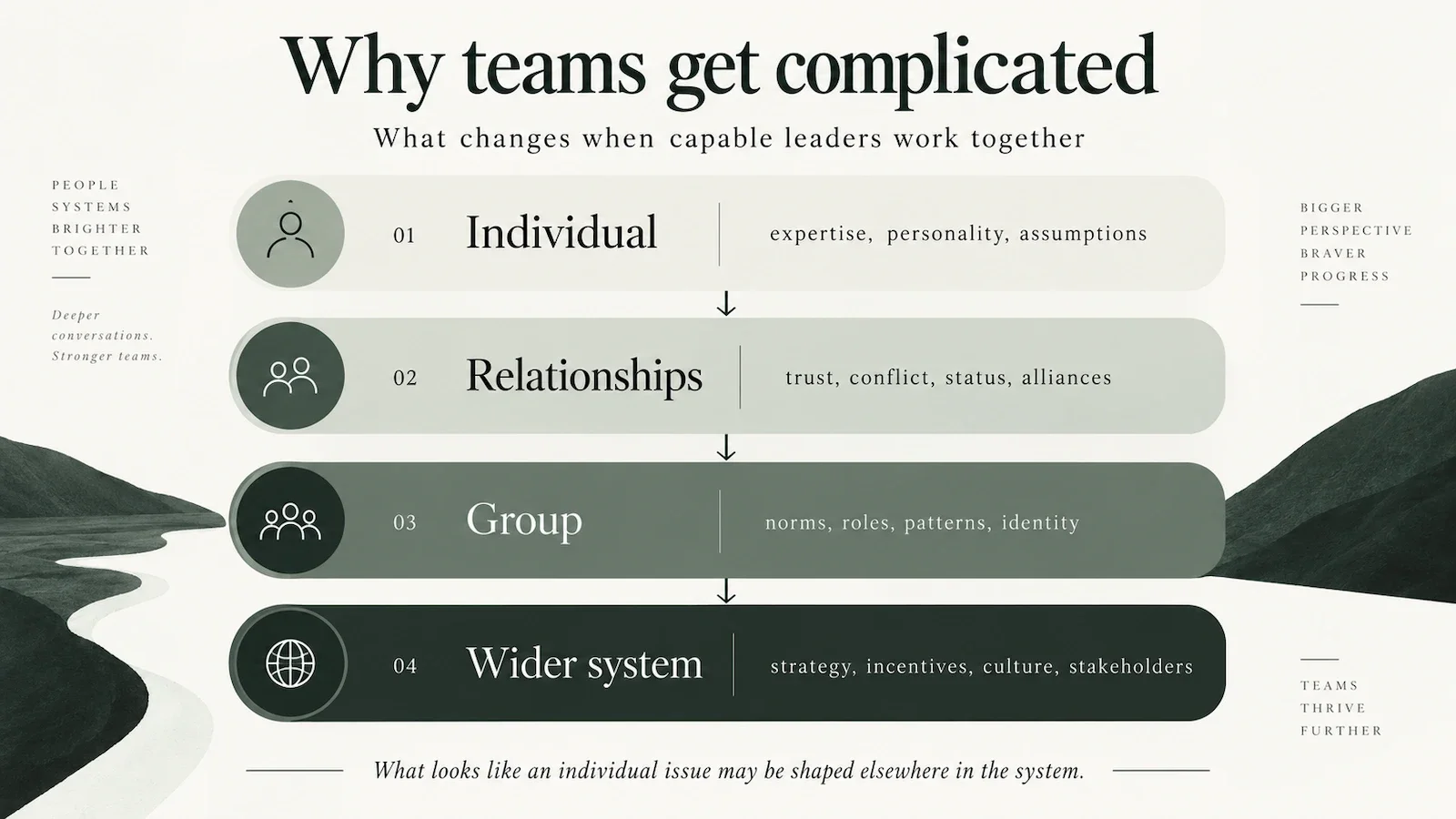
That sounds obvious, but it matters. When we move from working with an individual to working with a team, we do not simply add more people. We create another level of complexity.
The individuals are still there, with their different expertise, histories, personalities, values and assumptions. But now there are relationships between them. There is status and power. There are shared experiences, alliances and expectations. There are things that can safely be said, things that feel harder to say, and things that everyone seems to know without anybody quite articulating them.
Over time, the team develops patterns of its own.
And all of this is taking place inside an organisation which has its own strategy, history, incentives, culture, politics and pressures.
So a leadership team is not simply several individual leaders sitting around the same table.
It is a social system.
This helps explain an apparent paradox at the heart of senior teams. High individual capability does not automatically turn into high collective capability.
Decades of team research have increasingly shifted attention from simply asking who is in the team towards examining what happens between people, how knowledge is integrated and whether the surrounding conditions make effective teamwork possible (Kozlowski & Ilgen, 2006; Mathieu et al., 2008). Research specifically involving top management teams similarly points towards the importance of how executives actually integrate and work together, rather than simply their individual characteristics (Carmeli & Schaubroeck, 2006).
I think of this as the capability conversion problem.
A senior team may contain enormous expertise, but its members also hold different information, incentives, accountabilities and definitions of success. They have to turn all of that distributed capability into collective judgement and coordinated action without flattening the legitimate differences that make having a leadership team worthwhile in the first place.
That is where teams become much trickier than individuals.
The same behaviour can mean very different things
Take something ordinary: a person goes quiet.
In a one-to-one conversation, I might become curious about what is happening for that individual.
In a leadership team there are many more possibilities.
Perhaps they disagree but do not think it is wise to say so. Maybe the Chief Executive has already signalled where they stand. Perhaps this person has challenged the issue before and nothing happened. They might not feel confident in their evidence. Public disagreement may not fit their cultural or professional expectations. They may simply believe the decision belongs to someone else.
There is another possibility too.
Their silence may be useful to the group. By staying quiet they might, without anybody consciously deciding this, help everyone avoid a conversation nobody much wants to have.
The visible behaviour is identical.
The mechanism underneath it is not.
This is why I have become increasingly cautious about moving too quickly from an observation such as “people aren't speaking up” to a diagnosis such as “this team lacks psychological safety”.
Psychological safety matters enormously. Edmondson's foundational work linked it with team learning behaviour, while Frazier and colleagues' later meta-analysis drew on 136 samples involving more than 22,000 people and nearly 5,000 groups. But safety is not simply comfort or niceness, and silence by itself does not tell us what produced it (Edmondson, 1999; Frazier et al., 2017).
Sometimes a better question is simply:
What is happening here that makes this behaviour understandable?
That question keeps us curious for a little longer before we start fixing things.
Think about your last leadership meeting
Who spoke first? Who changed the direction of the conversation? Who became quieter when the stakes rose? And which conversation happened afterwards rather than in the room?
Those moments can tell you as much about how a team really works as its agenda, values or stated ways of working.
The visible meeting is only part of the meeting
Christine Thornton uses a phrase I particularly like: “the secret life of groups”.
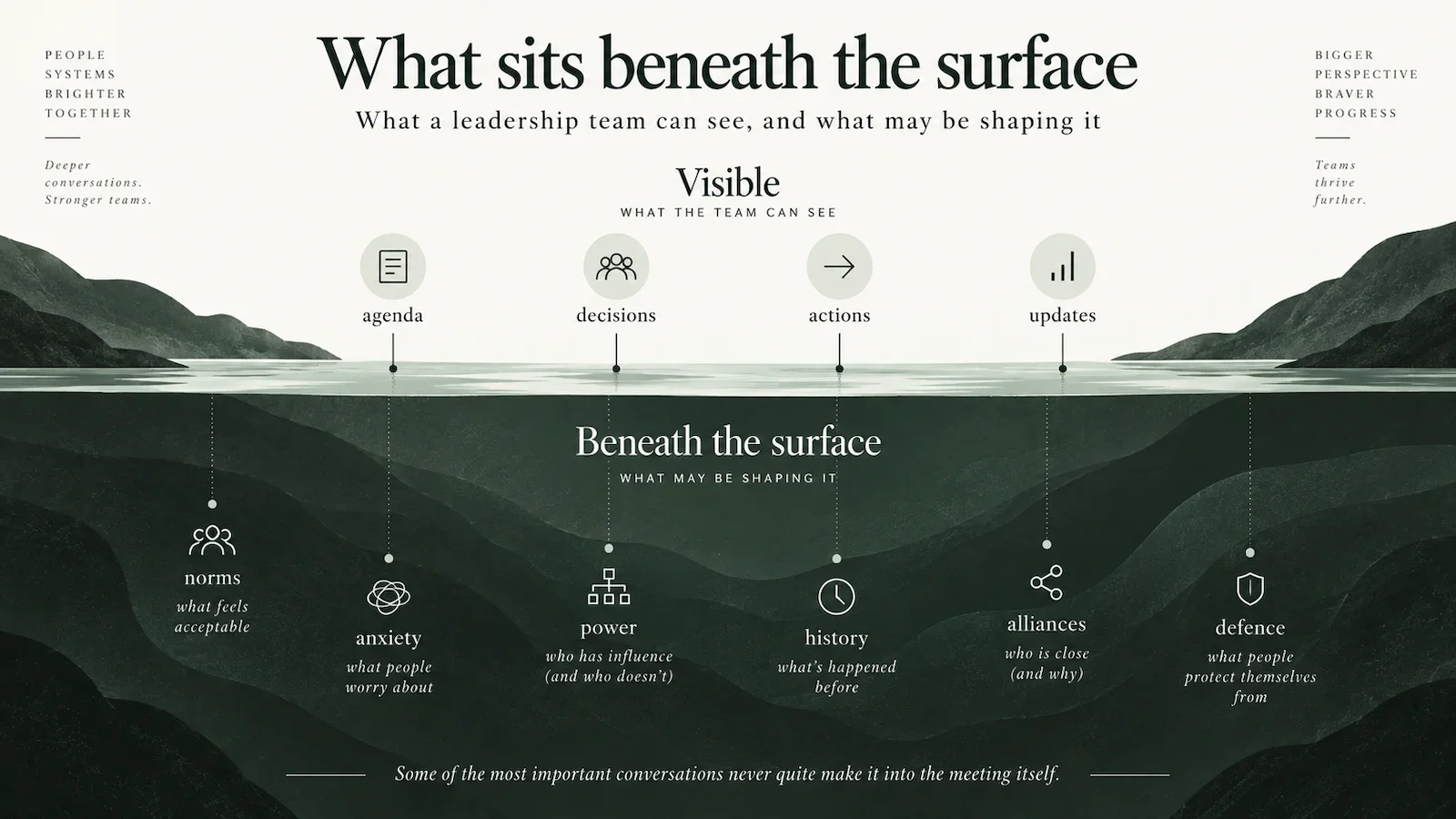
Most organisations understandably pay considerable attention to the visible life of a leadership team. There is the agenda, strategy, KPIs, papers, decisions and actions.
But another conversation is happening alongside it.
Who can interrupt whom? Whose contribution immediately changes the atmosphere? Who gets listened to before they have really explained their case? Who seems to need considerably more evidence than somebody else before the group takes them seriously?
Which subjects suddenly change the energy?
Who looks towards the CEO before answering?
Whose jokes relieve tension?
Which disagreement is perfectly acceptable, and which feels somehow more dangerous?
What gets discussed freely in the room, and what emerges later in twos and threes?
Thornton's work brings together group analysis, psychology and systems thinking precisely to illuminate these less visible, including subconscious and non-verbal, aspects of group life. Her third edition explicitly explores learning, holding and exchange, the “secret life” of groups, systems and complexity, and difficult patterns of behaviour.
I find the idea of holding particularly useful.
Groups need enough containment to tolerate uncertainty without immediately escaping from it. They need to be able to stay with not knowing long enough to think, exchange genuinely different perspectives and learn.
That sounds straightforward until the question on the table involves a major restructuring, disappointing performance, someone's future, a strategy people privately doubt or a decision with no obviously good answer.
Then uncertainty becomes much harder to tolerate.
Being in a group changes us
It is tempting to assume that people bring a relatively stable personality into a team and then behave accordingly.
Of course personality matters.
But anybody who has worked across several teams will recognise something else. We do not show up identically in every group.
A leader can be outspoken in one setting and oddly cautious in another. Somebody who is creative and relaxed with their own people becomes careful around the executive table. The person described as “difficult” in one group works brilliantly in another.
Their personality did not change between the two meetings.
The social environment did.
Groups make us aware of things that barely exist when we are alone. We notice status and belonging. We read reactions. We judge credibility. We make calculations about when to challenge and when to hold back.
For a senior executive the question is rarely just:
“Do I disagree?”
It may be:
“Do I challenge this idea, from this person, in this room, in front of these people, at this moment?”
That is a much more complicated judgement.
And power is not only hierarchy. Expertise, control of resources, organisational tenure, proximity to decision-makers, board access and personal status all shape whose voice carries weight. Research on power within senior teams suggests that its effects are contingent and relational rather than captured by a simple “less hierarchy is better” rule (Greer, Caruso & Jehn, 2011; Smith et al., 2006).
This matters because it makes individual explanations less satisfying.
Someone may indeed need to change their behaviour.
But we should also ask what the group is bringing out in them.
Sometimes the group is protecting itself from something
This is where things become particularly interesting.
Groups do not just process tasks and information. They also experience uncertainty, disappointment, competition, hope, dependency, anxiety and the wish to belong.
Sometimes a group develops ways of making those experiences easier to tolerate.
A leadership team facing profound uncertainty may gradually become more dependent on the Chief Executive for certainty and direction.
Anxiety created by an external threat can become an internal fight.
Two functions can come to represent opposite sides of an unresolved organisational dilemma. Commercial becomes “growth”; Finance becomes “control”. Innovation becomes “the people who want progress”; Risk becomes “the people who always say no”.
After a while, everybody can forget that the organisation needs both sides of the tension.
The conflict becomes located in people.
Psychodynamic thinkers have long used ideas such as dependency, projection, splitting and defences against anxiety to understand patterns like these. Bion's work on group behaviour, Menzies Lyth's study of social systems as defences against anxiety and later organisational work by Obholzer and Roberts provide useful lenses here (Bion, 1961; Menzies Lyth, 1960; Obholzer & Roberts, 1994).
There is a very human version of this which most of us will recognise.
One person gradually becomes the difficult one.
She's always negative.
He makes everything complicated.
That department blocks us.
Perhaps some of the criticism is entirely justified.
But another question becomes possible:
What becomes easier for the rest of us if one person carries most of the difficulty?
That does not mean there is always projection or scapegoating. It means it is worth wondering.
This is where psychodynamic ideas are most useful to me. They are not a licence to diagnose people from across a boardroom table. They provide additional hypotheses when the obvious explanation does not quite explain the pattern.
The discipline matters. Before deciding that something unconscious is occurring, it makes sense to examine task, authority, incentives, capability, information and decision rights. Your evidence review makes exactly this caution: psychodynamic interpretations have high interpretive risk and should remain testable hypotheses rather than verdicts.
Sometimes dependency is actually unclear authority.
Sometimes “defensiveness” is a reasonable response to badly handled challenge.
But sometimes a repeated group pattern prompts a more interesting question:
What might this team be protecting itself from having to feel, acknowledge or discuss?
Look beneath the behaviour
A recurring team pattern may be solving a problem as well as creating one.
Dependence on the CEO may reduce uncertainty. Avoiding disagreement may protect relationships. Blaming one function may simplify a more uncomfortable organisational tension. Before trying to remove a pattern, ask what purpose it may currently be serving.
Before fixing the relationships, ask whether there is actually a team
There is also a much more practical reason teams are tricky.
Not every group called a team really is one.
We use the word extraordinarily loosely. Having the same boss, attending the same executive meeting and appearing next to one another on an organisation chart does not necessarily create meaningful interdependence.
Hackman's work on team effectiveness, and Wageman and colleagues' work specifically with senior leadership teams, puts considerable emphasis on the conditions surrounding teamwork. Is this a real team? Does it have a compelling collective purpose? Are membership, structure and organisational support fit for that purpose? (Hackman, 2002; Wageman, Hackman & Lehman, 2005; Wageman et al., 2008).
One question cuts through a surprising amount of noise:
What does this group need to accomplish together that its members cannot achieve through their functions acting separately?
If the answer is unclear, I would hesitate before running a trust workshop.
Perhaps the leadership meeting is mainly a collection of functional updates. Maybe every genuinely difficult decision eventually returns to the CEO. Perhaps executives are told to “think enterprise” while almost all of their incentives reward functional performance.
Those are not primarily relationship problems.
They are problems of team design.
And coaching cannot compensate indefinitely for poor design.
A useful test
What does this leadership team need to accomplish together that its members could not achieve through their functions acting separately?
If the answer is unclear, the first challenge may not be trust, communication or team behaviour. It may be the collective purpose and design of the team itself.
Six excellent brains do not automatically become one better brain
Assuming there really is collective work to do, another difficulty appears.
The knowledge required to make a senior decision is usually distributed.
The Finance Director knows something others do not. The commercial leader sees another part of reality. Operations understands implications that are almost invisible from Head Office. The Chief People Officer may see a capability risk that never appears in the financial model. The Chief Executive knows something about the board or investor landscape.
In principle, this is one of the reasons the team exists.
But getting information into the room is not the same as integrating it.
People repeat what everybody already knows. They assume other people share context that actually exists only in their own head. They present neat recommendations while hiding the uncertainty underneath them. Status influences whose information receives attention.
Mesmer-Magnus and DeChurch's meta-analysis of 72 studies involving 4,795 groups found information sharing associated with performance, cohesion, decision satisfaction and knowledge integration. Separate meta-analytic work by DeChurch and Mesmer-Magnus also links team cognition with team processes and performance (Mesmer-Magnus & DeChurch, 2009; DeChurch & Mesmer-Magnus, 2010).
The issue may therefore not be that the organisation needs cleverer executives.
The executives may need to become better at thinking together.
That is a different capability.
Trust matters, but trust is not simply “being open”
Trust quite rightly features heavily in discussions about teams.
De Jong, Dirks and Gillespie's meta-analysis of 112 studies and 7,763 teams found a positive relationship between intrateam trust and performance. Particularly relevant for senior teams, the relationship was stronger where task interdependence, authority differentiation and skill differentiation were high (De Jong, Dirks & Gillespie, 2016).
But trust is more complicated than a single score.
I might trust someone's competence but not their motives. I can trust a colleague with confidential information but still doubt that they will deliver what they promised. And trust is not simply something a team either has or lacks before the work begins.
Teams create trust through what happens next.
Good judgement, reliability, honest communication and repaired mistakes can strengthen it. Broken commitments and private lobbying erode it.
Simons and Peterson's research with top management teams is interesting here because they found that trust reduced the tendency for task disagreement to turn into relationship conflict (Simons & Peterson, 2000).
That is a useful way to think about trust in senior teams.
It is not about making everybody closer.
It is about having enough justified confidence in one another to expose uncertainty, depend on commitments and disagree without assuming hostile intent.
Power changes what can be said
Now put the Chief Executive back into the conversation.
They say:
“I'm genuinely open. My instinct is Option B, but I'd really like to hear what everyone else thinks.”
They may completely mean it.
But the meeting has changed.
The CEO's preference is not simply another contribution. Formal authority gives it weight whether they want that weight or not.
Senior teams also contain plenty of informal power: expertise, revenue ownership, tenure, reputation, access and relationships.
Equal airtime does not mean equal influence.
And this can create a surprisingly powerful loop.
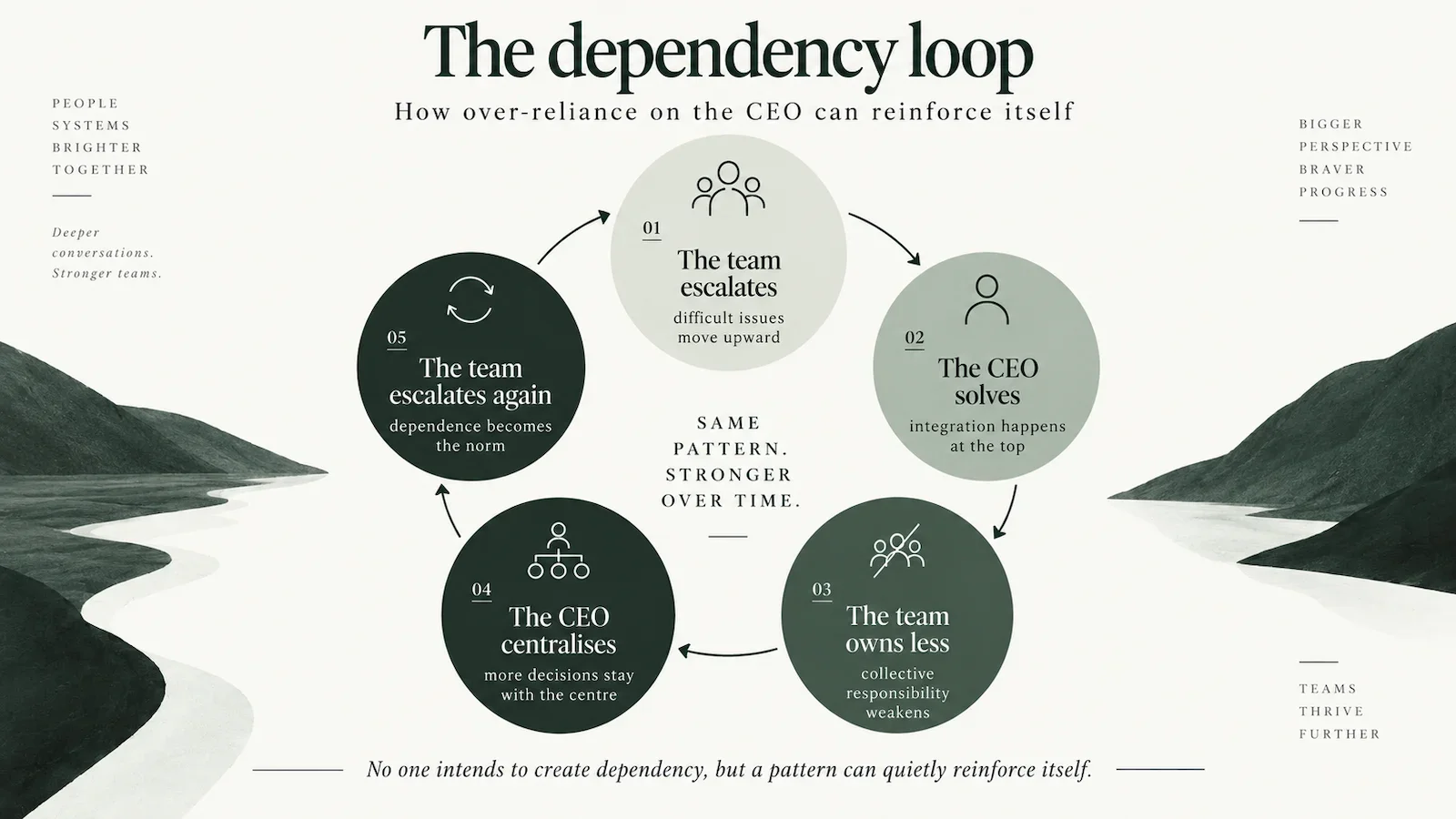
A Chief Executive becomes frustrated because the team repeatedly pushes difficult issues upwards. Wanting to keep things moving, they solve more of those issues themselves.
The team learns that difficult integration ultimately belongs to the CEO.
So it escalates more.
The Chief Executive sees even less ownership and becomes more directive still.
No one intended to produce dependency, but together they have created it. Your evidence review identifies exactly this kind of reinforcing cycle in senior-team behaviour.
When the pattern is becoming visible
If decisions keep returning to the CEO, difficult conversations happen after the meeting, or functions keep pulling in different directions, waiting rarely makes the pattern disappear.
The useful next step is not to label the team as dysfunctional. It is to understand where the constraint actually sits: purpose, decisions, challenge, accountability, relationships or the wider system around the team.
“Healthy conflict” is a bit too easy
There is a familiar piece of team advice that says high-performing teams need healthy conflict.
The intention is sensible.
The wording can mislead.
Teams certainly need to be able to disagree. But disagreement that improves thinking and conflict that consumes attention are not the same thing.
Earlier meta-analyses had already complicated the idea that task conflict is broadly beneficial (De Dreu & Weingart, 2003; de Wit, Greer & Jehn, 2012). A substantial 2026 update by Yuan, Yin and Sun examined task, relationship, process and status conflict and found all four negatively associated with performance on average, while also identifying substantial variation across contexts.
This is not an argument for harmony.
Quite the opposite.
A strong leadership team has to be able to say things such as “I don't think the evidence supports that”, “What are we assuming?”, “I see the risk differently” or “I will support the decision, but I am not persuaded by that part of the reasoning.”
That can be uncomfortable. At times it should be.
But useful challenge does not require people to become adversaries.
The aim is not “more conflict”.
It is better disagreement.
Teams remember, even when nobody talks about the past
Groups also accumulate history.
Somebody challenges an important decision and gets shut down. An executive makes a mistake and is embarrassed publicly. Two functions survive a bruising restructuring. Someone gets the role several colleagues expected to be considered for.
Nobody needs to announce a new team rule afterwards.
The team learns one.
Don't go there.
There is no point challenging that.
Agree in the room and deal with it afterwards.
Repeated interactions create expectations, and expectations change behaviour. Eventually the pattern begins to reproduce itself.
That is why teams can have surprisingly good insight into their difficulties and still continue behaving in very familiar ways.
Knowing the pattern exists is not always enough to alter it.
Sometimes the problem in the room began somewhere else
This may be the most important reason not to treat teams as closed systems.
Imagine persistent tension between the commercial and risk leaders.
It might be personal.
But suppose the board is simultaneously demanding aggressive growth and substantially lower risk.
The two executives may be carrying opposite sides of a contradiction created somewhere else.
Or perhaps executives are told to behave as one enterprise team while bonuses remain overwhelmingly tied to divisional performance.
Or regional leaders are told they are empowered while every consequential decision continues to require central approval.
The organisation walks into the room with its leaders.
Systemic approaches to team coaching are useful precisely because they widen the frame. Hawkins places particular emphasis on commissioning, stakeholders, boundary connections and learning. Widdowson and Barbour provide a broader practitioner map spanning purpose, identity, relationships, ways of working and transformation. Neither should be treated as a complete causal theory of team performance, but both help prevent team development becoming obsessively inward-looking (Hawkins, 2021; Widdowson & Barbour, 2025).
There is a psychodynamic version of this too.
Menzies Lyth's classic research showed how organisational systems can develop structures and routines that help people manage anxiety. Her context was very different from a modern executive team, so the work should not be casually transplanted. But the underlying question remains useful.
Could an apparently interpersonal problem be helping the wider organisation manage something difficult?
Your own evidence review makes a similar point: teams can become containers for wider organisational anxiety and contradictory demands, and what appears to be a split between two people or functions may actually be sustained by governance, incentives or the business model itself.
So before attempting to repair a relationship, I would sometimes ask:
What might these people be carrying on behalf of the wider system?
Before trying to fix the people
Ask whether the team is struggling with a relationship problem, or whether the relationship is carrying a problem created somewhere else in the organisation.
Conflicting targets, unclear authority, competing incentives and contradictory stakeholder demands can all surface as tension between individuals. Coaching the relationship alone may leave the mechanism untouched.
Stronger teams learn to notice themselves
None of this means high-performing teams somehow escape group dynamics.
They do not.
One of their more useful capabilities is becoming better at noticing what they themselves contribute to what happens.
Researchers call part of this team reflexivity, deliberate reflection on objectives, strategies and processes followed by adaptation. A 2024 meta-analysis found performance benefits while also identifying important conditions around team size, tenure and leadership (Khosravi, Rezvani & Ashkanasy, 2024).
In practice, it need not sound academic.
After a difficult decision, a team can ask: What just happened there? Whose information did we use? What did we miss? When did the conversation become less useful? What did we avoid? What will we do differently next time?
Structured debriefing has one of the stronger adjacent evidence bases in team development, although much of that evidence comes from operational and applied settings rather than senior executive teams, so transfer needs care (Tannenbaum & Cerasoli, 2013).
Reflection without a changed routine is interesting conversation.
Learning shows up when the next meeting is different.
So, why are teams trickier?
Because adding another person does far more than add another personality.
It creates relationships and comparisons. It introduces status and belonging. Information becomes distributed. People acquire histories with one another. Power affects participation. Groups develop norms and expectations, some obvious and some barely visible.
They also find ways of managing uncertainty and anxiety.
And none of this takes place in isolation from the organisation.
The board, strategy, incentives, customers, structure, history and culture all enter the room in one form or another.
That is why extremely capable people can occasionally produce surprisingly poor collective outcomes.
It is also why the answer is not always “team coaching”.
Sometimes an individual genuinely needs to change their behaviour. Sometimes two people need a difficult conversation. Sometimes clearer decision rights would do more good than another workshop. Sometimes the team itself has developed a pattern that nobody intended. Sometimes the organisation needs redesign, facilitation, mediation or straightforward performance management.
And sometimes something less visible is happening beneath the surface.
The useful work is not selecting the most sophisticated explanation.
It is working out which explanation best fits what is actually happening.
That is one of the things that makes working with teams so interesting to me.
In individual coaching, the person is the client.
In team coaching, the team itself becomes part of the client.
You listen to what people say, but also to what happens between them. You pay attention to the presenting issue, but also to the pattern around it. And you stay curious about what the wider organisation may be contributing to what happens inside the room.
When teams begin to do some of that noticing for themselves, something shifts.
What previously felt like “just how things work around here” becomes something the team can examine.
And once a pattern can genuinely be seen, it becomes much more possible to choose whether to keep it.
The more useful comparison
Not “Is this a good team?” but “Is the way we work together good enough for what the organisation now needs from us?”
A team can have worked successfully for years and still find that greater scale, transformation, new leadership or a more complex environment requires a different level of collective performance.
Some questions worth taking back to your leadership team
Rather than asking whether yours is a “high-performing team”, try something more concrete. What do you genuinely need to accomplish together that none of you can achieve through your own function? Which conversations become harder when the stakes rise? What happens after the most powerful person in the room gives their view? What gets discussed afterwards that really belonged inside the meeting?
Where do the same disagreements keep reappearing in different forms? What have you collectively learnt not to talk about? When are you genuinely acting as enterprise leaders, and when are you negotiating on behalf of your functions? What tensions from the wider organisation might you be carrying into the room?
And perhaps the question I find most interesting:
What does everybody in this team already know, but nobody quite says?
Leadership team coaching
Leadership team coaching works with more than the capabilities of the individual leaders around the table. It pays attention to the team's collective purpose, relationships, decision-making, recurring patterns and the wider organisational system in which the team operates.
My approach draws on systemic team coaching, group dynamics and psychologically informed practice, while staying firmly connected to the real work the team needs to accomplish.
Leadership team coaching
When the challenge sits between people rather than within one individual, developing leaders separately may address only part of the problem.
Leadership team coaching works with the team as a collective system: its purpose, relationships, decision-making, recurring patterns and the wider organisational context in which it operates.
References
Bion, W. R. (1961). Experiences in Groups. London: Tavistock.
Carmeli, A. & Schaubroeck, J. (2006). Top management team behavioral integration, decision quality, and organizational decline. The Leadership Quarterly, 17(5), 441–453.
Chartered Institute of Personnel and Development (2023). High-performing teams: An evidence review. London: CIPD.
DeChurch, L. A. & Mesmer-Magnus, J. R. (2010). The cognitive underpinnings of effective teamwork: a meta-analysis. Journal of Applied Psychology, 95(1), 32–53.
De Dreu, C. K. W. & Weingart, L. R. (2003). Task versus relationship conflict, team performance, and team member satisfaction: a meta-analysis. Journal of Applied Psychology, 88(4), 741–749.
De Jong, B. A., Dirks, K. T. & Gillespie, N. (2016). Trust and team performance: a meta-analysis of main effects, moderators, and covariates. Journal of Applied Psychology, 101(8), 1134–1150.
de Wit, F. R. C., Greer, L. L. & Jehn, K. A. (2012). The paradox of intragroup conflict: a meta-analysis. Journal of Applied Psychology, 97(2), 360–390.
Edmondson, A. C. (1999). Psychological safety and learning behavior in work teams. Administrative Science Quarterly, 44(2), 350–383.
Edmondson, A. C., Roberto, M. A. & Watkins, M. D. (2003). A dynamic model of top management team effectiveness: managing unstructured task streams. The Leadership Quarterly, 14(3), 297–325.
Frazier, M. L., Fainshmidt, S., Klinger, R. L., Pezeshkan, A. & Vracheva, V. (2017). Psychological safety: a meta-analytic review and extension. Personnel Psychology, 70(1), 113–165.
Greer, L. L., Caruso, H. M. & Jehn, K. A. (2011). The bigger they are, the harder they fall: linking team power, team conflict, and performance. Organizational Behavior and Human Decision Processes, 116(1), 116–128.
Hackman, J. R. (2002). Leading Teams: Setting the Stage for Great Performances. Boston, MA: Harvard Business School Press.
Hackman, J. R. & Wageman, R. (2005). A theory of team coaching. Academy of Management Review, 30(2), 269–287.
Hawkins, P. (2021). Leadership Team Coaching: Developing Collective Transformational Leadership, 4th ed. London: Kogan Page.
Khosravi, P., Rezvani, A. & Ashkanasy, N. M. (2024). A meta-analysis of team reflexivity: antecedents, outcomes, and boundary conditions. Human Resource Management Review, 34(4), 101042.
Kozlowski, S. W. J. & Ilgen, D. R. (2006). Enhancing the effectiveness of work groups and teams. Psychological Science in the Public Interest, 7(3), 77–124.
Mathieu, J. E., Maynard, M. T., Rapp, T. & Gilson, L. (2008). Team effectiveness 1997–2007: a review of recent advancements and a glimpse into the future. Journal of Management, 34(3), 410–476.
Menzies Lyth, I. (1960). A case-study in the functioning of social systems as a defence against anxiety. Human Relations, 13(2), 95–121.
Mesmer-Magnus, J. R. & DeChurch, L. A. (2009). Information sharing and team performance: a meta-analysis. Journal of Applied Psychology, 94(2), 535–546.
Obholzer, A. & Roberts, V. Z. (eds.) (1994). The Unconscious at Work. London: Routledge.
Simons, T. L. & Peterson, R. S. (2000). Task conflict and relationship conflict in top management teams: the pivotal role of intragroup trust. Journal of Applied Psychology, 85(1), 102–111.
Tannenbaum, S. I. & Cerasoli, C. P. (2013). Do team and individual debriefs enhance performance? A meta-analysis. Human Factors, 55(1), 231–245.
Thornton, C. (2025). Group and Team Coaching: The Secret Life of Groups, 3rd ed. Routledge. The current edition explicitly covers invisible group processes, learning, holding and exchange, systems and complexity, and difficult patterns in teams.
Wageman, R., Nunes, D. A., Burruss, J. A. & Hackman, J. R. (2008). Senior Leadership Teams: What It Takes to Make Them Great. Boston, MA: Harvard Business Press.
Widdowson, L. & Barbour, P. J. (2025). Building Top-Performing Teams: A Practical Guide to Team Coaching for Organizational Success, 2nd ed. London: Kogan Page.
Yuan, Z., Yin, J. & Sun, J. (2026). The paradox of team conflict revisited: an updated meta-analysis of the team conflict-team performance relationships. Journal of Applied Psychology, 111(2), 195–224.

Under the Surface
A monthly briefing on the hidden dynamics shaping senior leadership, teams and change…
Read next…