Synthesising research on executive team effectiveness, strategic decision-making and the challenges of collective leadership.
An Operations Director can be right about resilience. A Finance Director can be right about cash. A Technology Director can be right about the need to modernise.
The organisation can still make the wrong decision.
This is one of the difficulties of senior leadership. We bring together people with considerable expertise, give them responsibility for different parts of the business, and expect them to make decisions in the interests of an enterprise that no single executive fully understands.
For years, organisations have invested heavily in developing individual leadership capability. Yet the research suggests that something else deserves at least as much attention: how that capability is brought together when decisions become difficult.
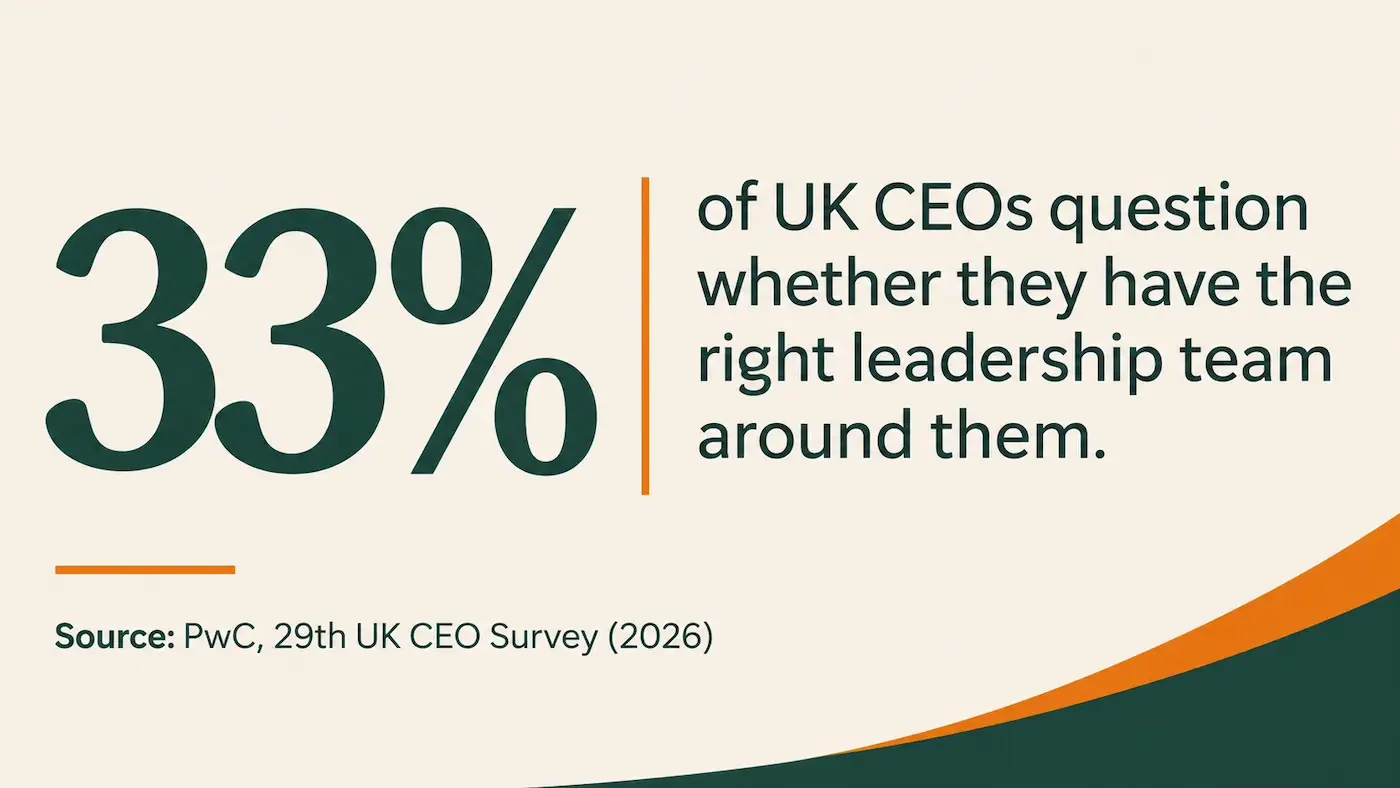
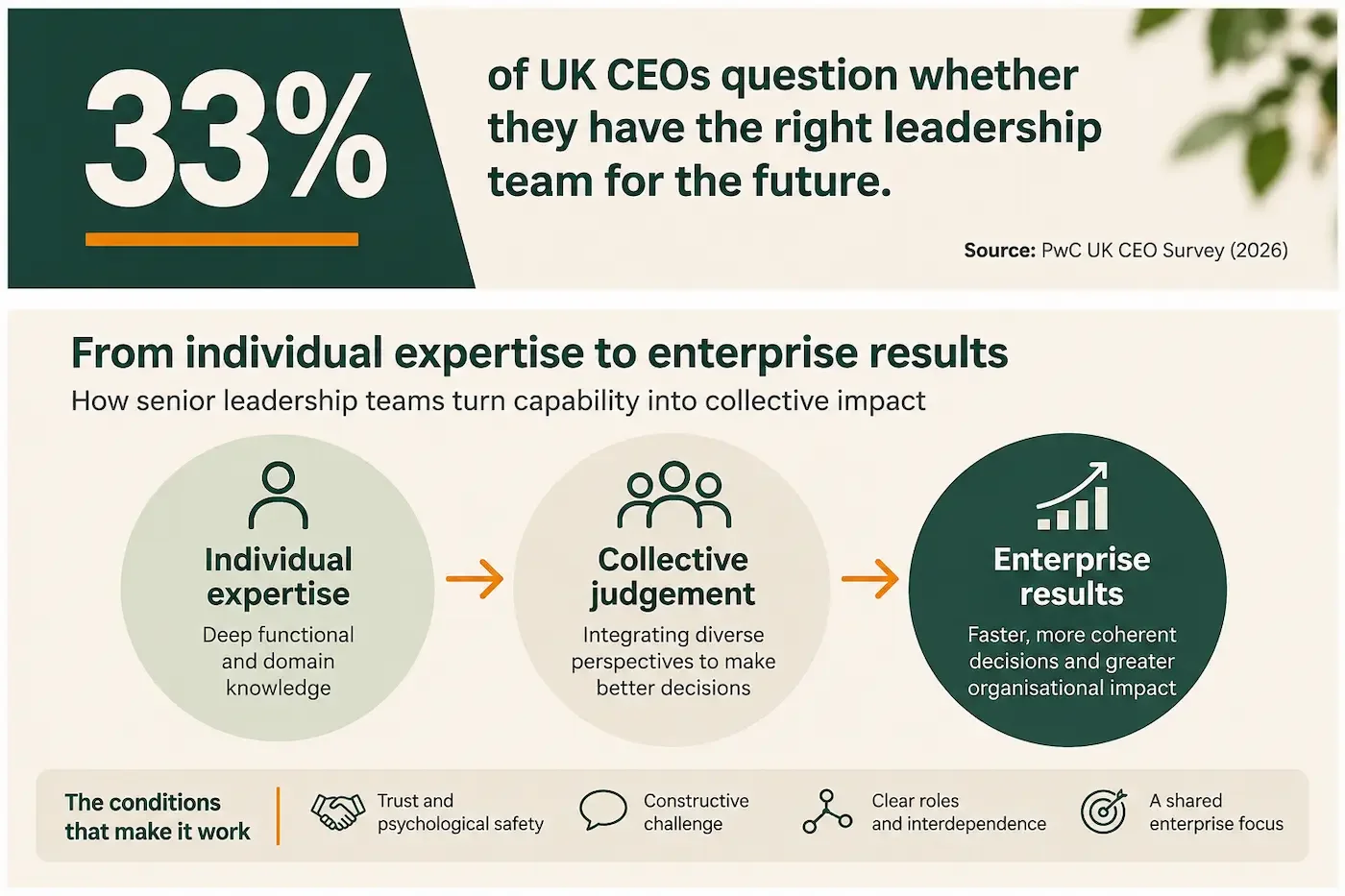
In PwC's 2026 UK CEO Survey, 33% of CEOs questioned whether they had the right leadership team around them. The same proportion reported unnecessary bureaucracy and internal politics that could hamper organisational agility (PwC, 2026).
The obvious response is to examine the calibre of the executives. Sometimes that will be necessary. Capability, experience and judgement matter enormously.
But there is another possibility.
What if the constraint is not always the quality of the executives, but the quality of the decisions they are able to make together?
Why do senior leadership teams struggle?
Research points to several interconnected challenges: competing functional priorities, insufficient sharing of important information, difficulties handling disagreement, unclear collective responsibilities and organisational structures that do not always support enterprise-wide decisions.
A senior leadership team can therefore contain highly capable executives without achieving the collective performance their organisation needs. The difficulty may lie less in individual expertise than in how effectively that expertise is brought together.
That distinction becomes increasingly important as the demands on organisations change.
This article synthesises research from strategic management, top management team effectiveness, organisational psychology and systems thinking. It also draws on recent evidence about the pressures facing CEOs.
The argument is straightforward: many senior leadership teams are being asked to deliver increasingly integrated enterprise outcomes while continuing to operate through structures, incentives and habits built around individual functional performance.
The consequences deserve serious attention.
The business environment no longer respects organisational boundaries
The external pressures facing organisations do not arrive neatly separated into finance, operations, technology, commercial and people issues.
Geopolitical developments affect supply chains, investment decisions and customer markets. AI creates opportunities for productivity and innovation, while raising questions about risk, skills, capital allocation and organisational design. Regulatory changes can alter competitive positions and operating models almost overnight.
The World Economic Forum's Global Risks Report 2026 identifies geoeconomic confrontation as the leading global risk for the year (WEF, 2026).
In February, EY reported that 78% of UK CEOs had changed strategic investment plans in response to geopolitical or trade developments. Meanwhile, KPMG's October 2026 CEO Outlook found that 86% of UK CEOs remained confident about their companies' growth prospects over the next three years (EY, 2026; KPMG, 2026).
These findings are drawn from different surveys, but together they illustrate the competing demands facing business leaders.
Organisations are not simply retreating in response to uncertainty. They are investing, transforming and pursuing growth while seeking greater resilience.
And those ambitions create difficult trade-offs.
Consider an international manufacturer deciding whether to increase regional production capacity.
The Operations Director sees an opportunity to reduce supply-chain vulnerability. Finance sees significant capital expenditure and uncertain returns. Commercial leaders are concerned about customer competitiveness. Technology leaders argue that automation and digital infrastructure must be part of the investment. HR is considering future workforce capability.
Each perspective is legitimate. Each contains information the others need.
The enterprise decision depends on bringing those perspectives together, understanding their interdependencies and making a judgement that may leave some functional priorities only partly satisfied.
Michael Porter's work on strategy is particularly relevant here.
Porter (1996) distinguished operational effectiveness from strategy, emphasising the importance of trade-offs and the fit between an organisation's activities. Improving individual operations does not automatically produce competitive advantage. How those activities reinforce one another matters.
The best decision for an individual function may not be the best decision for the enterprise.
David Teece (2007) extended our understanding of organisational adaptability through dynamic capabilities: the capacity to sense changes, seize opportunities and reconfigure resources and capabilities.
James March (1991) explored another enduring tension: the need to exploit existing strengths while exploring new possibilities.
Together, these ideas reveal something important.
The ability to respond to change depends on more than having an intelligent strategy. It depends on the organisation's capacity to make and implement decisions that cut across established boundaries.
Research on complexity leadership makes a similar point. Uhl-Bien, Marion and McKelvey (2007) argue that adaptive outcomes emerge through interactions across complex organisational systems, not simply through direction from those at the top.
These theories operate at different levels of analysis. None proves that a particular executive team structure causes superior performance.
But they do raise a practical question:
If the business increasingly depends on cross-functional judgement and adaptation, has the senior leadership team's way of working developed to meet that need?
A group of accomplished executives is not necessarily an enterprise team
One of the more revealing findings from recent research appeared in Harvard Business Review in 2025.
Drawing on Gartner surveys, Ana Moreno reported that only 31% of C-suite executives identified the C-suite as their primary team (Moreno, 2025).
Think about that for a moment.
The executives responsible for leading the enterprise may identify more strongly with their own functions than with the collective leadership group.
That is not necessarily surprising.
Most executives reach senior positions through success in a particular discipline. Their professional reputation, relationships, experience and often their performance measures are tied to that area.
The CFO is expected to protect financial performance. The COO is responsible for execution. The CIO or CTO must address technological capability and risk. Commercial leaders are expected to deliver growth.
These responsibilities do not disappear when executives join the top team.
Nor should they.
I have spent much of my career moving between engineering, manufacturing, R&D, supply chain and international business leadership. One thing those different perspectives make clear is that a decision can look entirely reasonable from one part of an organisation and much less convincing from another.
The difficulty is not having different perspectives. It is what happens when those perspectives must be reconciled.
Research on top management teams helps explain why this matters.
Hambrick and Mason's (1984) Upper Echelons Theory proposed that strategic choices are partly shaped by the experiences, values and characteristics of senior executives. Hambrick (2007) subsequently developed this perspective, recognising that executive characteristics and their effects cannot be understood independently of context.
A particularly important qualification comes from Hambrick, Humphrey and Gupta (2015).
Their research demonstrates that top management teams differ in the degree to which executives' roles are genuinely interdependent. This influences how team composition relates to organisational outcomes.
In other words, not every senior executive group needs to behave like a highly integrated team.
Some leadership forums exist principally to share information, coordinate functional activity or advise the CEO. There may be little benefit in demanding intense collective involvement in decisions that properly belong to individual executives.
The distinction matters.
Wageman and colleagues (2008), drawing on research involving more than 100 senior leadership teams, emphasised the importance of establishing compelling collective work before focusing on team development.
A CEO therefore needs to distinguish between two questions:
Do I have capable executives responsible for the important functions of the business?
And:
Do I have a leadership team capable of accomplishing the work that genuinely requires those executives to act together?
The first question concerns individual capability.
The second concerns the design and effectiveness of the collective.
Confusing them can lead organisations to invest in team-building activity when the more fundamental issue is an unclear mandate, inappropriate decision rights or a lack of meaningful shared responsibility.
Before you invest in team development
Is the challenge your leadership team, or the way it is expected to work?
Capable executives can still struggle to deliver collectively. Before investing in another intervention, it is worth understanding where shared priorities, decision-making and team dynamics may be holding performance back. Our Leadership Team Performance Diagnostic offers a practical starting point.
The missing link between expertise and collective judgement
If having experienced executives is insufficient, what allows their capabilities to become an effective collective resource?
The research offers a useful answer.
Hambrick's concept of behavioural integration describes the extent to which a top management team engages in mutual collaboration, exchanges information and makes important decisions jointly.
Simsek and colleagues (2005), studying 402 firms, found that CEO, team and organisational factors all contributed to behavioural integration.
Carmeli and Schaubroeck (2006) examined 116 top management teams and found that greater behavioural integration was associated with better strategic decision quality and less organisational decline.
These are important findings, although their observational nature limits causal conclusions.
They suggest that the value of executive expertise depends partly on how effectively the team can use it.
This sounds obvious until we examine how groups actually process information.
In their influential 1985 experiments, Stasser and Titus found that groups tended to spend more time discussing information already shared among members than information held by only one person.
Later research reinforced the importance of information exchange. Mesmer-Magnus and DeChurch's (2009) meta-analysis of 72 independent studies found positive relationships between information sharing and several team outcomes, including performance and knowledge integration.
There is a useful distinction here.
A leadership team may have access to all the expertise required for a decision without that expertise materially influencing the decision.
The most familiar information can dominate because it is easier to discuss, more widely understood or closer to an emerging consensus.
Specialist knowledge may be discounted because its implications are uncomfortable, difficult to explain or inconsistent with the prevailing view.
And the most senior or confident voice may receive disproportionate attention.
The organisational consequence can be significant.
When a team fails to integrate relevant information, its decisions may reflect the most influential perspective rather than the best available collective judgement.
A leadership team can have all the expertise it needs and still fail to make use of it.
This also challenges a familiar assumption about speed.
Kathleen Eisenhardt's (1989) study of strategic decision-making in eight technology firms found that faster decision-makers often used more information and considered more alternatives than slower decision-makers.
Speed did not necessarily come from cutting corners. The faster teams had developed ways of examining evidence, resolving disagreement and connecting decisions with implementation.
The study is small and specific to its context. Nevertheless, its implications remain interesting.
An executive team that struggles to make decisions may not need less debate. It may need a better way of debating.
A question worth asking
Is your leadership team making the most of its collective expertise?
When decisions repeatedly return to the CEO, functional priorities compete or important challenges go unresolved, the cost can extend well beyond the meeting room. Our five-minute Leadership Team Performance Diagnostic helps identify where your team may be losing effectiveness.
Is constructive conflict really good for teams?
This is an area where leadership advice has often been more confident than the evidence warrants.
We are frequently told that high-performing teams embrace conflict.
There is some truth in the underlying idea. Complex decisions benefit from competing perspectives, rigorous examination of assumptions and the willingness to challenge weak reasoning.
But disagreement and conflict are not identical.
Allen Amason's (1996) research into top management teams distinguished cognitive disagreement about tasks and decisions from affective conflict involving personal tensions.
His work suggested that intellectual disagreement could improve strategic decision quality, while personal conflict could undermine acceptance and relationships.
This distinction became influential in subsequent management thinking.
However, the wider evidence has proved more complicated.
De Wit, Greer and Jehn's (2012) meta-analysis of 116 studies found consistently negative relationships between relationship and process conflict and group outcomes. Task conflict was more nuanced, with more favourable relationships in some contexts, including top management teams.
A significant update appeared in February 2026.
Yuan, Yin and Sun's meta-analysis found that task, relationship, process and status conflict were all negatively associated with team performance on average. The relationships varied considerably across contexts, particularly for task and relationship conflict.
This does not mean executive teams should avoid disagreement.
It means that simply increasing conflict is a poor development objective.
A more useful distinction is between the quality of the thinking and the social consequences of how that thinking takes place.
Can an executive question an investment assumption without the discussion becoming a contest over authority?
Can a team examine several competing explanations without treating one leader's position as the position to defeat?
Can members revise their views in response to evidence without losing credibility?
And can the team reach a decision while preserving sufficient commitment among those whose recommendations were not adopted?
Psychological safety has a legitimate role here.
Edmondson's (1999) research demonstrated its relationship with learning behaviour in work teams. A later meta-analysis by Frazier and colleagues (2017), drawing on 136 independent samples, extended our understanding of its antecedents and outcomes.
But psychological safety is not the same as comfort, and it does not imply agreement.
The relevant question is whether people can raise information, uncertainty and concerns when doing so may carry interpersonal consequences.
Morrison's (2014) review of employee voice and silence provides another useful perspective. People may withhold relevant information because speaking up appears risky, pointless or unlikely to influence the outcome.
At senior levels, the consequences may involve reputation, authority and political capital rather than an immediate fear of punishment.
That difference deserves attention.
A boardroom can be perfectly civil while important information remains unexplored.
Equally, a robust discussion can be valuable without becoming personally damaging.
The aim is not to create a more confrontational leadership team.
It is to create a team capable of examining difficult questions without allowing status, defensiveness or interpersonal tensions to determine the answer.
What sits beneath the formal discussion?
There is another dimension that strategic management and conventional team-effectiveness research do not fully capture.
Senior executives are not detached decision-making instruments.
They have professional identities, reputations, ambitions, responsibilities and relationships with the people they lead.
They also operate within systems of power, authority and expectation.
A proposal to reduce investment in a business unit can be understood rationally as a capital allocation decision.
For the executive responsible, it may also raise questions about the future of the function, the value of earlier decisions, their standing among colleagues and the people whose careers depend on the business.
These concerns are not necessarily irrational or inappropriate.
They are part of the human experience of organisational leadership.
Systems-psychodynamic thinking offers a useful way to explore how such pressures influence group behaviour.
Bion (1961) examined how groups can become occupied with managing anxiety in ways that interfere with their primary task.
The Tavistock tradition, including the work brought together by Obholzer and Roberts (2019), extends attention to roles, authority, boundaries and the unconscious processes that can develop within organisations.
This perspective can help us consider why an executive team repeatedly avoids a necessary decision, becomes dependent on the CEO or locates responsibility for a wider organisational difficulty in one individual or function.
It is important, however, not to turn these concepts into convenient explanations for every problem.
A leader defending a budget may be protecting personal status. They may also be identifying a genuine business risk that colleagues have underestimated.
Repeated disagreement may reflect interpersonal difficulties. It may equally result from incompatible objectives, conflicting incentives or unclear decision rights.
The distinction is critical.
What looks like a relationship problem may be a structural problem. What looks like resistance may be a legitimate strategic disagreement.
A systemic interpretation becomes useful when it helps distinguish these possibilities, not when it replaces evidence with speculation.
This is also where the CEO's role becomes particularly interesting.
The CEO is not outside the system
CEOs understandably focus on the performance of the people they lead.
They assess individual capability, review delivery, challenge proposals and intervene when decisions stall.
Yet their own behaviour also shapes the functioning of the executive team.
Consider a CEO who wants greater collaboration but routinely resolves disagreements through separate conversations with individual executives.
Each conversation may be efficient. Each intervention may appear reasonable.
Over time, however, the team can learn that the route to a decision is through the CEO rather than through collective examination of the issue.
The executive group becomes a set of relationships centred on one person.
This may work well for certain decisions. It becomes problematic when it prevents the leadership team from developing responsibility for genuinely shared work.
The CEO's influence is supported by research.
Carmeli, Tishler and Edmondson (2012), studying 77 top management teams, found relationships between CEO relational leadership, trust, learning from failure and strategic decision quality.
Their findings suggest that the relational conditions created by the CEO can influence how effectively the team learns and makes decisions.
Recent McKinsey research offers another perspective.
Its 2025 study of 354 members of 28 executive teams found comparatively strong self-ratings for goals, commitment and purpose, but weaker scores for innovative thinking, psychological safety, conflict management and feedback (Desmarescaux et al., 2025).
The sample was relatively small and weighted towards Asia-Pacific and the Middle East, so the findings should not be treated as representative of all executive teams.
Nevertheless, the contrast is revealing.
Senior leadership teams may be confident about where the organisation is heading while finding it harder to examine opposing views, challenge assumptions and learn from disagreement.
This raises a demanding question for CEOs.
Are they developing a team that can exercise collective judgement, or a group of capable executives who have become exceptionally good at interpreting and responding to the CEO's judgement?
The distinction is subtle, but important.
Collective capability has to be developed through real work
If collective judgement is an important organisational capability, how should senior leadership teams develop it?
The temptation is to treat the problem principally as one of relationships.
Better understanding, more trust and greater openness can all help. But they are not substitutes for appropriate team design or the experience of making difficult decisions together.
Research on senior leadership teams has consistently emphasised enabling conditions: meaningful collective work, suitable membership, clear authority and organisational support (Wageman et al., 2008).
Beyond design, teams need opportunities to examine how they actually operate.
A meta-analysis by Tannenbaum and Cerasoli (2013) found that structured debriefing was associated with improved effectiveness across different settings. Although this research is not specific to executive teams, it supports the value of learning deliberately from completed work.
That has practical implications.
After a major strategic decision, a leadership team might examine whether it considered the most important information, how assumptions were tested, whether the right people influenced the discussion and what subsequently happened during implementation.
This is different from another conversation about how well everyone is communicating.
It connects team development directly with the decisions for which executives are accountable.
More recent research also suggests that collective leadership and shared understanding may reinforce one another.
A 2025 systematic review by Gambonnet and colleagues examined the relationship between collective forms of leadership and team cognition, including shared mental models and knowledge of one another's expertise.
Their findings suggest a potentially reciprocal relationship: understanding the team's collective knowledge may help leadership emerge where it is needed, while shared leadership may strengthen that understanding.
The capability has to exist in how the team operates, not merely in the experience listed on its members' CVs.
The evidence remains developing, and the review is not restricted to senior executive teams.
Even so, it points towards an important principle.
Collective leadership capability is not simply a collection of individual interpersonal skills. It develops through repeated interactions, decisions, shared knowledge and adjustments to how work is organised.
This brings us back to the business environment.
If the enterprise needs to sense changes, make strategic choices and reconfigure resources, the senior team must have a way of doing those things collectively.
A more demanding test of senior leadership team effectiveness
Much of the language surrounding leadership teams focuses on trust, alignment, collaboration and cohesion.
These are useful concepts, but they can become ends in themselves.
A team can enjoy good relationships and still make weak decisions.
It can agree on strategic priorities while avoiding the trade-offs required to deliver them.
It can become more confident in meetings without becoming more effective in the organisation.
The better test is what the team enables the enterprise to accomplish.
I would examine five questions.
1. What work genuinely requires collective leadership?
If the executive team's agenda consists largely of functional updates, it is worth questioning whether the most important enterprise decisions are receiving sufficient collective attention.
2. How well does the team integrate different forms of expertise?
Do financial, operational, commercial, technological and people perspectives influence decisions, or do they remain separate contributions competing for approval?
3. Can the team make and own difficult trade-offs?
When the enterprise needs to prioritise one objective over another, can members accept responsibility for the collective decision, including when it disadvantages their own function?
4. How does the team handle uncertainty and disagreement?
Does it explore competing explanations and test assumptions? Can members question one another's thinking without turning the discussion into a personal contest?
5. Does the team learn from the consequences of its decisions?
Can it examine what worked, what did not and what needs to change, without defaulting to defensiveness or individual blame?
These questions are deliberately demanding.
They move the discussion beyond whether executives like working together towards whether the organisation benefits from their collective judgement.
Evidence of progress should ultimately be sought in better decisions, clearer accountability, coordinated implementation, stronger organisational learning and relevant business outcomes.
These outcomes also need to be interpreted carefully. Faster decisions are not always better decisions, and improvements in financial performance cannot automatically be attributed to changes in team behaviour.
From individual leadership excellence to enterprise capability
There is a tension at the heart of modern executive leadership.
We continue to organise much of business through functions, specialist expertise and individual accountability.
At the same time, many of the organisation's most consequential challenges are becoming increasingly interdependent.
That tension will not disappear through better communication alone.
It requires clarity about what the senior team exists to achieve, how decisions are made, how authority is exercised and how different forms of expertise are brought together.
Sometimes the answer will involve developing the team's relationships and behaviours. Sometimes it will require changes to governance, incentives, decision rights or organisational structure.
And sometimes the CEO will need to reconsider their own contribution to the way the team operates.
This is not an argument for turning every group of senior executives into a highly integrated team. There are good reasons to preserve individual accountability and specialist authority.
The challenge is to recognise where collective leadership is genuinely necessary, and then build the conditions that allow it to work.
The wider research suggests that this is an important organisational capability, not simply a desirable feature of executive relationships.
As global pressures change, that capability may become even more consequential.
The question for CEOs is therefore not only whether they have strong executives leading each function.
It is whether those executives can make the decisions, accept the trade-offs and exercise the collective judgement that the enterprise now requires.
That is a different standard of leadership team effectiveness.
And a more useful one.
For CEOs and senior HR leaders
What might your leadership team's current way of working be costing the business?
Slow decisions, competing priorities and recurring tensions are not always problems of individual capability. Understanding what is sustaining them is the first step. We can explore your team's challenges, what needs to change and whether team coaching is the right intervention.
Research basis and limitations
This article selectively synthesises peer-reviewed studies, foundational theoretical work, published business research and contemporary CEO surveys. It is a narrative synthesis, not a systematic review.
The studies cited examine different populations, contexts and levels of analysis. Findings about general work teams cannot automatically be applied to executive teams, and observed correlations do not establish causation.
Systems-psychodynamic concepts are used as interpretive perspectives rather than demonstrated explanations for specific organisational behaviours.
The practical conclusions represent an integration of the evidence and professional judgement, not a separately validated model of leadership team effectiveness.
📚 References
Amason, A.C. (1996) 'Distinguishing the effects of functional and dysfunctional conflict on strategic decision making: Resolving a paradox for top management teams', Academy of Management Journal, 39(1), pp. 123–148.
Bion, W.R. (1961) Experiences in Groups and Other Papers. London: Tavistock Publications.
Carmeli, A. and Schaubroeck, J. (2006) 'Top management team behavioral integration, decision quality, and organizational decline', The Leadership Quarterly, 17(5), pp. 441–453.
Carmeli, A., Tishler, A. and Edmondson, A.C. (2012) 'CEO relational leadership and strategic decision quality in top management teams: The role of team trust and learning from failure', Strategic Organization, 10(1), pp. 31–54.
de Wit, F.R.C., Greer, L.L. and Jehn, K.A. (2012) 'The paradox of intragroup conflict: A meta-analysis', Journal of Applied Psychology, 97(2), pp. 360–390.
Desmarescaux, F., Kumra, G., Sengupta, J. and Sridhar, M. (2025) 'Demystifying top-team performance: What every CEO needs to know', McKinsey & Company, 2 October. Available at: https://www.mckinsey.com/capabilities/strategy-and-corporate-finance/our-insights/demystifying-top-team-performance-what-every-ceo-needs-to-know (Accessed: 3 November 2026).
Edmondson, A.C. (1999) 'Psychological safety and learning behavior in work teams', Administrative Science Quarterly, 44(2), pp. 350–383.
Eisenhardt, K.M. (1989) 'Making fast strategic decisions in high-velocity environments', Academy of Management Journal, 32(3), pp. 543–576.
EY (2026) 'UK CEOs adapt investment plans amid geopolitical shifts', 9 February. Available at: https://www.ey.com/en_uk/newsroom/2026/02/uk-ceos-adapt-investment-strategy-2026 (Accessed: 3 November 2026).
Frazier, M.L., Fainshmidt, S., Klinger, R.L., Pezeshkan, A. and Vracheva, V. (2017) 'Psychological safety: A meta-analytic review and extension', Personnel Psychology, 70(1), pp. 113–165.
Gambonnet, M., Blanchet, C., Michinov, E. and Guilbert, L. (2025) 'Collective forms of leadership and team cognition in work teams: A systematic and critical review', Acta Psychologica, 259, article 105403.
Hambrick, D.C. (2007) 'Upper echelons theory: An update', Academy of Management Review, 32(2), pp. 334–343.
Hambrick, D.C. and Humphrey, S.E. and Gupta, A. (2015) 'Structural interdependence within top management teams: A key moderator of upper echelons predictions', Strategic Management Journal, 36(3), pp. 449–461.
Hambrick, D.C. and Mason, P.A. (1984) 'Upper echelons: The organization as a reflection of its top managers', Academy of Management Review, 9(2), pp. 193–206.
KPMG (2026) 'KPMG 2026 CEO Outlook', 15 October. Available at: https://kpmg.com/uk/en/media/press-releases/2026/10/kpmg-ceo-outlook-uk-2026.html (Accessed: 3 November 2026).
March, J.G. (1991) 'Exploration and exploitation in organizational learning', Organization Science, 2(1), pp. 71–87.
Mesmer-Magnus, J.R. and DeChurch, L.A. (2009) 'Information sharing and team performance: A meta-analysis', Journal of Applied Psychology, 94(2), pp. 535–546.
Moreno, A. (2025) 'Does your C-suite really operate as a team?', Harvard Business Review, November–December. Available at: https://hbr.org/2025/11/does-your-c-suite-really-operate-as-a-team (Accessed: 3 November 2026).
Morrison, E.W. (2014) 'Employee voice and silence', Annual Review of Organizational Psychology and Organizational Behavior, 1, pp. 173–197.
Obholzer, A. and Roberts, V.Z. (eds.) (2019) The Unconscious at Work: A Tavistock Approach to Making Sense of Organizational Life. 2nd edn. London: Routledge.
Porter, M.E. (1996) 'What is strategy?', Harvard Business Review, 74(6), pp. 61–78. Available at: https://hbr.org/1996/11/what-is-strategy (Accessed: 3 November 2026).
PwC UK (2026) Time for change: The evolving role of the CEO in building a future-ready business. 29th UK CEO Survey. Available at: https://www.pwc.co.uk/ceo-survey.html (Accessed: 3 November 2026).
Simsek, Z., Veiga, J.F., Lubatkin, M.H. and Dino, R.N. (2005) 'Modeling the multilevel determinants of top management team behavioral integration', Academy of Management Journal, 48(1), pp. 69–84.
Stasser, G. and Titus, W. (1985) 'Pooling of unshared information in group decision making: Biased information sampling during discussion', Journal of Personality and Social Psychology, 48(6), pp. 1467–1478.
Tannenbaum, S.I. and Cerasoli, C.P. (2013) 'Do team and individual debriefs enhance performance? A meta-analysis', Human Factors, 55(1), pp. 231–245.
Teece, D.J. (2007) 'Explicating dynamic capabilities: The nature and microfoundations of (sustainable) enterprise performance', Strategic Management Journal, 28(13), pp. 1319–1350.
Uhl-Bien, M., Marion, R. and McKelvey, B. (2007) 'Complexity leadership theory: Shifting leadership from the industrial age to the knowledge era', The Leadership Quarterly, 18(4), pp. 298–318.
Wageman, R., Nunes, D.A., Burruss, J.A. and Hackman, J.R. (2008) Senior Leadership Teams: What It Takes to Make Them Great. Boston, MA: Harvard Business Press.
World Economic Forum (2026) The Global Risks Report 2026. Geneva: World Economic Forum. Available at: https://www.weforum.org/publications/global-risks-report-2026/ (Accessed: 3 November 2026).
Yuan, Z., Yin, J. and Sun, J. (2026) 'The paradox of team conflict revisited: An updated meta-analysis of the team conflict–team performance relationships', Journal of Applied Psychology, 111(2), pp. 195–224.

Read next…