What Makes a Successful CEO? Why Getting Selected and Succeeding Are Not the Same Thing
One of your strongest executives is being discussed as a future CEO.
They have the track record, credibility and results. But the harder question is what, exactly, those achievements tell you about success in a role they have never held.
Are you judging whether they will be selected, whether they fit what the organisation needs next, whether they can make the transition, or whether they will perform once they are there?
Those are related questions. They are not the same question.
Organisations understandably look for evidence of future success in what an executive has already achieved. Yet a larger role changes the context in which those strengths must operate. The qualities that make somebody an outstanding functional, divisional or regional leader may remain valuable while becoming insufficient, or occasionally constraining, as responsibility expands.
There is another complication. “Successful CEO” does not have one universally agreed meaning. Different studies examine different outcomes, including selection, subsequent company performance, productivity and career progression. None captures everything a board, employees, investors or other stakeholders might mean by successful leadership.
Research into CEO selection and performance nevertheless gives us important clues. Some characteristics appear to influence who gets hired. Others are associated with subsequent performance. Different organisational contexts may require different leadership approaches. And the transition itself can require successful executives to rethink how they lead.
So perhaps the useful question is not simply:
What makes a successful CEO?
It is:
What helps an executive get selected, fit the situation, make the transition and ultimately perform successfully in the role?
SELECTION → FIT → TRANSITION → PERFORMANCE
Related questions. Not interchangeable ones.
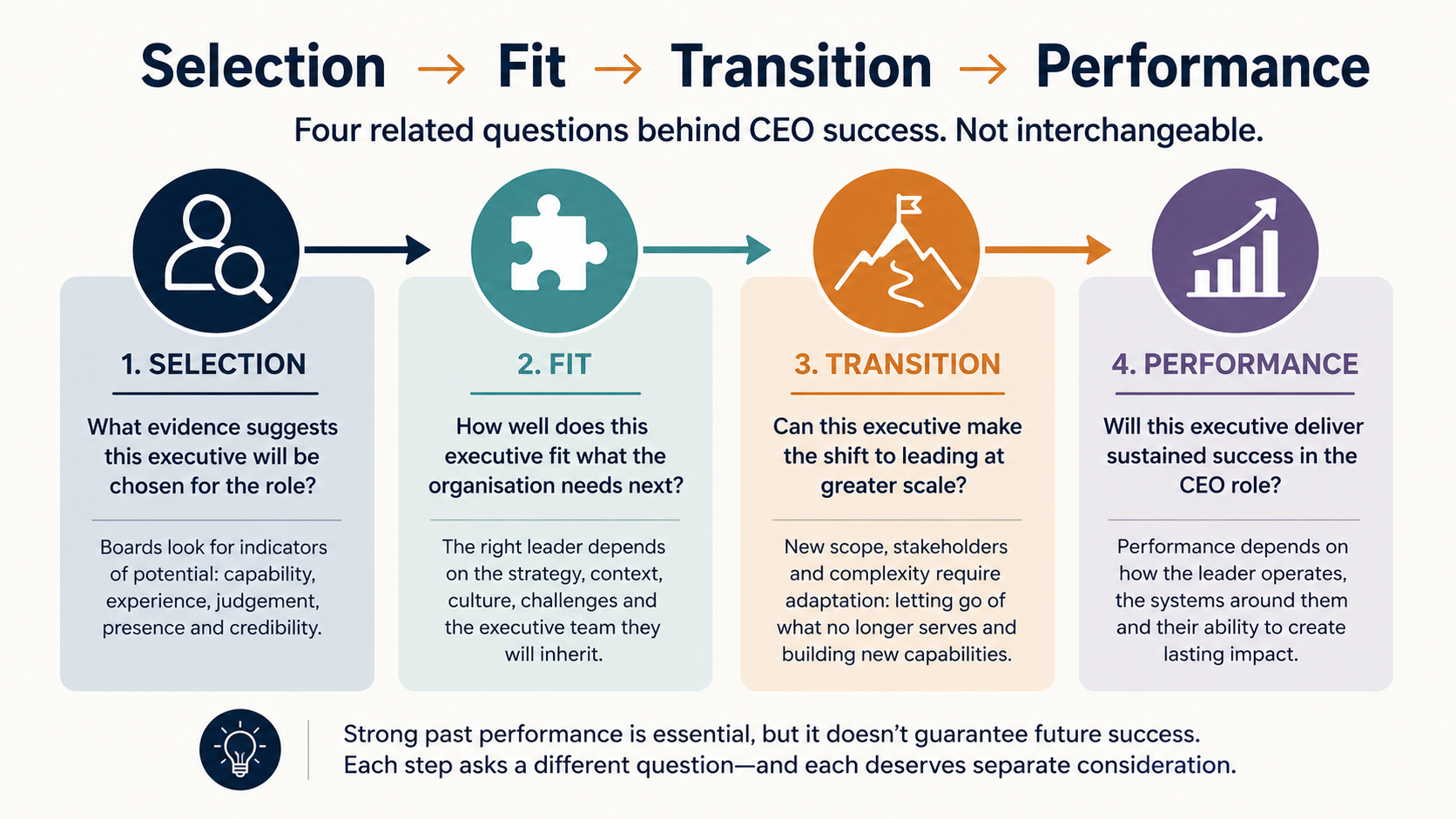
Four questions behind CEO success. Selection, fit, transition and performance are related, but they are not interchangeable.
What makes a successful CEO?
Search for CEO competencies or the qualities of a good CEO and you will find familiar lists: strategic thinking, communication, resilience, decisiveness, emotional intelligence, vision, integrity, execution and adaptability.
Most are difficult to disagree with.
The problem is that desirable characteristics do not automatically constitute a predictive model of CEO success.
One particularly useful research stream comes from Steven Kaplan and colleagues, using detailed assessments of executives considered for CEO and other C-suite positions.
Kaplan and Sorensen (2021) analysed 2,603 executive assessments and found that more than half of the variation across approximately 30 assessed characteristics could be represented through four broad dimensions:
general ability
execution versus interpersonal orientation
charisma versus analytical orientation
strategic versus managerial orientation.
A later study using more than 4,900 executive assessments again found four broadly similar dimensions (Decressin, Kaplan and Sorensen, 2025).
These should not be interpreted as four universal CEO competencies. They are statistical dimensions derived from a particular assessment dataset.
The evidence is unusually rich, but it also has important limits. Kaplan, Klebanov and Sorensen's earlier performance research focused on CEO candidates for companies involved in buyout and venture-capital transactions. Private-equity contexts also feature heavily in the later Decressin study. The findings should therefore be treated as important evidence, not as a universal description of every CEO population or organisational setting (Kaplan, Klebanov and Sorensen, 2012; Decressin, Kaplan and Sorensen, 2025).
Even with that qualification, the research exposes an important issue:
Different characteristics may matter for different outcomes.
Selection: what gets an executive selected for CEO?
Kaplan and Sorensen's findings are particularly interesting for selection.
Among executives already being considered for CEO roles, those assessed as having greater general ability and stronger interpersonal orientation were more likely to be hired.
When the authors considered these findings alongside their earlier research into subsequent company performance, they raised a provocative possibility: in their samples, boards may place greater weight on interpersonal skills during CEO selection than their relationship with subsequent performance would imply (Kaplan and Sorensen, 2021).
That does not mean interpersonal capability is unimportant.
A CEO needs to work with a board, lead other highly capable executives, communicate with investors and stakeholders, build confidence and navigate competing interests.
The more useful conclusion is that the characteristics influencing selection may not be identical to those most strongly associated with what happens afterwards.
Selection inevitably involves perception.
Does this person appear credible at the next level? Do board members trust their judgement? Can they communicate with clarity and authority? Can others imagine them representing the organisation?
That brings us to executive presence.
Does executive presence influence who looks ready for the top job?
Probably, although the CEO research does not measure executive presence directly.
The evidence does not tell us what executive presence is, but it does challenge the idea that CEO readiness can simply be equated with charisma.
Decressin, Kaplan and Sorensen (2025) found that later CEO candidates were less charismatic and more analytical than earlier candidates. Many of the changes they observed also persisted among CEOs who were subsequently hired.
That does not prove that charisma is irrelevant, nor that analytical CEOs are inherently superior.
It does make a simplistic image of executive presence as magnetism, extroversion or charismatic communication difficult to defend.
As I explore in Executive Presence vs Charisma, executive presence is broader than attracting attention. At senior levels, a more useful question is whether others experience sufficient credibility, judgement, clarity and appropriate authority in the leader for the role they are being asked to occupy.
And even then:
Looking ready for a larger role is not the same as being ready for it.
How is your executive presence being experienced?
A short self-assessment can help you identify where your strengths and development gaps may sit.
Explore five dimensions that can shape senior leadership impact: clarity, gravitas, strategic voice, stakeholder influence and interpersonal impact.
Fit: there may be no single ideal CEO
A second body of research makes the idea of a universal CEO profile even harder to sustain.
Bandiera, Prat, Hansen and Sadun (2020) studied the working behaviour of 1,114 CEOs across six countries using detailed diary data.
They identified two broad behavioural patterns. “Leader” CEOs spent comparatively more time in high-level, multifunctional interactions, while “manager” CEOs spent more time in individual meetings with core functions.
Firms employing the first type showed stronger productivity.
At first glance, that might appear to identify a superior CEO type.
The more interesting finding was different. Their structural analysis indicated that productivity differences could be explained by mismatches between CEO behaviour and the needs of the firm, rather than “leader” CEOs simply being better for every organisation (Bandiera et al., 2020).
Chen and Hambrick (2012) reached a related conclusion in turnaround situations. Replacing the CEO by itself had no general effect on improvement. Troubled companies performed better when poorly fitting incumbents were replaced by successors better matched to the conditions facing the organisation.
The implication is straightforward:
Do not begin by defining the ideal CEO. Begin by defining the leadership challenge.
What does this organisation require over the next several years?
Where will value need to be created?
What must be preserved or disrupted?
What kind of executive team will the CEO inherit?
What relationship will they need with the board?
And which demands are materially different from the candidate's previous experience?
This is why succession planning cannot sensibly be separated from strategy.
Shekshnia (2026) reaches a similar conclusion from a governance and succession perspective: CEO succession needs to be understood as a contextual organisational decision rather than merely the search for an abstractly “great” CEO.
A better question than:
“Is this person CEO material?”
may therefore be:
“CEO of what, facing which challenges, at this point in the organisation's development?”
The CEO transition: why past success does not guarantee future readiness
Senior executives are rarely considered for the C-suite because they have failed.
They arrive in contention because they have been highly successful.
And that creates a paradox.
The organisation wants to preserve the strengths responsible for that success while asking the executive to operate in circumstances that may require those strengths to be used differently.
Ibarra, Hildebrand and Vinck (2023) highlight this developmental challenge in their study of CEO successions. They describe how executives can rise through organisations partly through hands-on, directive leadership, while greater seniority increasingly requires them to enable and achieve results through other capable leaders.
For some executives, this involves a deeper shift in how they understand their role.
A leader may previously have created value by being the person who knew the answer. At enterprise level, value may increasingly come from creating the conditions in which other people can generate better answers.
Decisiveness may need to coexist with greater curiosity.
High standards remain useful, but excessive personal control can restrict the capability of the executive team.
Deep expertise remains valuable, but the CEO cannot be the functional expert in every room.
Attention to detail remains useful, but not when it prevents the executive from operating at the strategic altitude the role requires.
This is where strengths can sometimes become constraints.
But the transition is not simply about doing less of what previously worked.
Sound judgement, execution discipline, resilience, commercial understanding and the ability to build trust may become even more important.
The developmental challenge is often one of range: knowing when an established strength serves the situation and when a different response is required.
That gives us a more useful view of readiness:
Readiness for a larger role is not the absence of development needs. It is partly the capacity to recognise, learn and adapt to demands that have not previously been encountered.
This kind of shift is also at the heart of executive transition coaching, where the challenge is often not acquiring an entirely new leadership identity but adapting an already successful one to greater scale.
Performance: what actually predicts success after selection?
Kaplan, Klebanov and Sorensen (2012) related assessed CEO characteristics to subsequent corporate performance and found positive relationships with general ability and execution-related skills.
Compare that with the later selection evidence showing greater general ability and interpersonal orientation associated with being hired.
Together, those findings suggest that the qualities given weight during selection may differ from those associated with subsequent performance in the earlier sample.
This should not become another simplistic formula:
execution matters; people skills do not.
That goes beyond the evidence and ignores the relational nature of executive leadership.
There is also evidence pointing in another direction. Hansen et al. (2021) analysed C-suite job descriptions and found increasing demand for social skills, particularly in larger and more information-intensive organisations.
A more useful conclusion is that successful enterprise leadership requires multiple capabilities that interact with one another.
Execution without sufficient interpersonal effectiveness can damage the system required to sustain results.
Interpersonal effectiveness without the capacity to make difficult choices and execute is equally insufficient.
Strategic capability without implementation remains aspiration.
Operational excellence without sufficient strategic perspective can optimise yesterday's business.
The question is not which single quality wins.
It is whether the executive has, or can develop, a sufficiently broad leadership repertoire for the situation they are entering.
What actually changes once somebody becomes CEO?
Selection research asks who gets the role.
A different question is what the person actually has to do once they occupy it.
McKinsey's CEO research organises the job around six broad responsibilities: strategy, organisational alignment, the top team, the board, external stakeholders and personal effectiveness (Dewar, Hirt and Keller, 2019).
McKinsey's framework is best viewed as a research-informed practitioner model rather than a validated predictive model of CEO performance.
Its value here is simpler.
The CEO increasingly works through a system of relationships.
The executive team consists of capable leaders with their own expertise and accountabilities. The board has authority over the CEO rather than beneath them. Investors, regulators, customers and other stakeholders cannot simply be instructed. And the CEO's time and attention become scarce organisational resources.
This is a more realistic picture than searching for somebody who scores highly against every desirable leadership characteristic.
What does this mean for CEO succession planning?
For boards, CEOs and HR leaders, the research suggests that succession planning should involve more than identifying the strongest current performers.
Past performance is essential evidence, but it needs to be interpreted in context.
A successful executive has demonstrated that they can succeed in the roles they have already held.
The succession question is whether the evidence supports a reasonable judgement that they can succeed under the materially different demands of the next one.
This aligns closely with CIPD guidance. CIPD argues that succession planning should take account of how the organisation is likely to evolve and the capabilities required in future business-critical roles, rather than focusing only on current skill needs. It also cautions against overly mechanistic approaches to assessing leadership potential (CIPD, 2025a).
Its broader talent-management guidance makes the same strategic point: identifying and developing talent is most useful when connected to organisational strategy rather than treated as an isolated HR process (CIPD, 2025b).
Five questions to ask before deciding that someone is CEO-ready
1. What has actually driven this executive's success so far?
Separate underlying capability from advantages created by role, team, market conditions or organisational context.
2. What will be materially different in the CEO role?
Consider changes in scale, ambiguity, board accountability, strategic breadth, external visibility and dependence on other senior leaders.
3. What does this organisation need from its next CEO?
Growth, turnaround, strategic renewal, operational discipline, acquisition integration or cultural transformation may place different demands on a leader.
4. What evidence do we have beyond reputation and current performance?
Triangulate track record, structured assessment, stakeholder evidence, relevant experience and, where appropriate, psychometric information.
5. What is a selection risk and what is a development need?
A gap does not automatically disqualify somebody. Ask how consequential it is for the future role, whether it is realistically developable and whether the executive has the capacity and willingness to adapt.
This distinction matters when apparently simple observations emerge:
“Too operational.”
“Not strategic enough.”
“Excellent, but difficult.”
“Doesn't bring people with them.”
“Not quite ready for the board.”
These statements may reflect development needs, insufficient exposure, perceptions that need testing against evidence, or a genuine mismatch between the leader's current repertoire and the future role.
The purpose of good succession assessment is not to convert observations into labels. It is to test what they mean, how consequential they are, and whether they represent a selection risk, an experience gap or a development opportunity.
The same diagnostic principle applies more broadly to leadership development. Coaching, training, mentoring, assessment and team development have different centres of gravity. The useful starting point is understanding what needs to change, what may be maintaining the current situation and at what level the issue sits.
Are you treating a selection risk as a coaching need?
The wrong intervention can leave a capable leader working harder on the wrong problem.
A concern about readiness may reflect a skill gap, lack of experience, a behavioural pattern, a relationship issue, team dynamics or the wider organisational system. Diagnosing where the real need sits changes what development is most likely to help.
Diagnose the development need before choosing the intervention →
Can executive assessment predict CEO success?
Assessment can contribute valuable evidence.
It cannot eliminate uncertainty.
The Kaplan research is based largely on extensive structured executive assessments examining candidates' career histories and behaviour across previous situations. The approach is considerably richer than simply administering a personality questionnaire.
More broadly, Sackett et al. (2022) provide a useful caution against false precision. Their reanalysis found that the predictive validity of many personnel-selection procedures had historically been overestimated after statistical corrections, while structured interviews remained among the strongest approaches.
The wider lesson is useful:
Selection methods provide evidence, not certainty.
Psychometric assessment can add another lens.
A well-chosen personality assessment may generate useful hypotheses about how an executive tends to operate, what they value, how they may be experienced and which patterns could become more visible under pressure.
But no credible assessment should be treated as a test of whether somebody possesses the personality of a successful CEO.
At this level, the stronger approach is usually triangulation: track record, structured assessment, strategic context, stakeholder evidence, relevant experience, psychometric information where useful, and informed human judgement.
The aim is not to find the perfect score.
It is to build a more complete picture of the executive and the situation into which they may be moving.
What might only become visible when the pressure rises?
The most useful assessment insight is often not a score, but a pattern worth testing before the role gets bigger.
Personality assessment can add another perspective on strengths, motives and behaviours that may become more pronounced under pressure. Used well, it creates hypotheses to explore alongside the leader's experience, role and organisational context, not a verdict about potential.
What does this mean for CEO and C-suite development?
There is a final implication that often gets neglected in discussions about CEO readiness.
Selection does not have to wait for a perfectly finished leader.
If the next role genuinely represents greater scale and complexity, it would be surprising if no further development were required.
Perhaps one of the most important succession questions is not whether the candidate already displays every capability required by the CEO role, but whether they can recognise and adapt to substantially different demands.
A highly capable executive may need to broaden rather than replace their leadership style.
They may need to become more comfortable leading beyond their own expertise, influence peers differently from the way they previously managed direct reports, work with a board rather than simply present to one, allow other executives greater autonomy while still holding the system accountable, and understand how their behaviour changes under greater scrutiny and pressure.
Executive coaching through CEO and C-suite transitions
This is one reason executive coaching can be particularly valuable as leaders move into CEO and other C-suite roles.
Not because the successful executive needs to be fixed.
And not because the coach has a standard template for what a CEO should look like.
The value of coaching at this level is the opportunity for an experienced executive to think rigorously about the transition with an independent, confidential thinking partner who has no stake in the organisational politics surrounding the appointment.
Professional coaching can provide a bespoke space in which the executive examines the realities of the larger role alongside how they currently lead.
What from their existing approach remains valuable?
What may become less effective as scale increases?
Where are they relying on strengths too heavily?
Where do they need greater range?
What are they avoiding?
How do important stakeholders experience them?
What does leading through an executive team require?
How do they want to work with the board?
And how will they know that their leadership is actually changing?
The work may include reflection and challenge, but it can also incorporate stakeholder feedback, 360 data, psychometric assessment, behavioural experimentation, rehearsal and relevant psychological or leadership frameworks.
The objective is not to manufacture a generic CEO persona.
It is to help an already capable executive increase the range and flexibility of how they lead in relation to the role and organisational context they are actually entering.
The role gets bigger. The space to think can get smaller.
Greater scale brings more complexity, visibility and consequence, just when independent thinking can become particularly valuable.
Executive coaching provides a bespoke, confidential thinking partnership for senior leaders navigating a bigger role. The focus is not on creating an ideal leadership persona, but on understanding what still serves the leader, what needs to evolve and how they want to lead when the demands around them change.
The executive team matters too
There is another reason to avoid treating CEO success purely as an individual characteristic.
Decressin, Kaplan and Sorensen (2025) found that the assessed abilities of executives considered for senior roles in the same organisation were positively correlated. Their interpretation is consistent with high-ability executives complementing one another.
That does not establish that a particular team configuration causes superior performance.
But it reinforces a wider point:
The CEO does not operate independently of the leadership system around them.
A highly capable CEO surrounded by an ineffective executive team faces a different challenge from an equally capable CEO working with leaders who can challenge, complement and execute around them.
At some point the question therefore changes from:
“Is this individual capable?”
to:
“Can this group of senior leaders operate effectively together around the organisation's most important work?”
That is a team-level question, not simply another CEO competency.
Where recurring constraints sit between senior leaders rather than within one individual, leadership team coaching can work directly with how the team makes decisions, challenges, manages accountability and leads the wider organisation.
So, what makes a successful CEO?
The research does not give us a definitive checklist.
That may be one of its most useful conclusions.
General ability matters. Execution appears to matter. Interpersonal capability matters, particularly in selection and in the inherently relational demands of the role. Strategic, analytical and communication orientations may matter differently in different circumstances.
CEO behaviour matters.
Organisational context matters.
The executive team matters.
And the leader's capacity to adapt as the role changes matters.
The evidence therefore points away from a universal CEO profile and towards a more demanding proposition:
CEO success is better understood as an interaction between the capability of the executive, the leadership behaviours required by the role, the context in which they are operating and their ability to adapt as those demands change.
For organisations considering a senior leader for a larger role, that changes the question.
It is not simply:
“Have they been successful enough to become CEO?”
It is:
“What has made them successful so far, how well does that fit what the organisation needs next, and what will need to evolve for them to succeed at greater scale?”
That is a much more useful starting point for selection, succession and development.
Frequently asked questions
What makes a successful CEO?
There is no single profile that guarantees CEO success. Research suggests that general ability, execution, interpersonal capability and other leadership characteristics can matter, but their importance depends partly on the outcome being considered and the organisational context. A more useful view is that CEO success involves the interaction between capability, fit, transition and performance.
What is the difference between being selected as CEO and succeeding as CEO?
The qualities that influence who gets selected are not necessarily identical to those associated with subsequent performance. Research by Kaplan and colleagues suggests that characteristics such as general ability and interpersonal capability can influence selection, while earlier research linked subsequent company performance particularly with general ability and execution-related capability.
How should organisations assess CEO readiness?
Start with what the organisation will require from its next CEO rather than a generic list of CEO competencies. Consider the candidate's track record, relevant experience, future role demands, stakeholder evidence and assessment data, while distinguishing between a genuine selection risk, an experience gap and a development need.
Does executive presence matter when selecting a CEO?
Executive presence can influence how others perceive a leader's readiness for greater responsibility, but it should not be confused with charisma alone. CEO research does not directly measure executive presence, and evidence showing that later CEO candidates became less charismatic and more analytical cautions against equating charisma with readiness.
Can psychometric assessment predict CEO success?
No single psychometric assessment can reliably determine whether somebody will become a successful CEO. Assessment can provide useful hypotheses about personality, motives, strengths and patterns under pressure, but it is best interpreted alongside track record, context, stakeholder evidence and other forms of assessment.
How can executive coaching support a CEO or C-suite transition?
Executive coaching can provide an independent, confidential thinking partnership as a leader moves into greater scale, complexity and visibility. It can help the executive examine which existing strengths remain useful, where greater behavioural range is needed, how key relationships are changing and how they want to lead in the new context.
📚 References
Bandiera, O., Prat, A., Hansen, S. and Sadun, R. (2020) ‘CEO behavior and firm performance’, Journal of Political Economy, 128(4), pp. 1325–1369.
Chartered Institute of Personnel and Development (CIPD) (2025a) ‘Succession planning’. Factsheet. London: CIPD. Available at: https://www.cipd.org/uk/knowledge/factsheets/succession-planning-factsheet/ (Accessed: 25 August 2026).
Chartered Institute of Personnel and Development (CIPD) (2025b) ‘Talent management: Guidance for people professionals’. London: CIPD. Available at: https://www.cipd.org/uk/knowledge/guides/talent-management/ (Accessed: 25 August 2026).
Chen, G. and Hambrick, D.C. (2012) ‘CEO replacement in turnaround situations: Executive (mis)fit and its performance implications’, Organization Science, 23(1), pp. 225–243.
Decressin, Y., Kaplan, S.N. and Sorensen, M. (2025) ‘Have CEOs changed?’, Journal of Financial Economics, 173, 104169.
Dewar, C., Hirt, M. and Keller, S. (2019) ‘The mindsets and practices of excellent CEOs’, McKinsey & Company, 25 October. Available at: https://www.mckinsey.com/capabilities/strategy-and-corporate-finance/our-insights/the-mindsets-and-practices-of-excellent-ceos (Accessed: 25 August 2026).
Hansen, S., Ramdas, T., Sadun, R. and Fuller, J. (2021) The Demand for Executive Skills. NBER Working Paper No. 28959. Cambridge, MA: National Bureau of Economic Research.
Ibarra, H., Hildebrand, C.A. and Vinck, S. (2023) ‘The leadership odyssey’, Harvard Business Review, May–June. Available at: https://hbr.org/2023/05/the-leadership-odyssey (Accessed: 25 August 2026).
Kaplan, S.N., Klebanov, M.M. and Sorensen, M. (2012) ‘Which CEO characteristics and abilities matter?’, The Journal of Finance, 67(3), pp. 973–1007.
Kaplan, S.N. and Sorensen, M. (2021) ‘Are CEOs different?’, The Journal of Finance, 76(4), pp. 1773–1811.
Sackett, P.R., Zhang, C., Berry, C.M. and Lievens, F. (2022) ‘Revisiting meta-analytic estimates of validity in personnel selection: Addressing systematic overcorrection for restriction of range’, Journal of Applied Psychology, 107(11), pp. 2040–2068.
Shekshnia, S. (2026) ‘21 Questions About CEO Succession’, INSEAD Knowledge, 8 June. Available at: https://knowledge.insead.edu/leadership-organisations/21-questions-about-ceo-succession (Accessed: 25 August 2026).

Under the Surface
A monthly briefing on the hidden dynamics shaping senior leadership, teams and change…
Read next…