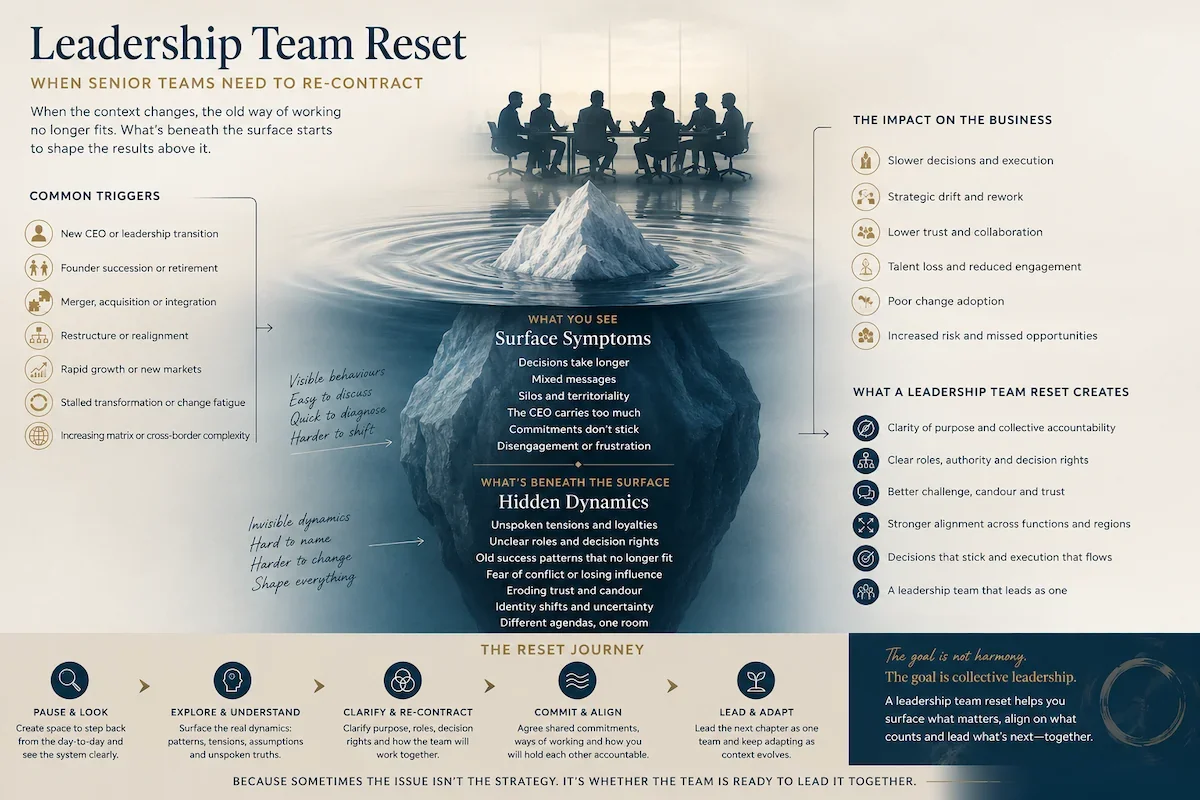
If every difficult decision still ends up back with the CEO, you may not have an executive team. You may have a group of senior functional leaders sharing a meeting.
Everyone around the table may be highly capable.
The CFO knows finance. The COO knows operations. The commercial leader knows the customer. The CHRO understands the people implications. Individually, they may be exactly the leaders the organisation needs.
Yet collectively, something is not working.
Decisions are agreed and then quietly reopened. Difficult disagreements are taken offline. Functions protect their own priorities. The CEO becomes the broker between executives who should be able to work things through directly.
The problem is rarely a lack of intelligence or commitment.
It is that individual leadership capability and collective leadership capability are not the same thing.
I explore that distinction in more depth in Why Are Teams Trickier? What Changes When Capable Leaders Work Together.
The instinct is often to develop the individuals, run another strategy day or improve the meeting process. Any of those may help. But if the same difficulty keeps appearing between the leaders, or between the team and the organisation it is trying to lead, working with each person separately can leave the real problem untouched.
That is where executive team coaching becomes relevant.
Done well, it does not take the leadership team away from the business to “work on itself”. It uses the team’s real business challenges to improve how members think, challenge, decide and lead together.
So the useful question is not:
Could this team benefit from development?
Almost every leadership team could.
It is:
A better question is whether the way this team works together is beginning to constrain the organisation it is supposed to lead.
If it is, developing the individual leaders may only get you so far. The team itself may need attention.
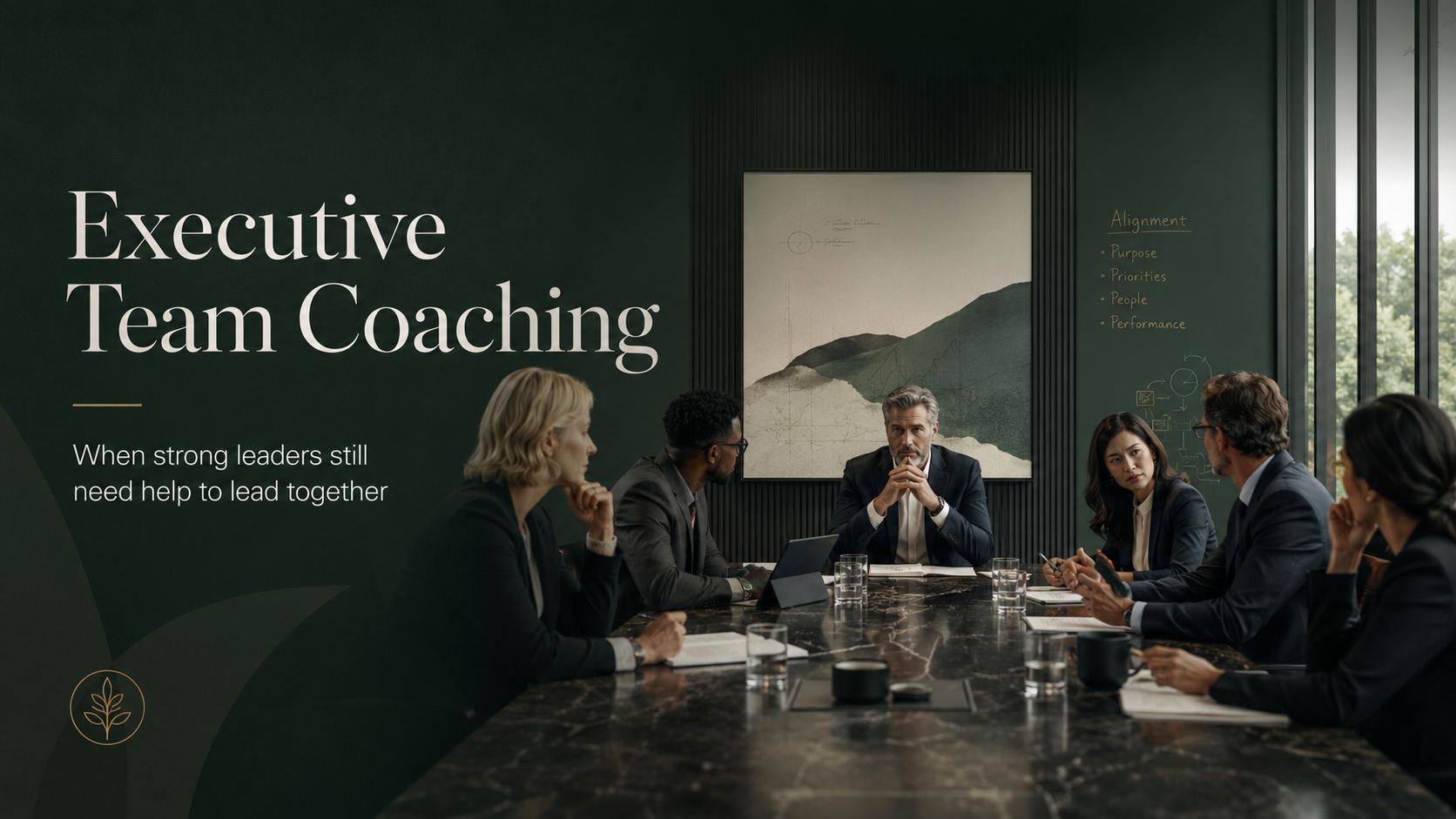
Strong individual leaders do not automatically create an effective leadership team.
What is executive team coaching?
Executive team coaching is a structured development process in which an intact senior leadership team works collectively on how it thinks, decides, challenges, collaborates and leads the wider organisation. Unlike individual executive coaching delivered to several members of the same team, the team itself is the client. The work combines attention to live business priorities with examination of the recurring patterns, relationships and wider organisational forces that help or hinder collective performance.
A CEO, CFO, COO and CHRO could each have excellent individual coaches and the organisation might still never address what happens when the four of them need to make a difficult enterprise decision together.
Individual executive coaching can help a leader develop greater self-awareness, judgement, confidence, behavioural range or stakeholder influence.
Team coaching asks different questions.
What work can only this team do?
How does it make important decisions?
What happens when members genuinely disagree?
Whose information gets heard?
Which issues repeatedly get softened, delayed or taken offline?
Do members hold one another accountable, or does accountability mainly run upwards through the CEO?
And does the team think and act on behalf of the enterprise, or primarily as a collection of senior functional leaders?
This is one reason the International Coaching Federation treats team coaching as a distinct coaching discipline. Its team coaching competencies include working with the team as a single entity, collective dynamics, conflict, participation, systemic awareness and the team’s ability to learn and become increasingly autonomous (ICF, 2025).
Hackman and Wageman (2005) similarly frame team coaching around helping members make effective use of their collective resources in accomplishing the team’s work. For a senior team, better relationships matter because they affect the quality of the work the team can do together.
First ask: is this genuinely a team?
A group can be senior without being a team.
Reporting to the same chief executive, attending the same meeting and appearing together on an organisation chart does not automatically create meaningful interdependence.
A genuine senior team has collective work that cannot sensibly be completed by its members acting separately. For a deeper look at why individually capable executives can still underperform collectively, see High-Performing Executive Teams: Why Individual Capability Is Not Enough.
Wageman et al. (2008) emphasise conditions including clear boundaries, compelling direction, appropriate membership, sound structure, organisational support and competent coaching. Their work also highlights a recurring senior-team problem: accomplished executives can remain strongly oriented towards their own domains rather than the team’s shared enterprise work.
That creates a useful first diagnostic question:
What must these people accomplish together that none of them can accomplish through their own function?
If the answer is unclear, the team may have a design or purpose problem before it has a coaching problem.
When does an executive team need coaching?
There is no score at which a team suddenly “needs coaching”.
I would look instead for recurring patterns with material consequences.
I would not infer much from one difficult meeting, or even from a period of tension. Senior teams should disagree sometimes, particularly when the stakes are high. I pay more attention when the same difficulty keeps returning: the same decision being reopened, the same conversation moving offline or the same person repeatedly becoming the broker.
If you are seeing those recurring symptoms but are not yet sure what sits underneath them, Leadership Team Reset: 7 Signs Your Senior Team Has Outgrown Its Old Way of Working explores the warning signs in more detail.
A new CEO or a significantly changed team
Changing the CEO changes more than one box on the organisation chart.
Authority shifts. Relationships need to be renegotiated. Executives who knew how to work with the previous leader have to learn a different pattern. An internal promotion can be particularly complex when somebody becomes accountable for people who were recently peers.
Mergers, acquisitions, restructures and significant changes in executive-team membership create similar questions.
What is this team now here to accomplish?
Which decisions belong here?
What does the CEO need from the team?
What should team members expect from one another?
What from the previous way of working still serves the organisation, and what now needs to change?
A team coaching engagement can provide a structured way to answer those questions while the new team is actually beginning to work together.
Strategy or transformation requires genuine collective leadership
Transformation has a habit of exposing weaknesses that normal operating conditions can hide.
Finance, operations, technology, commercial and people leaders may each be behaving perfectly rationally from within their own accountabilities.
Collectively, however, they may be making transformation almost impossible.
One function protects service. Another protects cost. Another wants speed. Another sees a people risk. All four perspectives may be legitimate.
The problem appears when the organisation lacks a forum capable of integrating them into an enterprise decision.
At that point the issue is not simply collaboration.
It is collective leadership across competing demands.
The CEO has become the team’s operating system
This is a pattern worth watching.
Executives take difficult disagreements to the CEO separately.
The CEO brokers relationships between peers.
Members wait for the CEO to resolve trade-offs they could work through together.
Information travels up and back down rather than across the team.
The chief executive becomes progressively more overloaded while the team becomes progressively less capable of collective leadership.
The individuals may be excellent.
The system around the CEO is not.
Important decisions do not stay decided
Everyone apparently agreed.
Then implementation begins and different functions behave as though different decisions were made.
Sometimes that reflects unclear decision rights.
Sometimes important information never entered the discussion.
Sometimes disagreement was present but insufficiently safe to express.
Information sharing matters because teams can only use knowledge that becomes available to the group. Mesmer-Magnus and DeChurch’s (2009) meta-analysis of 72 studies involving 4,795 groups found positive relationships between information sharing and team performance, cohesion, knowledge integration and decision satisfaction.
A team can therefore have all the expertise it needs around the table and still fail to use it when it matters.
Conflict has either become personal or disappeared underground
“We don’t really have conflict” is not necessarily reassuring.
Some teams genuinely deal with differences constructively.
Others have simply learned where not to disagree.
The real conversation moves to corridors, messages, one-to-ones with the CEO and the meeting after the meeting.
Simply encouraging more conflict misses the point.
A major recent meta-analysis revisiting the relationship between team conflict and performance found that task, relationship, process and status conflict were all negatively related to team performance on average, although the strength and nature of those relationships varied considerably across contexts (Yuan, Yin and Sun, 2026).
That challenges the simplistic idea that task conflict is inherently healthy.
The developmental task is more precise:
Can the team surface consequential differences early enough, examine them well enough and resolve them without either personalising or suppressing them?
Psychological safety is part of that picture, but it should not be reduced to being nice to one another. Edmondson’s foundational work links psychological safety with team learning behaviour, while Frazier et al. (2017) synthesised evidence from 136 independent samples involving more than 22,000 individuals and nearly 5,000 groups.
For a senior team, psychological safety needs to support candour, challenge and learning, not comfortable agreement.
These recurring patterns can also carry significant organisational consequences. For the evidence and practical warning signs, see what happens when team dysfunction becomes established.
When the pattern is becoming visible
If decisions keep returning to the CEO, difficult conversations happen after the meeting, or functions are pulling in different directions, waiting rarely makes the pattern disappear.
The useful next step is not to label the team as dysfunctional. It is to understand where the constraint actually sits: purpose, decisions, challenge, accountability, relationships or the wider system around the team.
How does a leadership team’s stage of development matter?
Leadership teams do not develop in a straight line.
A newly formed executive team will often face different challenges from a team that has worked together for years. Equally, an established and previously effective team can behave very differently after a change of CEO, merger, restructuring, acquisition or major shift in strategy.
Tuckman’s familiar model describes groups moving through forming, storming, norming and performing, with later work adding adjourning (Tuckman, 1965; Tuckman and Jensen, 1977).
It remains a useful reminder that uncertainty, tension and disagreement are not necessarily evidence that a team is failing.
But executive teams are rarely that tidy.
They do not simply progress through a neat sequence and arrive permanently at “performing”.
Research on group development has challenged that assumption. Gersick (1988), for example, found that teams can maintain established patterns for long periods and then change rapidly around important transition points.
What matters in practice is that teams can lose ways of working that once served them well when the environment changes.
A team that worked extremely well under one CEO may struggle under another.
A stable team may lose its rhythm during a major transformation.
An acquisition may introduce new accountabilities, stakeholders and power dynamics.
A strategy change can render previously effective decision routines inadequate.
The team has not necessarily become dysfunctional.
Its context may have changed faster than its collective way of working.
For senior leadership teams, I therefore find three questions more useful than simply asking which “stage” the team is in:
What is this team currently trying to become?
What has changed around it?
Which ways of working that served it previously are no longer sufficient?
A newly appointed team may need to establish collective purpose, trust, decision rights and basic working agreements.
A more established team may need stronger challenge, enterprise thinking and greater ability to work through complex trade-offs.
A team disrupted by new leadership or transformation may need to re-contract, even if many of its members have worked together for years.
Executive team coaching can help the team recognise that shift deliberately rather than interpreting every period of turbulence as failure.
Sometimes a successful team simply needs to adapt to a context that has changed around it.
Executive team coaching is not six executive coaching conversations in one room
This is where buyers can understandably become confused.
Several interventions may look similar from the outside. They solve different problems.
Individual executive coaching
Use individual executive coaching when the principal development need sits within one leader.
That might involve executive presence, transition, judgement, confidence, stakeholder influence, behavioural patterns or leadership under pressure.
The individual is the client.
Facilitation
Use facilitation when a group needs help accomplishing a specific piece of work, such as reaching a decision, agreeing priorities, developing a strategy or designing an operating plan.
A facilitator primarily helps the group use a better process to produce an outcome.
Training
Use training when there is a reasonably clear knowledge or skill gap.
Team building
Use team building when the immediate need is greater familiarity, connection or cohesion.
That can be entirely legitimate, particularly for a newly formed group.
Mediation
Use mediation when a specific conflict between identifiable parties requires structured resolution.
Executive team coaching
Consider team coaching when the recurring issue lies in how the intact team works together while performing its actual leadership role.
There will inevitably be overlap between these approaches.
A team coach sometimes facilitates.
A coaching programme may include individual conversations.
Training may sit inside a wider intervention.
But those distinctions matter because choosing an intervention before diagnosing the need is an easy way to spend money on the wrong problem.
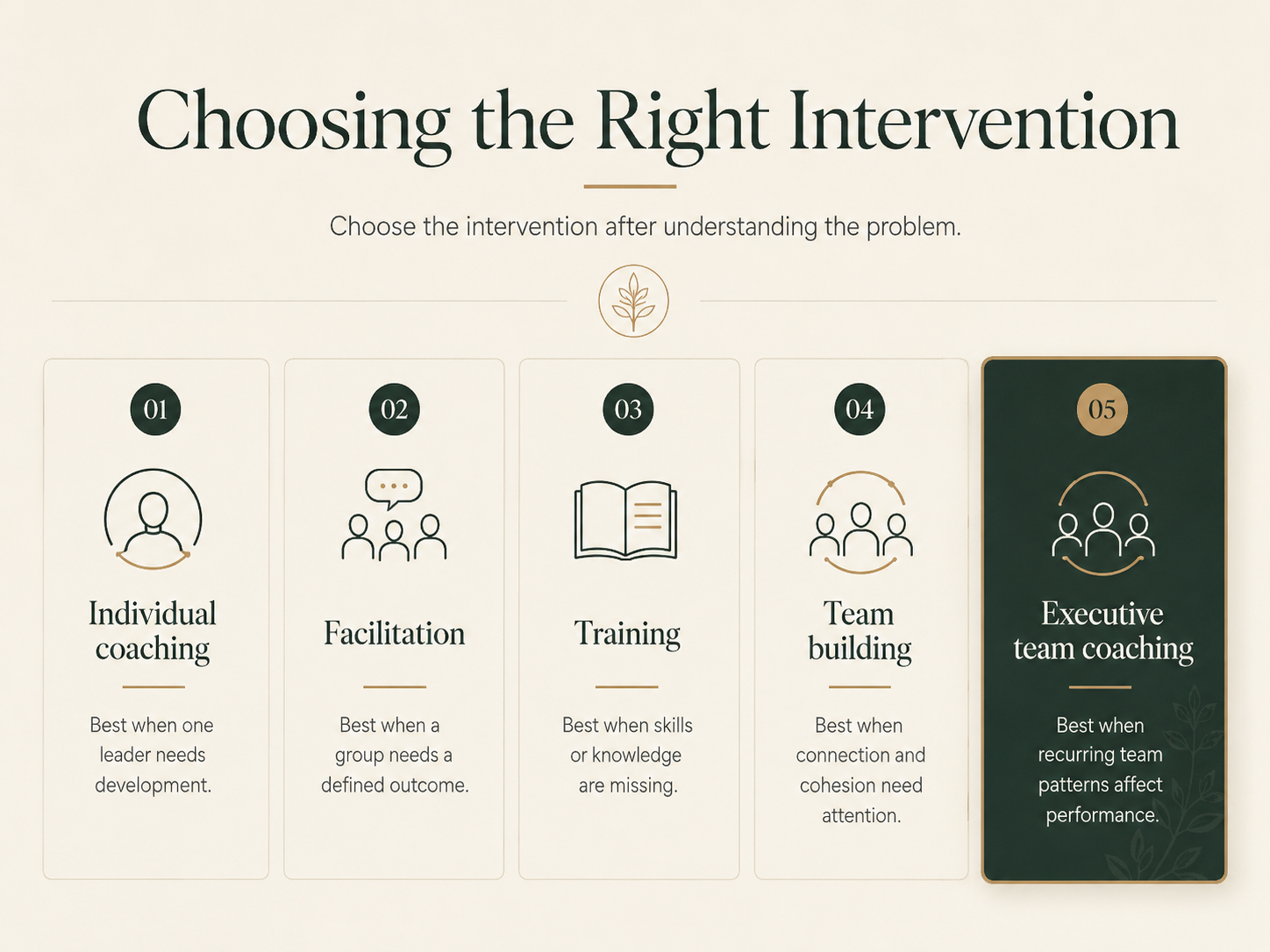
Different leadership problems require different interventions. Explore the need before choosing the solution.
If the question is broader than team coaching, I have set out a practical framework for choosing between coaching, training, mentoring, team development and other leadership interventions.
There is also emerging evidence that the distinction between coaching and facilitation is more than semantic. In a randomised controlled study comparing team coaching with team facilitation, Passmore, Tee and Gold (2025) found greater gains in participants’ perceptions of team cohesion and psychological safety in the coaching condition.
The study does not settle the wider evidence base, but it is useful because controlled research on team coaching remains relatively scarce.
Choose the intervention, not the label
If the problem keeps reappearing between the same leaders, across the same decisions or under the same pressures, a one-off workshop may treat the event without changing the pattern.
Executive team coaching is most useful when the team itself needs to become better at working through its real business challenges. If the need sits elsewhere, a different intervention may be the better investment.
What actually happens in executive team coaching?
There is no single process that every team should be forced through.
A newly formed leadership team and an established executive team navigating a major transformation require different work.
In practice, I tend to think about the work in four parts.
1. Contract: agree what the work is actually for
Team coaching starts before the first coaching session.
The CEO, sponsor, team and coach need sufficient agreement about the purpose of the work.
What needs to be different?
What organisational outcomes matter?
What behaviour or pattern is currently getting in the way?
Who is the client?
What is confidential?
If individual interviews are used, what will and will not be attributed?
What will be shared with an HR sponsor or board?
How will progress be judged?
This matters particularly at executive level because multiple client relationships can exist simultaneously.
If HR commissions the work, the CEO leads the team and eight executives participate, the contracting needs to be explicit.
Otherwise the ambiguity becomes part of the intervention.
2. Discover: understand what is really happening
A team may arrive saying:
“We need better communication.”
That tells us almost nothing.
Better diagnosis asks:
When does communication break down?
With whom?
Around which subjects?
Under what pressure?
What happens next?
Discovery might include individual conversations, stakeholder perspectives, team diagnostics, psychometric data, observation of meetings and examination of relevant organisational information.
A useful diagnosis narrows things down to the few patterns that are causing most of the drag.
You might discover that accountability runs strongly to the CEO but weakly between peers, or that one or two voices dominate while useful information is being lost. Sometimes what the team has labelled an execution problem is really strategic. And sometimes apparently personal tension between two executives makes much more sense once you see the contradictory organisational goals they are each being asked to protect.
Good diagnosis moves us from:
“Trust is low.”
to something the team can actually work on:
“When commercial and operational priorities conflict, disagreement moves into separate conversations with the CEO rather than being worked through between the two functions.”
3. Shift: work with the team’s real business
This is where team coaching becomes particularly useful.
The team does not have to stop doing its real work so that it can “do team development”.
Its work is often the richest source of development.
A live investment decision shows how power operates.
A strategic debate reveals whether genuine differences are usable.
A transformation problem exposes functional loyalties.
A missed commitment shows how accountability actually works.
The team coach can help the group notice what is happening while it happens.
Often, the most useful intervention is a well-timed question:
What just happened there?
Or:
You appeared to reach a decision ten minutes ago. Why are we debating it again?
Or:
Three people have contributed repeatedly and four have barely spoken. What information might this team currently be losing?
The coach is not there to make the business decision for the team.
The aim is to help the team develop greater capacity to think, challenge, decide and learn for itself.
4. Embed: see what survives contact with reality
Insight in the room is not the same as behavioural change.
The team returns to pressure.
Quarter-end arrives.
The transformation slips.
The board asks a difficult question.
A key customer escalates.
Old patterns become attractive precisely because they are familiar.
This is why useful team coaching usually involves repeated cycles of action and reflection rather than one impressive workshop.
Team reflexivity, broadly the team’s ability to reflect on objectives, strategies and ways of working, has a substantive research base. Schippers, Homan and van Knippenberg (2013), for example, found team reflexivity particularly valuable for initially lower-performing teams, with learning helping explain subsequent performance improvement.
A coaching engagement can deliberately create this rhythm:
act → notice → make sense → experiment → review
A good programme should make the coach progressively less necessary. Over time, the team should become better at noticing and working with these patterns for itself.
What makes executive team coaching systemic?
“Systemic” is a grand-sounding word for a fairly practical idea: look beyond the personalities sitting around the table.
It simply asks us not to explain everything by looking at the personalities sitting around the table.
I find it useful to look at three interconnected levels.
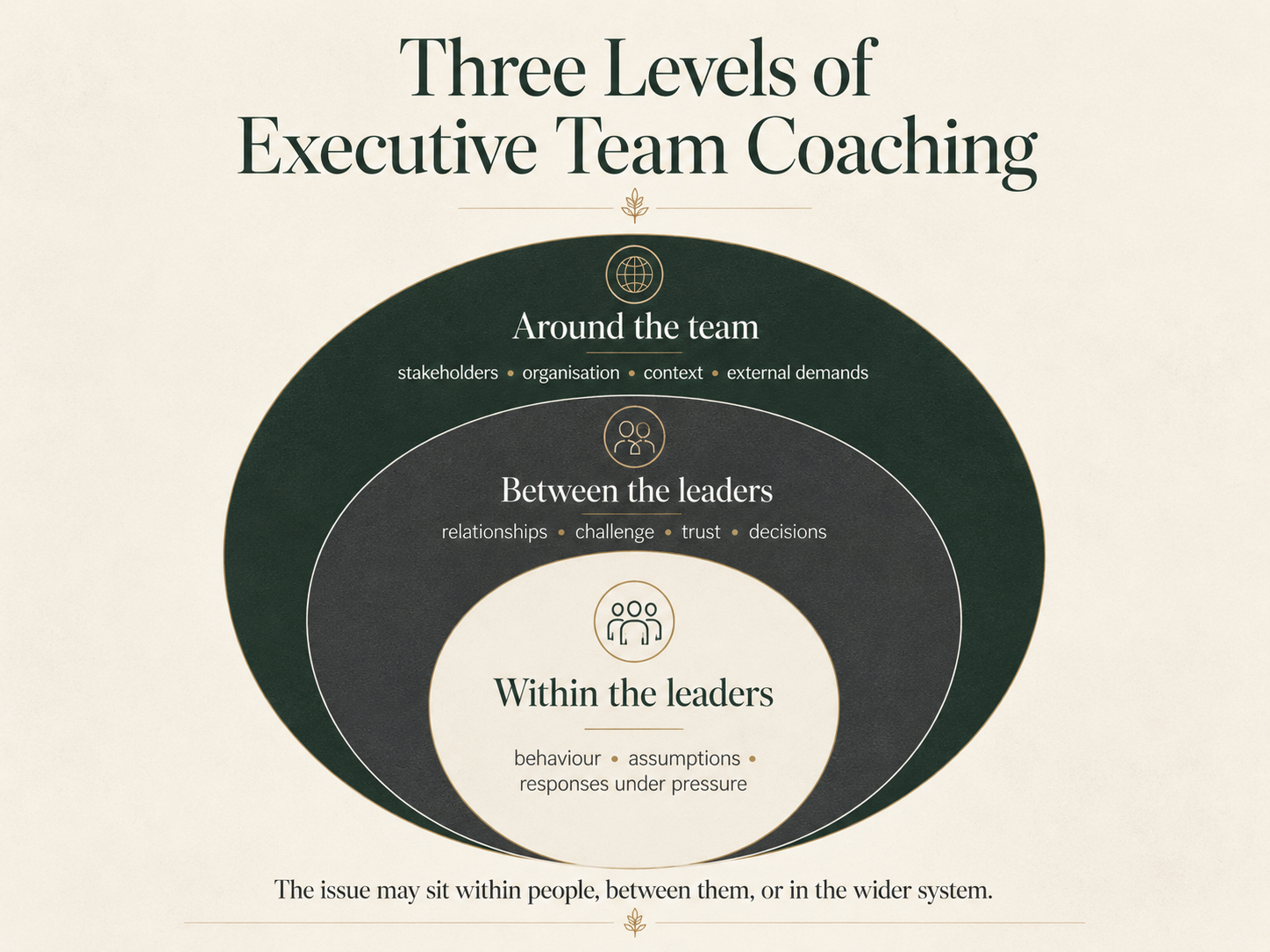
A systemic lens looks at what is happening within individual leaders, between members of the team, and around the team in the wider organisational system.
Within the leaders
Each executive brings a history, temperament, assumptions, preferences and characteristic responses to pressure.
One leader becomes more controlling when anxious.
Another withdraws.
One moves quickly towards action.
Another seeks more data.
One challenges directly.
Another is acutely aware of relational consequences.
These differences are not automatically strengths or weaknesses.
Their meaning depends on context.
Between the leaders
Patterns emerge in relationships. Patterns emerge between people too: who has influence, who can challenge whom, whose judgement carries weight and whose does not. Notice who speaks first, who gets interrupted, who can openly disagree with the CEO and who seeks their support afterwards.
These patterns may be powerful without being consciously designed.
For a deeper exploration of the less visible relational and psychological patterns that can shape senior teams, see The Hidden Forces Within Teams: Decoding the Complexities of Group Dynamics.
Around the team
Then widen the lens. What are the board, customers, employees, investors or regulators asking of this team? What pressures are coming from the organisation's history, its functions and geographies, or from a transformation already under way?
What does the wider system require from this team?
And what is the team currently doing to the system around it?
Hawkins’ systemic team coaching approach is particularly useful here because it explicitly extends the team’s attention beyond its internal relationships to stakeholders, collective purpose and the wider system the team exists to serve (Hawkins, 2021).
The ICF’s current competencies similarly include systemic awareness and recognition of external factors that influence team performance (ICF, 2025).
This gives us three useful questions:
What is happening within the leaders?
What is happening between the leaders?
What is happening between the team and the system around it?
A leadership team can improve its internal relationships and still fail if it is collectively solving the wrong problems.
That is why team effectiveness cannot ultimately be judged by asking only:
Do we work well together?
The harder question is:
Are we collectively creating what the organisation and its stakeholders need from us?
Look beyond the room
Sometimes the tension inside a leadership team is carrying a problem that originates somewhere else in the organisation.
Working systemically means looking at what is happening within the leaders, between them and around the team: stakeholders, competing demands, organisational history, transformation pressures and the system the team is trying to lead.
What does the evidence say about executive team coaching?
There are two evidence bases worth separating.
We know considerably more about team effectiveness
Decades of organisational and psychological research show that team performance depends on much more than the quality of the individual members.
Team design, purpose, information, coordination, trust, learning, leadership and organisational context all matter (Kozlowski and Ilgen, 2006; Mathieu et al., 2008).
This challenges the seductive assumption that:
excellent leaders + excellent leaders + excellent leaders = excellent leadership team.
It does not necessarily follow.
Senior-team research by Wageman et al. (2008) similarly points to the importance of the conditions surrounding the team, not simply the talent within it.
The research on team coaching itself is smaller
Here we should be more careful.
Hackman and Wageman’s (2005) influential theory argued that team coaching can support motivational, consultative and educational functions, but made an important qualification: coaching cannot compensate indefinitely for poor team design or missing enabling conditions.
Peters and Carr’s (2013) literature review found encouraging evidence across communication, interpersonal processes and performance, while also concluding that the empirical team-coaching literature remained at an early stage and needed more research in real management and leadership teams.
Carr and Peters’ (2013) qualitative work with two leadership teams reported participant-perceived improvements in areas including collaboration, productivity, relationships, communication, participation and peer coaching.
Useful evidence, but case-study evidence rather than proof of universal effects.
Rousseau, Aubé and Tremblay (2013), studying 97 work teams, found relationships between team coaching behaviours, goal commitment, support for innovation and team innovation. Their context was not executive team coaching delivered by an external coach, so again the evidence needs to be interpreted rather than overgeneralised.
More recently, Passmore, Tee and Gold’s (2025) controlled study found greater gains in perceived cohesion and psychological safety for team coaching compared with facilitation.
A 2026 mixed-method study involving nine teams across three organisations also reported improvements in areas including conflict resolution and planning, alongside qualitative improvements in alignment, communication and performance evaluation following a non-directive team coaching intervention (García-Galán et al., 2026). The sample remains modest, but it adds useful contemporary evidence to a developing field.
Taken together, the research is encouraging.
I would be wary of anybody claiming that team coaching has been proven to produce a particular percentage improvement in financial performance.
The more defensible conclusion is:
We have a substantial evidence base about the conditions and processes associated with team effectiveness, and a smaller but growing body of evidence suggesting that well-designed team coaching can help teams work on some of those processes.
Whether coaching is the right intervention still depends on the diagnosis.
When executive team coaching is not the answer
A credible team coach should be capable of saying:
You do not need team coaching.
There are several situations where I would question it.
There is no meaningful collective task
A senior forum that exists mainly to exchange information may not need to become a highly interdependent team.
Do not manufacture teamwork for its own sake. Consider group coaching.
The problem is structural
Confused governance, contradictory mandates, missing authority or badly designed incentives cannot simply be coached away.
Behaviour may be part of the response to the structure.
Change the structure.
One person’s performance is the real issue
Sometimes “the team isn’t working” is a more comfortable sentence than:
One executive is not currently performing at the level required.
That may need individual coaching, clearer management, role change or a different intervention.
The team needs one decision
If the issue is a defined strategic decision, a high-quality facilitated session may be enough.
Do not commission a nine-month programme because a two-day intervention will solve the problem.
The team lacks a specific capability
If the gap is knowledge or skill, teach it.
A particular conflict requires mediation
Team coaching can work with conflict.
But a serious, defined conflict between individuals may be better served by mediation or another specialist intervention.
The CEO wants everybody else fixed
This is one of the clearest warning signs.
The CEO is part of the team system.
Team coaching is unlikely to produce much if the implicit contract is:
“Please change them. I will continue as before.”
The problem sits beyond one team
Sometimes the leadership team is carrying a wider organisational contradiction.
If the real constraint involves governance, several leadership teams, organisational design, incentives, culture and stakeholder systems, the appropriate level of intervention may be broader organisational development or transformation consultancy.
Start with the problem, then choose the intervention.
How do you choose an executive team coach?
Individual coaching credentials are useful.
They are not sufficient by themselves.
Working with an intact senior team requires a different level of attention.
The coach is listening simultaneously to individuals, relationships, collective patterns, power, emotion, business content and the wider system.
I would look for several things.
Specific team-coaching competence
The ICF explicitly distinguishes team coaching from individual coaching and identifies additional competencies around contracting, trust, conflict, participation, collective dynamics and systemic awareness (ICF, 2025).
Ask about actual team-coaching training and experience, not simply whether the coach has worked with teams.
Enough organisational experience to understand the work
The team does not need its coach to know more about finance than the CFO.
It does need somebody capable of understanding power, accountability, competing priorities, transformation, matrix complexity and the difference between an interpersonal problem and a legitimate business tension.
Otherwise there is a risk of reducing serious organisational issues to generic observations about communication styles.
The ability to work with live dynamics
A framework or diagnostic can help a team make sense of what is happening. The harder test is whether the coach can work with the dynamics as they unfold in the room.
Can the coach recognise a pattern as it emerges?
Can they name it without unnecessarily escalating it?
Can they challenge the team without becoming another authority figure it simply defers to?
Can they stay useful when the room becomes uncomfortable?
Used well, assessment can provide one useful lens without becoming the diagnosis. For example, Hogan team coaching can help surface personality patterns, risks and values that the team can then explore alongside its live dynamics.
Clear contracting and confidentiality
Ask how individual conversations will be handled.
What information is attributed?
What remains confidential?
What happens if the sponsor asks privately what a team member said?
Who receives progress information?
What happens if an issue emerges that requires a different intervention?
Good contracting is part of the work. People need to know what will be shared, what will remain private and where the boundaries sit before they can work openly.
Methodological range
Beware of the coach who has one model for every team.
A strong practitioner may draw from team effectiveness research, systemic thinking, group dynamics, behavioural psychology, psychometrics, coaching and organisational development.
The method should follow the team’s needs.
The team should not be made to fit the method.
Judgement
A simple question can be revealing:
When would you advise us not to use team coaching?
Listen carefully to the answer.
How long does executive team coaching take?
There is no universally correct duration.
A relatively healthy team navigating a new CEO or significant transition may need a focused diagnostic and reset.
A team facing entrenched patterns, substantial transformation or complex stakeholder dynamics may need support over several months.
The useful distinction is between an event and a developmental process.
An away day can create insight.
It can establish priorities.
Sometimes it can produce an important reset.
But long-standing patterns rarely disappear because they were discussed once in a pleasant room away from the office.
Deeper work creates repeated opportunities to:
notice → experiment → return to work → encounter pressure → reflect → adapt
That is where new ways of working have a chance to become normal.
Longer is not automatically better.
A successful programme should make the coach progressively less necessary.
What should actually change?
Be careful with grand ROI claims.
Revenue, profitability, employee engagement, transformation progress and customer outcomes are affected by too many variables to attribute confidently to one coaching intervention.
Closer behavioural evidence is often much more informative.
After useful team coaching, you might reasonably look for evidence that:
important decisions are clearer and stay decided
disagreement surfaces earlier
more relevant information becomes available in the room
members challenge and support one another directly
peer accountability increases
the CEO becomes less of a bottleneck
functional perspectives are integrated into enterprise decisions
difficult conversations happen in the team rather than afterwards
stakeholder needs influence the team’s agenda
the team notices and corrects unhelpful patterns sooner
the team becomes better at reflecting and learning from its own work.
Those changes can contribute to meaningful business outcomes.
Clearer decisions can improve execution.
Better information can improve judgement.
Greater enterprise ownership can reduce functional fragmentation.
Earlier challenge can prevent expensive mistakes.
But keep the causal chain visible.
The goal of executive team coaching is not simply to create a leadership team that feels better.
It is to help the team become better able to perform the collective leadership work the organisation requires from it.
Does your leadership team need coaching?
Pressure, disagreement and competing priorities are normal in senior teams. The question is what the team can do with them.
Can it make difficult decisions and keep them made? Can people bring different expertise into the room without retreating into functional positions? Can disagreement happen openly enough to be useful, and can peers hold one another accountable without everything travelling through the CEO?
Most importantly, can the team notice when its own way of working has become part of the problem?
When the answer is repeatedly no, developing the individuals may only take you so far. The team itself may need attention.
And can they adapt when the organisation around them changes?
When the answer is repeatedly no, developing the individuals may not be enough.
The team itself may need to become the client.
Not sure where the constraint sits?
A struggling leadership team does not always need team coaching. The first step is to understand what is actually getting in the way.
The Leadership Team Performance Diagnostic gives you a quick, structured view of the areas most likely to be helping or hindering the team, from collective purpose and decision-making to challenge, accountability and the dynamics beneath the surface.
Frequently Asked Questions
What is executive team coaching?
Executive team coaching is a structured development process in which an intact senior leadership team works on its collective effectiveness. The team itself is treated as the client, with attention to how members make decisions, use information, challenge, collaborate, hold accountability and lead the wider organisation.
How is executive team coaching different from individual executive coaching?
Individual executive coaching focuses primarily on the development of one leader. Executive team coaching focuses on the collective patterns and performance of the intact team. Several members of a team can each receive individual coaching without the team itself ever being coached.
Is executive team coaching the same as team building?
No. Team building often focuses on connection, cohesion and relationships, sometimes through a relatively short intervention. Executive team coaching normally works with the team’s actual leadership task over time, including decisions, accountability, conflict, collective purpose, stakeholder relationships and recurring behavioural patterns.
How is team coaching different from facilitation?
Facilitation primarily helps a group use an effective process to accomplish a defined outcome, such as agreeing a strategy or reaching a decision. Team coaching is more developmental. It helps the team notice, understand and change the recurring patterns affecting how it works, with the aim of increasing the team’s own capacity over time.
What is systemic team coaching?
Systemic team coaching looks beyond the relationships inside the team to consider the wider system in which the team operates. This can include customers, employees, the board, other functions, organisational culture, transformation priorities and external stakeholders. It asks not only how well the team works together, but what the wider system needs from the team.
Do leadership teams move through predictable stages of development?
Models such as Tuckman’s forming, storming, norming and performing framework can provide a useful starting point, but real leadership teams rarely develop in a neat linear sequence. Teams can revisit earlier challenges when leadership, strategy, membership or organisational context changes. The more useful question is often what the team’s current context now requires it to become.
How long does executive team coaching take?
It depends on the situation. A focused team reset may take one or two months, while deeper work involving established patterns, major transformation or wider stakeholder complexity may continue for six months or longer. Duration should follow the problem and desired outcomes rather than a predetermined programme.
Who should take part in executive team coaching?
It is generally most useful with an intact team whose members have meaningful collective work and shared accountability for organisational outcomes. For a senior executive team, this commonly includes the CEO or managing director and the executives collectively responsible for leading the organisation or business unit.
When is executive team coaching not appropriate?
Team coaching may not be the best starting point when there is no genuine collective task, the issue is primarily one person’s performance, the main problem is structural or governance-related, a specific skill needs training, or a defined conflict requires mediation. The intervention should follow diagnosis of the underlying problem.
References
Carr, C. and Peters, J. (2013) ‘The experience of team coaching: A dual case study’, International Coaching Psychology Review, 8(1), pp. 80–98.
Edmondson, A.C. (1999) ‘Psychological safety and learning behavior in work teams’, Administrative Science Quarterly, 44(2), pp. 350–383.
Frazier, M.L., Fainshmidt, S., Klinger, R.L., Pezeshkan, A. and Vracheva, V. (2017) ‘Psychological safety: A meta-analytic review and extension’, Personnel Psychology, 70(1), pp. 113–165.
García-Galán, R., Ortiz-Marcos, I., Uribe-Rodríguez, D. and Molina-Sánchez, R. (2026) ‘Enhancing team and individual effectiveness through a nondirective team coaching intervention’, International Journal of Evidence Based Coaching and Mentoring, 24(3).
Gersick, C.J.G. (1988) ‘Time and transition in work teams: Toward a new model of group development’, Academy of Management Journal, 31(1), pp. 9–41.
Hackman, J.R. (2002) Leading Teams: Setting the Stage for Great Performances. Boston, MA: Harvard Business School Press.
Hackman, J.R. and Wageman, R. (2005) ‘A theory of team coaching’, Academy of Management Review, 30(2), pp. 269–287.
Hawkins, P. (2021) Leadership Team Coaching: Developing Collective Transformational Leadership. 4th edn. London: Kogan Page.
International Coaching Federation (2025) Team Coaching Competencies. International Coaching Federation.
Kozlowski, S.W.J. and Ilgen, D.R. (2006) ‘Enhancing the effectiveness of work groups and teams’, Psychological Science in the Public Interest, 7(3), pp. 77–124.
Mathieu, J.E., Maynard, M.T., Rapp, T. and Gilson, L. (2008) ‘Team effectiveness 1997–2007: A review of recent advancements and a glimpse into the future’, Journal of Management, 34(3), pp. 410–476.
Mesmer-Magnus, J.R. and DeChurch, L.A. (2009) ‘Information sharing and team performance: A meta-analysis’, Journal of Applied Psychology, 94(2), pp. 535–546.
Passmore, J., Tee, D. and Gold, R. (2025) ‘Team coaching using LSP and team facilitation: A randomized control trial study measuring team cohesion and psychological safety’, Journal of Work-Applied Management, 17(1), pp. 119–132.
Peters, J. and Carr, C. (2013) ‘Team effectiveness and team coaching literature review’, Coaching: An International Journal of Theory, Research and Practice, 6(2), pp. 116–136.
Rousseau, V., Aubé, C. and Tremblay, S. (2013) ‘Team coaching and innovation in work teams: An examination of the motivational and behavioral intervening mechanisms’, Leadership & Organization Development Journal, 34(4), pp. 344–364.
Schippers, M.C., Homan, A.C. and van Knippenberg, D. (2013) ‘To reflect or not to reflect: Prior team performance as a boundary condition of the effects of reflexivity on learning and final team performance’, Journal of Organizational Behavior, 34(1), pp. 6–23.
Tuckman, B.W. (1965) ‘Developmental sequence in small groups’, Psychological Bulletin, 63(6), pp. 384–399.
Tuckman, B.W. and Jensen, M.A.C. (1977) ‘Stages of small-group development revisited’, Group & Organization Studies, 2(4), pp. 419–427.
Wageman, R., Nunes, D.A., Burruss, J.A. and Hackman, J.R. (2008) Senior Leadership Teams: What It Takes to Make Them Great. Boston, MA: Harvard Business School Press.
Yuan, Z., Yin, J. and Sun, J. (2026) ‘The paradox of team conflict revisited: An updated meta-analysis of the team conflict-team performance relationships’, Journal of Applied Psychology, 111(2), pp. 195–224.

Under the Surface
A monthly briefing on the hidden dynamics shaping senior leadership, teams and change…
Read next…