The Role of Storytelling in Organisational Change: Why Meaning Matters as Much as the Message
Storytelling is often presented as a communication skill: a way to make presentations more engaging, speeches more memorable or messages more persuasive.
In organisational change, it matters for a deeper reason.
People do not only respond to the message. They respond to the meaning they make from it.
When leaders say “transformation”, people may hear “another restructure”. When leaders say “empowerment”, people may experience “more accountability without more authority”. When leaders say “alignment”, people may notice that disagreement is still happening outside the room.
This is why storytelling in leadership is not about charisma or performance. It is about helping people make sense of uncertainty, trust what is changing, and understand what their role now needs to become.
Key takeaways
Storytelling helps leaders create meaning, trust and momentum during organisational change.
The evidence base is strongest around narrative transportation, persuasion, identity, memory, emotion and organisational sensemaking.
Neuroscience is useful, but often overclaimed. Stories do not “hack the brain”; they engage attention, imagery, emotion and social understanding.
Manfred Kets de Vries adds a deeper psychodynamic lens: leaders and organisations often live inside stories they do not fully recognise.
In complex change, the hidden stories people already believe may matter more than the official change message.
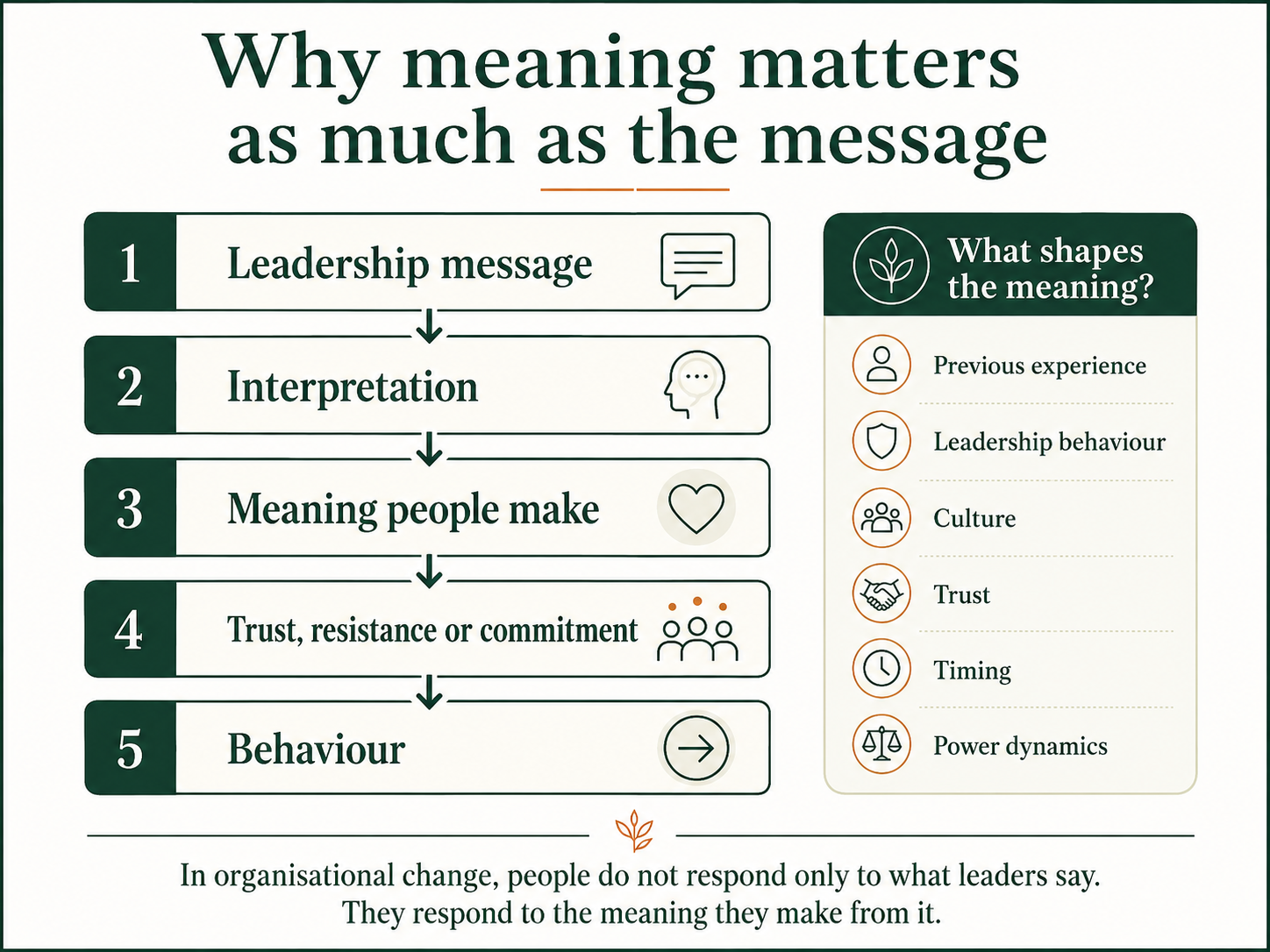
In organisational change, people do not respond only to what leaders say. They respond to the meaning they make from it.
What is leadership storytelling?
Leadership storytelling is the disciplined use of narrative to help people understand what is happening, why it matters and what action is now required (Denning, 2011).
Change is not experienced as a sequence of announcements, milestones or project plans; people make sense of it by creating stories about what is happening, why it matters, who they can trust, and what it means for them (Storr, 2019).
At its best, it connects four things:
Reality: What is happening now?
Meaning: Why does it matter?
Identity: Who do we need to become?
Action: What must we do differently?
That is very different from adding a personal anecdote to the start of a presentation.
In leadership, a story is not just something a person tells. It is also something others construct about them. A senior leader’s tone, timing, consistency, silence, behaviour under pressure and willingness to face difficult truths all shape the story people form about their credibility.
This is where storytelling connects directly to executive presence. Presence is not only how a leader speaks. It is the story others come to believe about their authority, judgement and trustworthiness.
Four stories leaders need during change
Leadership storytelling is not one generic activity. Different stories serve different leadership functions, including building trust, communicating values, creating a future orientation and helping people understand identity and purpose (Simmons, 2006; Denning, 2011).
1. The future story
A future story helps people understand where the organisation is going and why the change matters now. It turns strategy into something people can picture, not just something they are expected to accept.
Without a future story, change can feel like disruption without direction.
2. The values story
A values story shows what the organisation stands for when choices become difficult. This matters because change often exposes the gap between stated values and lived behaviour.
If leaders say they value empowerment, collaboration or agility, people will look for proof in decisions, trade-offs and everyday behaviour.
3. The lesson story
A lesson story builds trust by showing what has been learned, especially from difficulty, mistake or failure. It helps leaders sound human without becoming self-indulgent.
In change, this kind of story matters because people are often watching for signs of honesty. They do not need leaders to pretend everything is certain. They need evidence that leaders are learning quickly and facing reality.
4. The identity story
An identity story helps people understand who is leading them and what has shaped their judgement. It answers the unspoken question: why should we trust you with this change?
This is especially important when leaders are stepping into a new role, sponsoring transformation or asking others to behave differently. People do not only listen to the change message. They also form a story about the leader behind it.
These four stories should not be treated as scripts. They are lenses. A credible change narrative may combine several of them: a future people can move towards, values they can see in action, lessons that make leadership more trustworthy, and an identity shift that helps people understand who they now need to become.
Why does storytelling matter in organisational change?
Organisational change creates uncertainty. Uncertainty creates interpretation. Interpretation creates stories (Weick, 1995).
People naturally try to explain what is happening:
Is this change real?
Do senior leaders believe it?
Will this affect my role?
Is this another initiative that will disappear?
Are we allowed to challenge this?
Who is really making the decisions?
If leaders do not help people make meaning, people will make meaning without them. This is especially important for transformation leaders, who often need to create trust and momentum before the outcomes of change are visible.
That does not mean leaders should manipulate the narrative. In fact, the opposite is true. The more complex the change, the more important it becomes to tell a story that is credible, honest and behaviourally grounded.
A change story fails when the language is more ambitious than the lived experience. If leaders talk about trust but avoid challenge, the story weakens. If they talk about empowerment but continue to make every decision centrally, the story collapses. If they talk about agility but punish experimentation, people believe the behaviour, not the message.
What does the evidence say about storytelling?
The evidence base for storytelling is stronger than many sceptics assume, but more nuanced than many consultants suggest.
Research on narrative transportation shows that people can become absorbed in stories through attention, imagery and emotion, and that this absorption can influence beliefs and attitudes (Green and Brock, 2000). Green and Brock’s foundational work described transportation as a psychological state in which people are mentally and emotionally drawn into a narrative world.
A meta-analysis by Braddock and Dillard found positive relationships between narratives and changes in beliefs, attitudes, intentions and behaviours (Braddock and Dillard, 2016). That matters for leaders, but it should not be exaggerated. Stories can influence people, but they do not remove the need for trust, evidence, repetition and aligned behaviour.
Organisational research also shows that stories are not just messages from the top. David Boje’s study of an office-supply firm showed how people perform stories inside organisations to make sense of events, introduce change and navigate politics (Boje, 1991).
In other words, every organisation is already a storytelling system. The question is whether leaders understand the stories already circulating inside it.
What does neuroscience really tell us about storytelling?
Neuroscience has made storytelling more fashionable, but also more vulnerable to hype.
One useful finding is that successful communication can involve a form of speaker-listener alignment. Stephens, Silbert and Hasson used fMRI to study natural verbal communication and found that successful communication was associated with coupling between speaker and listener brain activity (Stephens, Silbert and Hasson, 2010).
That does not mean leaders can control another person’s brain with a story. It means effective communication involves shared attention, shared meaning and alignment between speaker and listener.
The safer claim is this:
Stories help people simulate experience, attach emotion to meaning, and remember information in a more human form.
David JP Phillips’ TEDxStockholm talk, The Magical Science of Storytelling, is a useful practitioner example because it makes the neuroscience accessible and introduces the idea that different stories can create different emotional states. But it should be treated as a gateway, not as the evidence base itself (Phillips, 2017).
The strongest case for leadership storytelling does not rest on simplistic claims about brain chemicals. It rests on psychology, communication research, organisational studies and lived leadership practice.
What does Manfred Kets de Vries add to leadership storytelling?
Manfred Kets de Vries brings a deeper lens. In Storytelling for Leaders: Tales of Sorrow and Love, he frames storytelling as central to leadership, influence, self-awareness and organisational life (Kets de Vries, 2025).
This matters because leaders are not only tellers of stories. They are also shaped by stories.
For example:
“I have to be the expert.”
“If I slow down, I lose control.”
“Conflict means something has gone wrong.”
“My value comes from rescuing others.”
“The organisation is irrational, so I have to be the adult in the room.”
“I am not political, therefore politics is dirty.”
These are not simply communication problems. They are identity stories.
This is where storytelling becomes highly relevant to executive coaching. A leader may need to communicate differently, but first they may need to understand the story they are living inside.
A technically brilliant executive moving into a broader leadership role, for example, may continue to tell themselves that credibility comes from having the answer. At senior level, that story can become limiting. Their new work is not to know more than everyone else. It is to create clarity, judgement, trust and collective direction across a system.
The story people hear is not always the story leaders think they are telling
In complex organisations, leaders rarely communicate into a blank space.
People interpret change through previous restructures, broken promises, cultural assumptions, national context, power dynamics, professional identity and what they see senior leaders actually do (Boje, 1991; Weick, 1995).
That is why the official change story is only one part of the work.
The deeper question is:
Is the leadership system behaving in ways that make the story believable?
A leadership team may say it is aligned, while the organisation experiences hesitation and mixed signals. A transformation may be described as empowering, while employees experience it as another top-down initiative. A senior executive may believe they are being clear and decisive, while stakeholders experience them as distant, defensive or difficult to read.
The gap between the intended story and the received story is often where change starts to stall.
When change gets stuck
If people no longer believe the story of change, more communication may not create more trust.
The useful work is often to understand the dynamics beneath the message: what senior leaders are signalling through their conversations, decisions and behaviour.
Why transformation narratives often fail
Transformation narratives usually fail for one of five reasons.
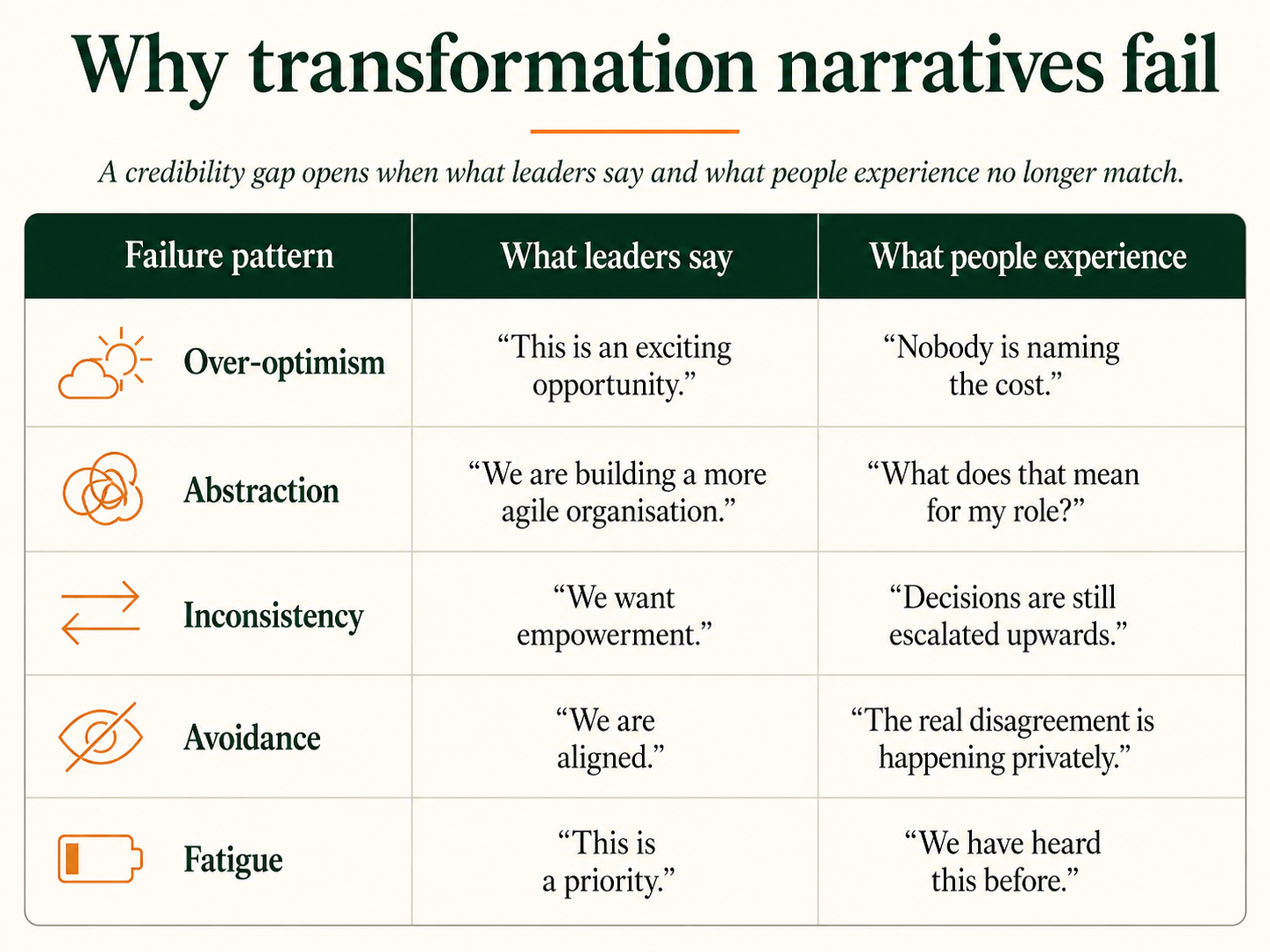
Why transformation narratives fail
The problem is not always the communication plan. Often, the problem is the leadership behaviour behind the communication.
A stronger change story does not need to be more polished. It needs to be more truthful, more specific and more visibly supported by action.
The hidden stories inside leadership teams
Leadership teams have stories too.
Some are explicit:
“We are a high-performing team.”
“We are aligned.”
“We challenge each other.”
“We are moving fast.”
Others are hidden:
“Conflict is risky here.”
“The CEO has already decided.”
“It is safer to agree in the room and disagree afterwards.”
“My function needs protecting.”
“We do not have time to slow down.”
“If I admit uncertainty, I lose authority.”
These hidden stories shape behaviour, because identity is partly organised through the narratives people construct about themselves and their roles (McAdams and McLean, 2013; Kets de Vries, 2025).
A team that says it values challenge but avoids difficult conversations is not suffering from a vocabulary problem. It is living inside a protective narrative. Until that narrative becomes visible, the team will keep repeating the same pattern with better language.
This is why storytelling matters in team coaching. The work is not just to help the team tell a better external story. It is to help the team see the internal story that is shaping trust, accountability and decision-making.
What can leaders learn from strong storytelling examples?
The point of using famous examples is not to glorify charismatic individuals. It is to understand different functions of story.
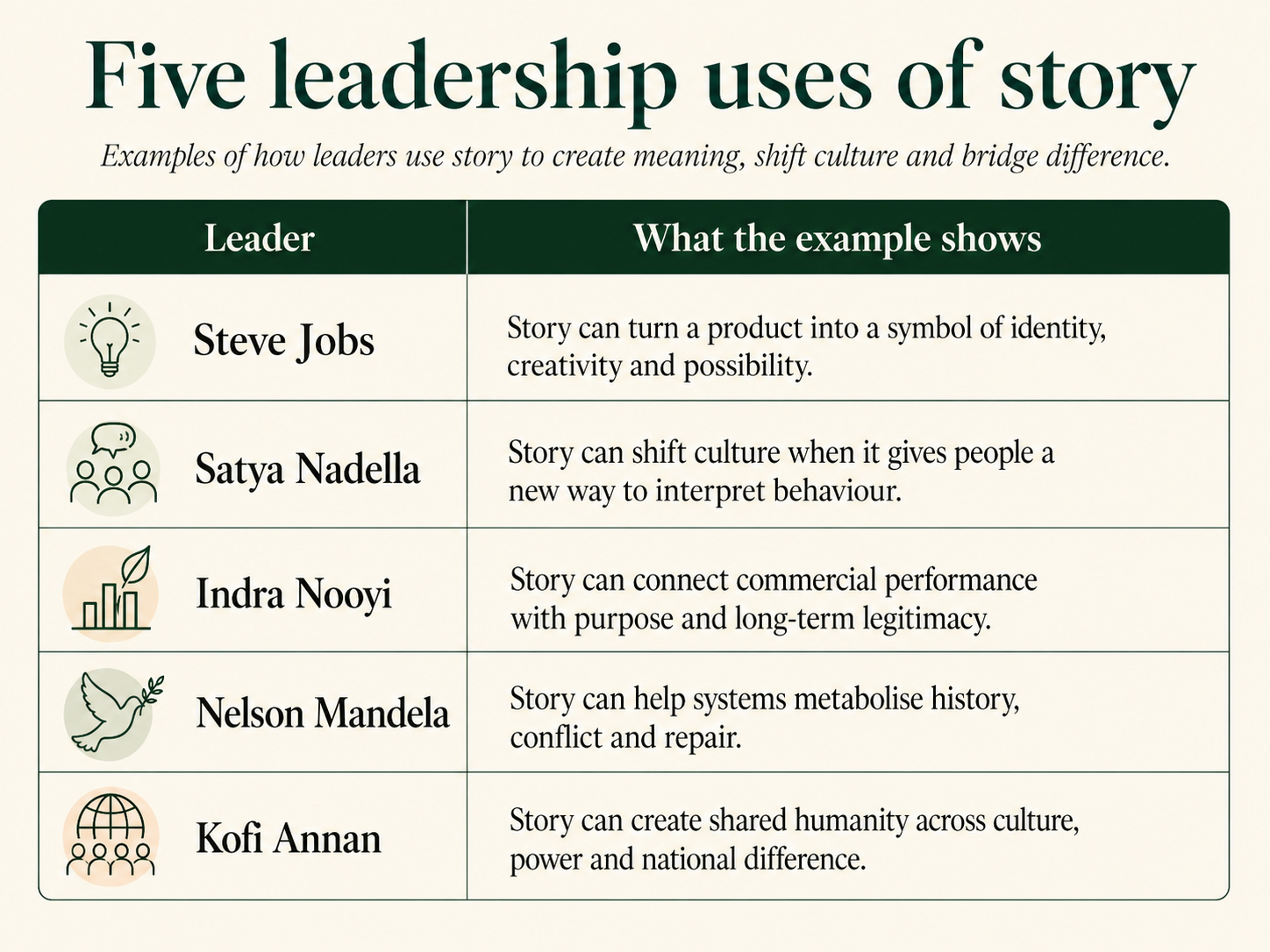
Five leadership uses of story
For organisational change, Satya Nadella is especially relevant. His phrase about moving Microsoft from a “know-it-all” culture to a “learn-it-all” culture worked because it was short, memorable and behavioural (Nadella, Shaw and Nichols, 2017). It gave people a new way to interpret how they should show up.
That is what strong change stories do. They do not only describe a future state. They help people understand the behaviour required to move towards it.
Storytelling and cross-cultural leadership
In global organisations, storytelling becomes even more important and more difficult, particularly in cross-cultural leadership. Rosinski’s work on coaching across cultures is a useful reminder that culture is not only national; it is also organisational, professional and personal, shaping how people interpret authority, trust, communication and change (Rosinski, 2003).
The same message can carry different meanings across cultures. Directness may be read as clarity in one context and disrespect in another. Silence may signal agreement in one culture and caution in another. A story about “empowerment” may land differently in organisations with different histories of hierarchy, psychological safety or national culture.
This does not mean leaders should create bland, lowest-common-denominator messages. It means they need to become more curious about how meaning is made.
Cross-cultural storytelling requires leaders to ask:
What assumptions does this story carry?
Who might feel included or excluded by it?
What past experiences will people use to interpret it?
Does the story translate across hierarchy, function, geography and culture?
What needs to be locally adapted without losing the core meaning?
This is where storytelling becomes less about performance and more about perspective-taking.
How can leaders use storytelling without slipping into spin?
The ethical line is simple:
Storytelling becomes manipulation when it asks people to believe a version of reality that leadership behaviour does not support.
Senior leaders should use stories to clarify reality, not conceal it.
A credible change story should include:
A truthful account of the current situation
Name the tension without catastrophising it.A clear reason for change
Explain why staying the same has a cost.A human consequence
Show who is affected and why it matters.A behavioural shift
Specify what leaders and teams need to do differently.Visible consistency
Make sure leadership behaviour reinforces the story.Room for response
Let people question, challenge and make meaning for themselves.
The aim is not to make people feel inspired for an hour. The aim is to make change more understandable, credible and actionable.
A practical storytelling framework for senior leaders
A useful leadership story has seven parts.
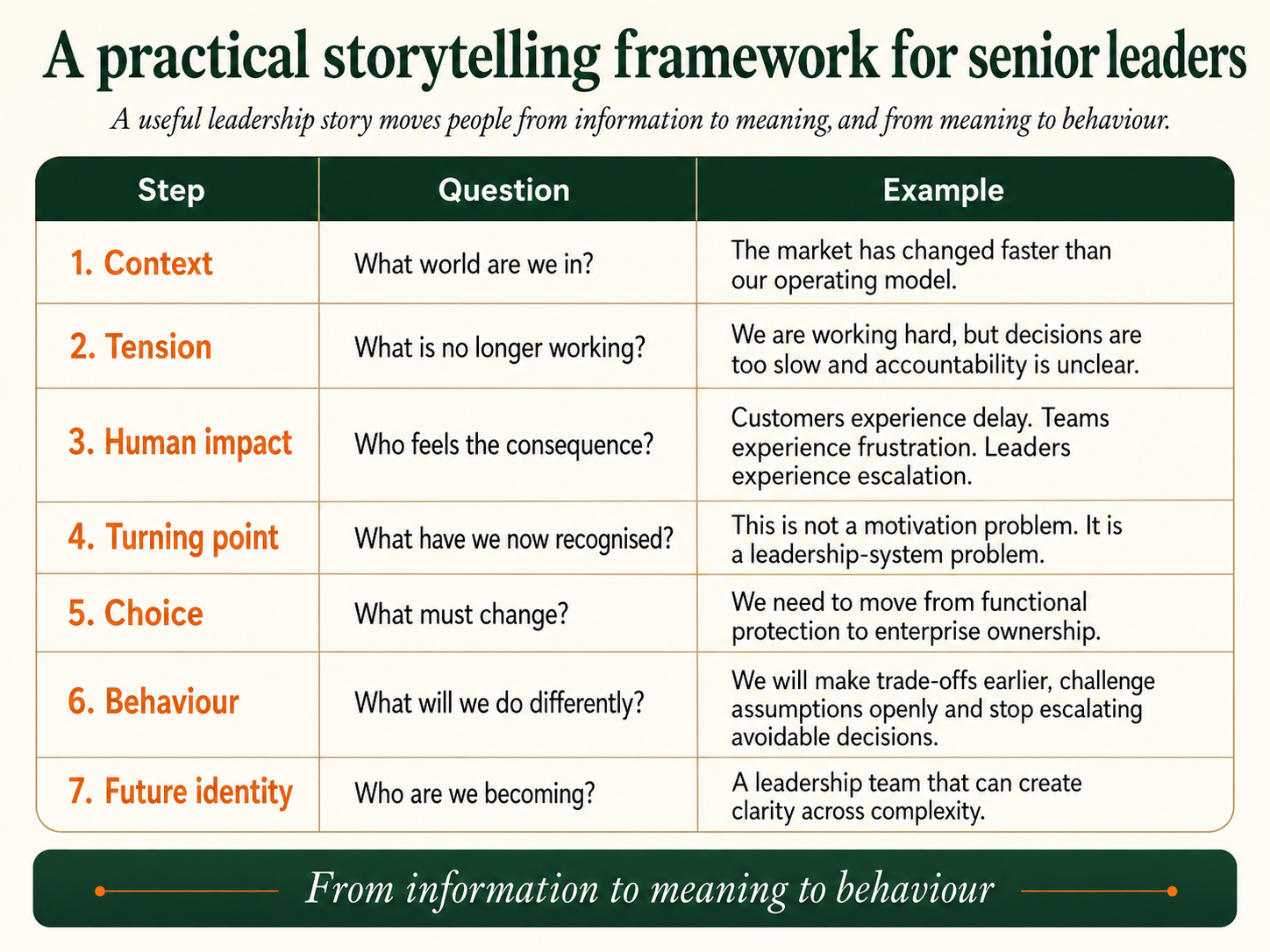
A practical storytelling framework for senior leaders
This framework works because it moves from information to meaning, and from meaning to behaviour.
This structure reflects wider work on leadership storytelling and persuasive narrative design: effective stories move from context and tension towards choice, meaning and action (Denning, 2011; Duarte, 2010).
Where storytelling becomes coaching work
Storytelling becomes part of leadership coaching when the story a leader is carrying, telling or avoiding begins to shape their impact, influence or ability to help others make sense of change.
Sometimes the work is personal: the story a leader tells about themselves no longer fits the role they now need to occupy. Sometimes it is relational: the leader needs to connect with a new team, a different stakeholder group or a more sceptical audience. And sometimes it is organisational: people are struggling to make sense of change, uncertainty or direction.
One common coaching moment is leadership transition. A leader may still be operating from an old story that once made them successful, but now limits the role they need to occupy:
from expert to enterprise leader
from founder to CEO
from functional head to executive committee member
from high performer to leader of other high performers
from national leader to global leader
from operator to transformation sponsor
At these points, the old story may still feel familiar and credible. But it can also create over-functioning, bottlenecks, defensiveness or a leadership presence that no longer matches the scale of the role.
For example, the story “I am the person who solves the hard problems” may have built credibility earlier in a career. At senior level, it may prevent others from stepping up. The more useful leadership story might become:
“My work is not to be the cleverest person in the room. It is to create the conditions in which the room becomes more intelligent.”
That is not just a better story. It is a different kind of leadership presence: less centred on personal expertise and more focused on clarity, steadiness and influence. It also connects to executive communication under pressure, where timing, tone and judgement shape how senior stakeholders interpret a leader’s message.
But storytelling is not only about a leader’s personal narrative. It also becomes critical when leaders need to help others make sense of change, uncertainty or direction.
In coaching, this often shows up when leaders are:
leading a change programme where the rationale has become too abstract, technical or corporate
joining a new team and needing to establish credibility quickly
communicating strategy to people with different levels of power, trust or understanding
helping teams connect day-to-day work with a bigger organisational purpose
rebuilding confidence after disruption, restructuring or poor communication
shifting from telling people what is changing to helping them understand why it matters
In these moments, the question is not simply “What is the message?” It is:
What story are people already telling themselves?
What does this audience need to believe, feel or understand before they can move?
Where is there a gap between the official narrative and lived experience?
What needs to be said plainly, without over-polishing it into corporate language?
This is where storytelling connects directly with executive presence, influence and change leadership. A leader’s story needs to be clear enough to orient people, honest enough to be trusted and human enough for people to connect with.
The best leadership stories do not manipulate. They help people see the work, the stakes and their own part in what happens next.
Final thought: meaning matters as much as the message
In organisational change, leaders often ask: “How do we communicate this?”
It is a useful question, but not the first one.
The deeper questions are:
What story are people already telling about this change?
What meaning are they making from what they see?
What leadership behaviours are reinforcing or undermining the message?
What identity shift is being asked of leaders, teams and employees?
What needs to become more visible, more honest or more human?
Storytelling matters because change is not only operational. It is psychological, social and cultural.
People need to understand the plan. But they also need to believe the story enough to act inside it.
Next step
If your change story is not landing as intended, the next step may be to explore what people are hearing, believing and experiencing.
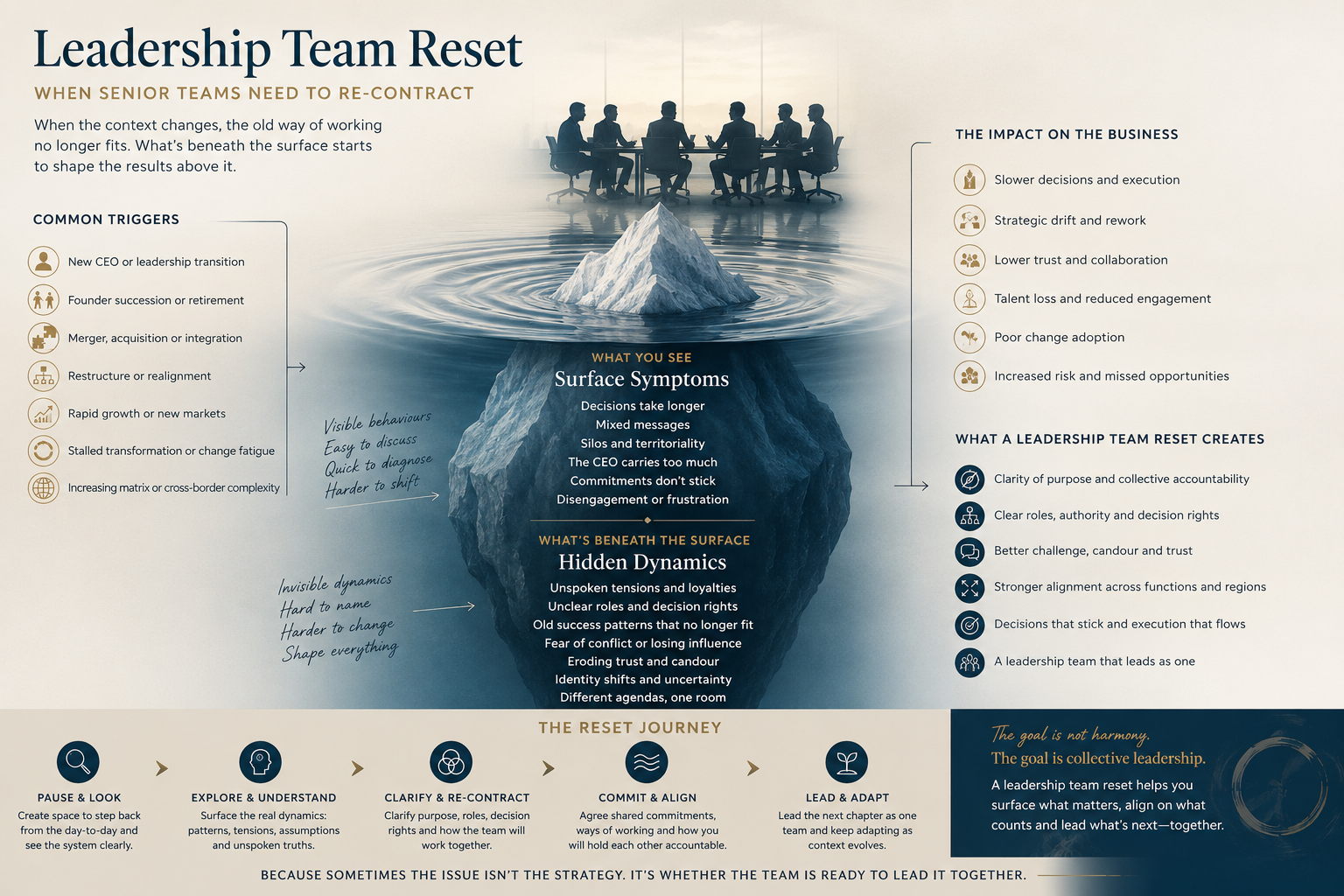
Leadership team coaching can help senior teams strengthen trust, alignment and the conversations that make change feel credible.
FAQ: Storytelling in Organisational Change
-
Leadership storytelling is the use of narrative to help people understand what is happening, why it matters and what action is now required. In organisational change, it is not just about making messages more engaging. It helps people make meaning from uncertainty, connect the change to their role and understand what behaviour needs to shift.
-
Storytelling matters in organisational change because people do not respond only to formal messages. They interpret change through previous experience, trust in leadership, culture, timing and what senior leaders actually do. A credible story helps people understand the reason for change, the human impact and the behaviours required to move forward.
-
Yes, but the evidence is more nuanced than many business books suggest. Research on narrative transportation, persuasion, memory, identity and organisational sensemaking shows that stories can influence attention, beliefs and behaviour. However, storytelling does not replace trust, evidence or aligned leadership behaviour. A weak story will not compensate for inconsistent action.
-
Neuroscience suggests that stories can support attention, emotional engagement, mental imagery and shared understanding. Some studies show that effective communication can create alignment between speaker and listener brain activity. But leaders should avoid simplistic claims that stories “hack the brain”. The stronger point is that stories help people simulate experience and attach meaning to information.
-
Leaders avoid manipulation by grounding their story in reality. A credible change story should name the current situation honestly, explain why change matters, show the human consequence, clarify the behaviour required and be reinforced by visible leadership action. Storytelling becomes manipulative when it asks people to believe a version of reality that leadership behaviour does not support.
-
Executive presence is partly shaped by the story others form about a leader’s credibility, judgement and trustworthiness. This story is created through what the leader says, how they say it, what they avoid, how they behave under pressure and whether their actions match their message. Strong storytelling helps leaders communicate meaning with clarity, authority and emotional intelligence.
-
Leadership teams often operate inside hidden stories about power, conflict, accountability and trust. For example, a team may say it values challenge while privately avoiding difficult conversations. Storytelling helps by making these hidden narratives visible, so the team can test whether its shared story supports or undermines better decisions, stronger alignment and collective performance.
-
Transformation narratives often fail when there is a gap between what leaders say and what people experience. Leaders may talk about empowerment while decisions still escalate upwards, or describe alignment while real disagreement happens privately. When the lived experience contradicts the official message, people believe the behaviour, not the story.
📚References
Boje, D.M. (1991) ‘The storytelling organization: A study of story performance in an office-supply firm’, Administrative Science Quarterly, 36(1), pp. 106-126.
Braddock, K. and Dillard, J.P. (2016) ‘Meta-analytic evidence for the persuasive effect of narratives on beliefs, attitudes, intentions, and behaviors’, Communication Monographs, 83(4), pp. 446-467.
Denning, S. (2011) The Leader’s Guide to Storytelling: Mastering the Art and Discipline of Business Narrative. 2nd edn. San Francisco: Jossey-Bass.
Duarte, N. (2010) Resonate: Present Visual Stories that Transform Audiences. Hoboken, NJ: Wiley.
Green, M.C. and Brock, T.C. (2000) ‘The role of transportation in the persuasiveness of public narratives’, Journal of Personality and Social Psychology, 79(5), pp. 701-721.
Kets de Vries, M.F.R. (2025) Storytelling for Leaders: Tales of Sorrow and Love. Abingdon: Routledge.
McAdams, D.P. and McLean, K.C. (2013) ‘Narrative identity’, Current Directions in Psychological Science, 22(3), pp. 233-238.
Nadella, S., Shaw, G. and Nichols, J.T. (2017) Hit Refresh: The Quest to Rediscover Microsoft’s Soul and Imagine a Better Future for Everyone. London: William Collins.
Phillips, D.J.P. (2017) ‘The magical science of storytelling’, TEDxStockholm, 16 March. Online video. Available at: YouTube. Accessed: 20 May 2026.
Rosinski, P. (2003) Coaching Across Cultures: New Tools for Leveraging National, Corporate and Professional Differences. London: Nicholas Brealey Publishing.
Simmons, A. (2006) The Story Factor: Inspiration, Influence, and Persuasion through the Art of Storytelling. New York: Basic Books.
Stephens, G.J., Silbert, L.J. and Hasson, U. (2010) ‘Speaker-listener neural coupling underlies successful communication’, Proceedings of the National Academy of Sciences, 107(32), pp. 14425-14430.
Storr, W. (2019) The Science of Storytelling: Why Stories Make Us Human and How to Tell Them Better. London: William Collins.
van Laer, T., Feiereisen, S. and Visconti, L.M. (2019) ‘Storytelling in the digital era: A meta-analysis of relevant moderators of the narrative transportation effect’, Journal of Business Research, 96, pp. 135-146.
Weick, K.E. (1995) Sensemaking in Organizations. Thousand Oaks, CA: Sage.

Under the Surface
A monthly briefing on the hidden dynamics shaping senior leadership, teams and change…
Read next…