What Is Cross-Cultural Coaching? How It Helps Leaders Build Trust, Influence and Credibility Across Cultures
A leader can be highly effective in one cultural context and unexpectedly misread in another.
The same directness that signals clarity in one setting may feel abrupt somewhere else. A pause that communicates respect in one culture may be interpreted as disengagement in another. A leader who is trying to be collaborative may be seen as lacking authority. A leader who is trying to show confidence may be experienced as arrogant.
This is why cross-cultural leadership is not simply about “understanding other cultures”. It is about understanding how leadership itself is interpreted.
I have worked across cultures for much of my career, including more than two decades in a global Fortune 100 organisation and later as an executive and team coach. In my coaching work, I have supported leaders across more than 60 nationalities. Again and again, the same pattern appears: capable leaders do not usually struggle because they lack intelligence or goodwill. They struggle because expectations are not shared, and the rules of trust, authority, challenge and influence are not always spoken out loud.
That is where cross-cultural coaching can help.
For leaders working across regions, countries or culturally diverse stakeholder groups, cross-cultural executive coaching can provide a confidential space to explore how trust, authority and influence are being interpreted.
What is cross-cultural coaching?
Cross-cultural coaching is not about memorising etiquette or reducing people to national stereotypes. It is a developmental process that helps leaders build trust, influence and credibility when expectations, communication norms and ways of working differ across cultures.
More specifically, in this article I define cross-cultural coaching as helping leaders work more effectively across cultural, geographical, organisational and professional differences. It focuses on how trust, authority, communication, influence, decision-making and disagreement are interpreted in different contexts, so leaders can adapt with greater awareness, credibility and range.
This definition draws on coaching across cultures, intercultural competence and cultural intelligence literature, which emphasise awareness, interpretation, behavioural flexibility and the ability to respond appropriately in context (Rosinski, 2003; Ang et al., 2007; Leung, Ang and Tan, 2014).
💬 Key idea: Cross-cultural coaching is not about memorising etiquette or cultural stereotypes. It is about building trust, influence and credibility when expectations are not shared.
For senior leaders, the issue is rarely as simple as learning facts about another country. The real challenge is often more subtle.
How is credibility built here?
How direct is too direct?
How do people show respect?
How is disagreement expressed?
How are decisions really made?
What does silence mean?
When does adapting become over-adapting?
These are not abstract cultural questions. They are leadership questions.
Cross-cultural coaching gives leaders a confidential space to explore these questions in relation to their real stakeholders, real meetings and real organisational pressures.
Philippe Rosinski, one of the key contributors to this field, frames coaching across cultures as a way to work constructively with national, corporate and professional differences, rather than treating culture as a problem to be managed. His Coaching Across Cultures introduced the Cultural Orientations Framework, which explores cultural dimensions in areas such as communication, time, identity, power, territory and group organisation (Rosinski, 2003).
Cross-cultural coaching is not etiquette training
A common misunderstanding is that cross-cultural coaching is mainly about etiquette: what to say, how to greet people, how formal to be, or which customs to remember.
That may be useful in some situations, but it is not enough for senior leadership.
At executive level, cross-cultural effectiveness is less about memorising rules and more about reading context. Leaders need to understand how expectations around authority, trust, disagreement, pace, feedback and relationship-building may differ.
For example:
In one context, direct feedback may be appreciated as honest and efficient.
In another, the same feedback may damage trust or create loss of face.
In one setting, asking questions may signal curiosity.
In another, it may be interpreted as uncertainty or lack of preparation.
In one organisation, challenge may be expected in public.
In another, the real conversation may happen privately before or after the meeting.
Good cross-cultural coaching does not reduce people to national labels. It helps leaders notice patterns, test assumptions and build a wider range of responses.
The aim is not to become a cultural chameleon. The aim is to lead with more awareness, flexibility and judgement.
💬 Coaching Cue: Which part of your leadership style are you assuming is universally understood?
Common dimensions used in cross-cultural coaching assessments
Cross-cultural coaching often uses frameworks or assessment tools to make invisible assumptions more visible. These tools do not all use the same language, but many are trying to help leaders understand similar practical questions:
How is trust built?
How directly do people communicate?
How is authority interpreted?
How are decisions made?
How is disagreement expressed?
How is time perceived and managed?
How much context is needed?
How do people balance individual and group priorities?
How comfortable are people with ambiguity, hierarchy or risk?
Rosinski’s Cultural Orientations Framework includes 17 dimensions grouped into areas such as time, communication, power, responsibility, identity, territory and organisation. The purpose is not to label people, but to help leaders understand cultural preferences and develop more versatility (Rosinski, 2003).
Erin Meyer’s The Culture Map is another widely recognised business framework. It looks at dimensions including communicating, evaluating, persuading, leading, deciding, trusting, disagreeing and scheduling. These dimensions are useful because they translate cultural difference into everyday leadership moments such as giving feedback, making decisions and building trust (Meyer, 2014).
Cultural Intelligence, often referred to as CQ, uses a different lens. It focuses on four capabilities: metacognitive, cognitive, motivational and behavioural cultural intelligence. In plain English, this means awareness, understanding, motivation and behavioural adaptability in intercultural situations (Ang et al., 2007; Van Dyne et al., 2012).
The Intercultural Development Inventory uses a developmental approach, building on the Developmental Model of Intercultural Sensitivity. This can be helpful when the question is not only “what differences exist?” but “how does this person currently make sense of difference?” (Hammer, Bennett and Wiseman, 2003).
For coaching, the value of these frameworks is not in memorising categories. Their value is in helping leaders ask better questions:
Where might I be assuming that my way of building trust is universal?
Where might my normal communication style be misread?
Where might I be interpreting others too quickly through my own cultural lens?
What leadership range do I need to develop?
Why capable leaders get misread across cultures
Cross-cultural difficulty is not a sign that someone lacks empathy, intelligence or experience. Often, the opposite is true. Many leaders get into difficulty because they keep using behaviours that made them successful in another setting.
A leader who has built credibility through speed may become frustrated in a context where trust has to be built before challenge is welcomed.
A leader who is used to open debate may misread caution as disengagement.
A leader who values humility may be overlooked in a context where authority needs to be signalled more explicitly.
This is also why cross-cultural leadership often overlaps with executive presence: leaders are not only communicating information, they are being interpreted through local expectations of confidence, credibility and authority.
A leader who is used to autonomy may struggle in a culture where decision-making is more relational, hierarchical or consensus-based.
This is why cross-cultural coaching needs to go beyond cultural knowledge. Leaders do not only need to know that cultures differ. They need to notice what is happening in the moment and adapt skilfully.
Research on cultural intelligence supports this distinction. Ang et al. (2007) found that different aspects of cultural intelligence predicted different outcomes: metacognitive and cognitive CQ predicted cultural judgement and decision-making, motivational and behavioural CQ predicted cultural adaptation, and metacognitive and behavioural CQ predicted task performance.
In plain English: awareness matters, knowledge matters, motivation matters, and behaviour matters. Cross-cultural coaching works with all four.
Next step
If the room is reading you differently from how you intend:
Cross-cultural leadership problems often look like communication issues, but underneath them sit trust, authority, hierarchy, pace and unspoken expectations. Coaching helps you slow the pattern down, understand the signals being sent and received, and choose the next behaviours that rebuild influence.
What cross-cultural coaching helps with
Cross-cultural coaching can support several leadership challenges.
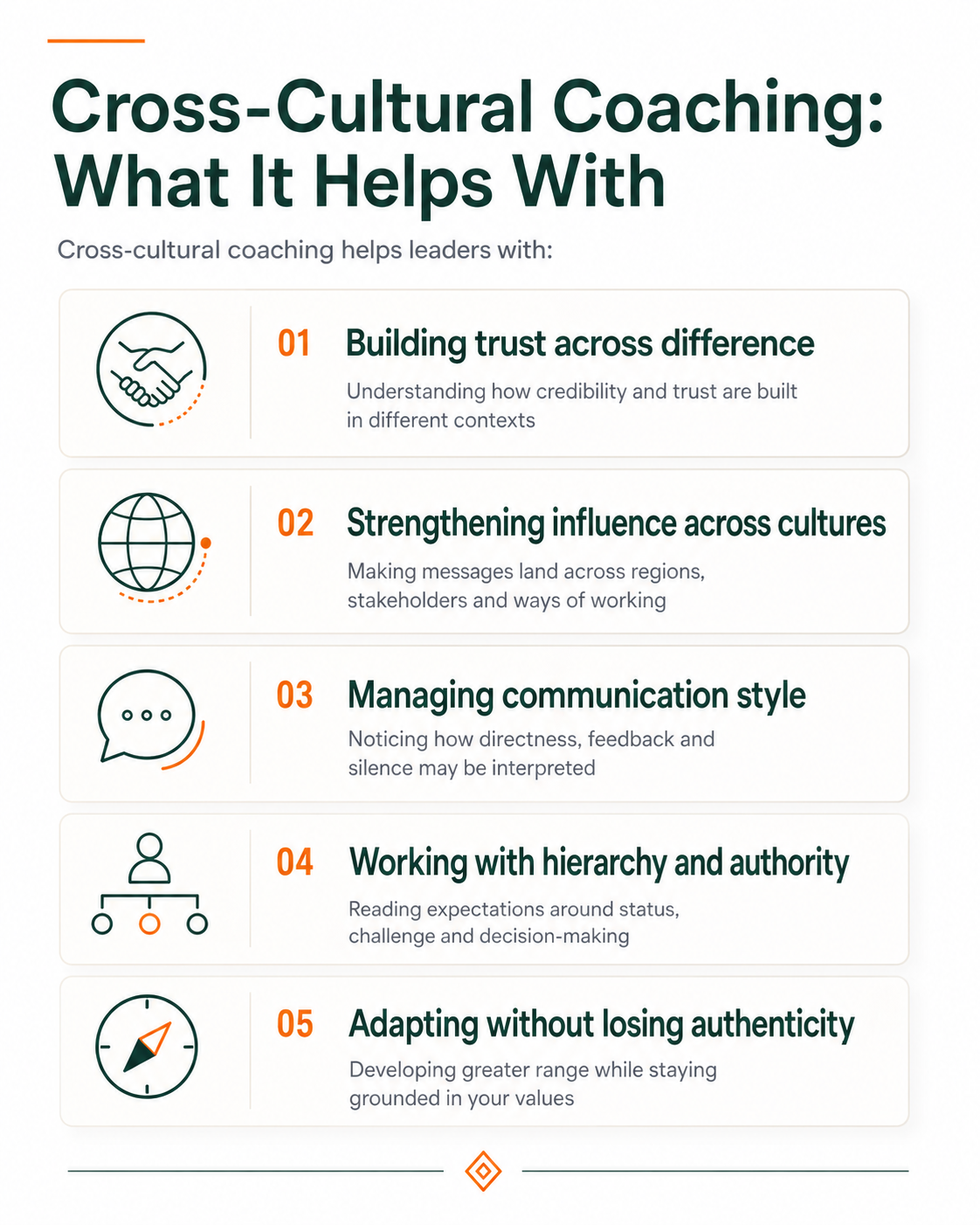
1. Building trust across difference
Trust does not form in the same way everywhere.
In some contexts, trust is built quickly through competence, reliability and task delivery. In others, it grows more slowly through relationship, loyalty, discretion, shared history or informal connection.
A senior leader who does not understand this may try to build trust in the wrong currency.
They may deliver the work, but neglect the relationship. Or they may invest in relationship-building, while stakeholders are waiting for clarity, pace and decisive action.
Cross-cultural coaching helps leaders notice how trust is being built, delayed or damaged in their particular stakeholder system.
2. Strengthening influence across cultures
Influence is not only about having a strong argument. It is also about timing, status, relationship, context and how the message is delivered.
In one culture, influence may depend on directness and clear recommendations. In another, it may depend on patience, indirect alignment and understanding the informal network before making a proposal.
This becomes especially important in global matrix organisations, where national culture, organisational culture and professional culture all interact. For senior leaders navigating this level of complexity, executive coaching for senior leaders can help connect cultural awareness with stakeholder influence, judgement and visible leadership behaviour. Rosinski’s work is useful here because it explicitly includes national, corporate and professional cultures rather than reducing culture to nationality alone (Rosinski, 2003).
Cross-cultural coaching helps leaders ask:
What will help this message land with this person, in this context, at this moment?
That question is often more useful than simply asking, “How do I communicate more clearly?”
3. Managing communication style
Many cross-cultural misunderstandings are not about intention. They are about interpretation.
A leader may think they are being clear, while others experience them as blunt. A leader may think they are being diplomatic, while others experience them as evasive. A leader may believe they are inviting challenge, while the group does not believe it is safe or appropriate to disagree openly.
The point is not to replace one communication style with another. The point is to build range.
Cross-cultural coaching helps leaders understand their default style, notice how it may be interpreted, and choose more deliberately.
4. Working with hierarchy and authority
Leaders often underestimate how differently authority is experienced across cultures and organisations.
In some contexts, challenge to seniority is normal and expected. In others, it may be seen as risky, disrespectful or politically unwise. In some teams, junior colleagues are expected to contribute early and openly. In others, they may wait to be invited.
Cross-cultural leadership research has repeatedly shown that leadership expectations vary across societies and that assumptions about effective leadership are not universally identical (Den Hartog et al., 1999; Dickson, Den Hartog and Mitchelson, 2003).
This affects meetings, feedback, decision-making, psychological safety and the quality of information that reaches senior leaders.
A leader may believe they are approachable, but the system may still treat them as high status. Coaching helps leaders close the gap between their intention and the impact they are actually having.
5. Adapting without losing authenticity
One of the most common tensions in cross-cultural leadership is the fear of over-adapting.
Leaders may ask:
How do I flex without becoming false?
How do I respect local norms without losing my leadership voice?
How do I remain clear without being culturally clumsy?
How do I build trust without becoming performative?
Good cross-cultural coaching does not ask leaders to become someone else. It helps them expand their range while staying grounded in their values, role and judgement.
How cross-cultural coaching differs from cultural intelligence training
Cultural intelligence training often teaches concepts, frameworks and general awareness. That can be useful. Research reviews describe intercultural competence as including traits, attitudes, worldviews, capabilities and combinations of these dimensions, with links to psychological, behavioural and performance outcomes (Leung, Ang and Tan, 2014).
Coaching is different because it applies those ideas to a leader’s actual work.
A training programme might explain that cultures differ in directness, hierarchy or decision-making. Coaching asks:
How is that playing out with your regional team, your board stakeholder, your new boss, your international peer group or your transformation programme?
The difference is practical application.
Cross-cultural coaching may include:
mapping key stakeholders and expectations
identifying where trust or credibility is being lost
exploring the leader’s own assumptions
preparing for difficult conversations
testing different communication strategies
reviewing what happened after real meetings
building a more flexible leadership repertoire
This is particularly useful for senior leaders because their challenges are rarely generic. They are specific, relational and context-sensitive.
When cross-cultural coaching is useful
Cross-cultural coaching is especially useful when a leader is:
moving into a global, regional or international role and needing executive transition coaching
leading across countries, functions or business units
managing a multicultural team or working with a leadership group that may benefit from team coaching
working with stakeholders who interpret authority differently
struggling to build trust across geographies
finding that their communication style is being misread
preparing for an international assignment or relocation
leading transformation across different cultural contexts, where coaching for transformation leaders can support influence, resilience and stakeholder alignment
working in a matrix organisation where local and global expectations conflict
needing to influence without direct authority
It can also help leaders who are technically strong but now need to operate with greater political, cultural and relational sophistication.
That last point matters. In senior roles, the challenge is often not capability. It is whether that capability is being recognised, trusted and interpreted accurately across difference.
What happens in cross-cultural coaching?
The process should be practical, confidential and grounded in the leader’s real context.
A typical coaching engagement might include five stages.
1. Clarify the leadership context
The work begins by understanding the role, the stakeholders, the cultural complexity and the leadership challenge.
The question is not simply:
What culture are you dealing with?
It is:
What is the leadership situation, and where is cultural difference affecting trust, influence, credibility or performance?
2. Map expectations and interpretations
The leader explores how different stakeholders may be interpreting their behaviour. This might include communication style, pace, decision-making, emotional expression, hierarchy, challenge, responsiveness or relationship-building.
3. Identify the leader’s default patterns
Every leader has a cultural lens.
That lens is shaped by national background, professional training, organisational history, personality, family system, education and previous success.
Coaching helps the leader see their own defaults more clearly.
4. Build behavioural range
The leader then experiments with different ways of communicating, influencing, listening, challenging and building trust.
The aim is not to become culturally perfect. The aim is to become more observant, flexible and effective.
5. Apply learning to real leadership moments
The work becomes valuable when it is applied to live situations: a difficult stakeholder conversation, a regional leadership meeting, a feedback conversation, a team reset, a negotiation or a transition into a broader role.
Workplace coaching research suggests that coaching can have positive effects on learning and performance outcomes, and executive coaching studies have found improvements in areas such as goal attainment, resilience and wellbeing (Grant, Curtayne and Burton, 2009; Jones, Woods and Guillaume, 2016).
Why cross-cultural coaching matters for global leadership
Global leadership is not just domestic leadership with more travel.
It requires leaders to work across different assumptions about:
how trust is earned
how power is shown
how disagreement is expressed
how decisions are made
how risk is discussed
how feedback is given
how relationships are maintained
how quickly change should happen
This is why cross-cultural coaching is relevant for leaders in global organisations, matrix structures, international teams and transformation roles.
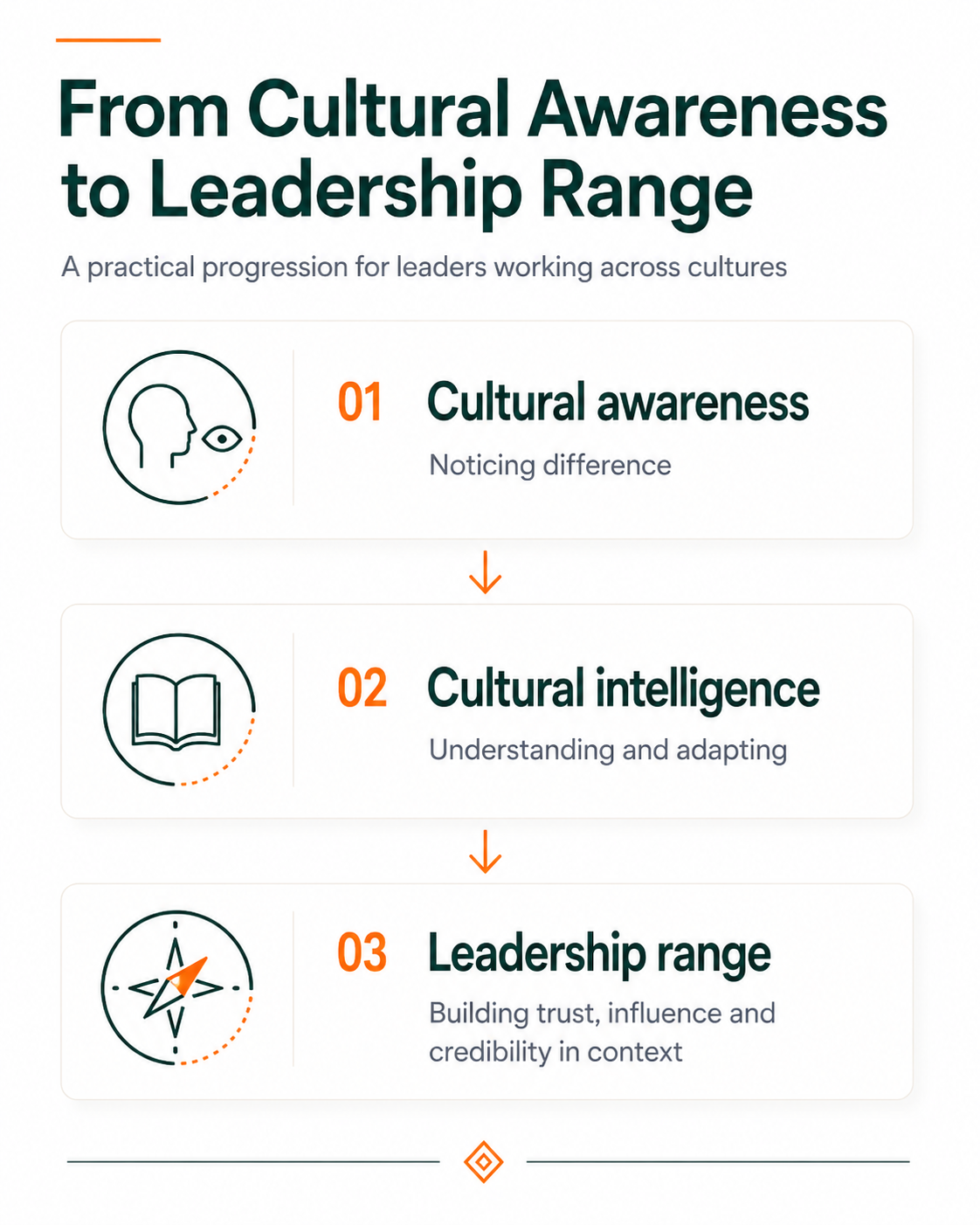
The central challenge is not simply cultural awareness. It is leadership range.
A leader with range can stay grounded while adapting. They can listen without becoming passive, challenge without becoming abrasive, and build relationships without losing strategic clarity.
Studies on cross-border leadership suggest that cultural intelligence can contribute to leadership effectiveness in international contexts, beyond general intelligence and emotional intelligence alone (Rockstuhl et al., 2011). That does not mean cultural intelligence explains everything, but it reinforces the case for developing awareness, judgement and behavioural flexibility in global leadership roles.
Cross-cultural coaching and executive presence
Cross-cultural coaching is also closely linked to executive presence.
A leader’s presence is not interpreted in a vacuum. Confidence, authority, warmth, humility and decisiveness are all read through cultural expectations.
A leader may intend to appear confident but be read as arrogant. Another may intend to appear collaborative but be read as uncertain. A leader may use humour to build connection, but the humour may not travel. A leader may use silence to show respect, while others interpret the silence as disengagement.
This is why cross-cultural leadership is not only about communication. It is about perception, meaning and trust.
💬 Coaching Cue: What might your stakeholders be reading from your pace, directness, silence or challenge that you did not intend?
The deeper value: adapting without becoming someone else
The best cross-cultural coaching does not give leaders a script. It helps them become more awake to context.
That includes:
noticing assumptions before acting on them
asking better questions about stakeholder expectations
recognising when a familiar strength is not landing
understanding where trust is being built or lost
adapting behaviour without losing personal authority
making the implicit more explicit
This is particularly important for senior leaders because they are often judged quickly. People watch not only what they say, but how they say it, who they listen to, how they respond to challenge and whether their behaviour fits the local expectations of credible leadership.
Final thought
Cross-cultural coaching is not about memorising etiquette, collecting cultural facts or becoming fluent in every local norm.
It is about building trust, influence and credibility when expectations are not shared.
For senior leaders, that often means developing greater awareness, flexibility and range. Not to dilute their leadership, but to make it more effective across contexts.
When expectations shift across cultures, leadership needs greater range.
Leading across cultures?
When expectations shift across cultures, leadership needs greater range.
Cross-cultural executive coaching helps senior leaders adapt to different expectations around trust, authority, communication and influence, without becoming inauthentic or losing clarity. It is particularly useful when a leader is moving into a broader global role, managing international stakeholders, or rebuilding credibility across cultural boundaries.
FAQ: Cross-cultural coaching
-
Cross-cultural coaching is a developmental coaching process that helps leaders work more effectively across cultural, geographical, organisational and professional differences. It focuses on how trust, authority, communication, influence, decision-making and disagreement are interpreted in different contexts, so leaders can adapt with greater awareness, credibility and range.
-
Cross-cultural coaching is useful for senior leaders, executives, managers and high-potential leaders who work across countries, regions, languages, cultures or diverse stakeholder groups. It is especially relevant for leaders moving into global roles, leading multicultural teams, working in matrix organisations or influencing international stakeholders.
-
No. Cultural awareness training usually teaches general concepts, frameworks or information about cultural difference. Cross-cultural coaching applies those ideas to the leader’s real context, stakeholders and challenges. It helps leaders understand how they are being interpreted and develop more effective ways to build trust, influence and credibility.
-
No. National culture can matter, but it is only one part of the picture. Cross-cultural coaching may also explore organisational culture, professional culture, leadership expectations, power dynamics, communication norms and the assumptions that shape how people work together.
-
Cross-cultural coaching can help with stakeholder influence, global leadership transitions, communication style, feedback, trust-building, conflict, decision-making, executive presence and leading multicultural teams. It is particularly useful when a leader is capable, but their style is being misread or their influence is not landing as intended.
-
It helps senior leaders notice their own assumptions, understand how others may be interpreting their behaviour, and develop greater leadership range. The aim is not to become someone else, but to adapt with more judgement, clarity and confidence across different cultural contexts.
📚References
Ang, S., Van Dyne, L., Koh, C., Ng, K.Y., Templer, K.J., Tay, C. and Chandrasekar, N.A. (2007) ‘Cultural intelligence: its measurement and effects on cultural judgment and decision making, cultural adaptation and task performance’, Management and Organization Review, 3(3), pp. 335–371.
Den Hartog, D.N., House, R.J., Hanges, P.J., Ruiz-Quintanilla, S.A. and Dorfman, P.W. (1999) ‘Culture specific and cross-culturally generalizable implicit leadership theories: are attributes of charismatic/transformational leadership universally endorsed?’, The Leadership Quarterly, 10(2), pp. 219–256.
Dickson, M.W., Den Hartog, D.N. and Mitchelson, J.K. (2003) ‘Research on leadership in a cross-cultural context: making progress, and raising new questions’, The Leadership Quarterly, 14(6), pp. 729–768.
Grant, A.M., Curtayne, L. and Burton, G. (2009) ‘Executive coaching enhances goal attainment, resilience and workplace well-being: a randomised controlled study’, The Journal of Positive Psychology, 4(5), pp. 396–407.
Hammer, M.R., Bennett, M.J. and Wiseman, R. (2003) ‘Measuring intercultural sensitivity: the Intercultural Development Inventory’, International Journal of Intercultural Relations, 27(4), pp. 421–443.
Jones, R.J., Woods, S.A. and Guillaume, Y.R.F. (2016) ‘The effectiveness of workplace coaching: a meta-analysis of learning and performance outcomes from coaching’, Journal of Occupational and Organizational Psychology, 89(2), pp. 249–277.
Leung, K., Ang, S. and Tan, M.L. (2014) ‘Intercultural competence’, Annual Review of Organizational Psychology and Organizational Behavior, 1, pp. 489–519.
Meyer, E. (2014) The Culture Map: Breaking Through the Invisible Boundaries of Global Business. New York: PublicAffairs.
Rockstuhl, T., Seiler, S., Ang, S., Van Dyne, L. and Annen, H. (2011) ‘Beyond general intelligence and emotional intelligence: the role of cultural intelligence in cross-border leadership effectiveness’, Journal of Social Issues, 67(4), pp. 825–840.
Rosinski, P. (2003) Coaching Across Cultures: New Tools for Leveraging National, Corporate and Professional Differences. London: Nicholas Brealey.
Van Dyne, L., Ang, S., Ng, K.Y., Rockstuhl, T., Tan, M.L. and Koh, C. (2012) ‘Sub-dimensions of the four factor model of cultural intelligence: expanding the conceptualization and measurement of cultural intelligence’, Social and Personality Psychology Compass, 6(4), pp. 295–313.

Under the Surface
A monthly briefing on the hidden dynamics shaping senior leadership, teams and change…
Read next…