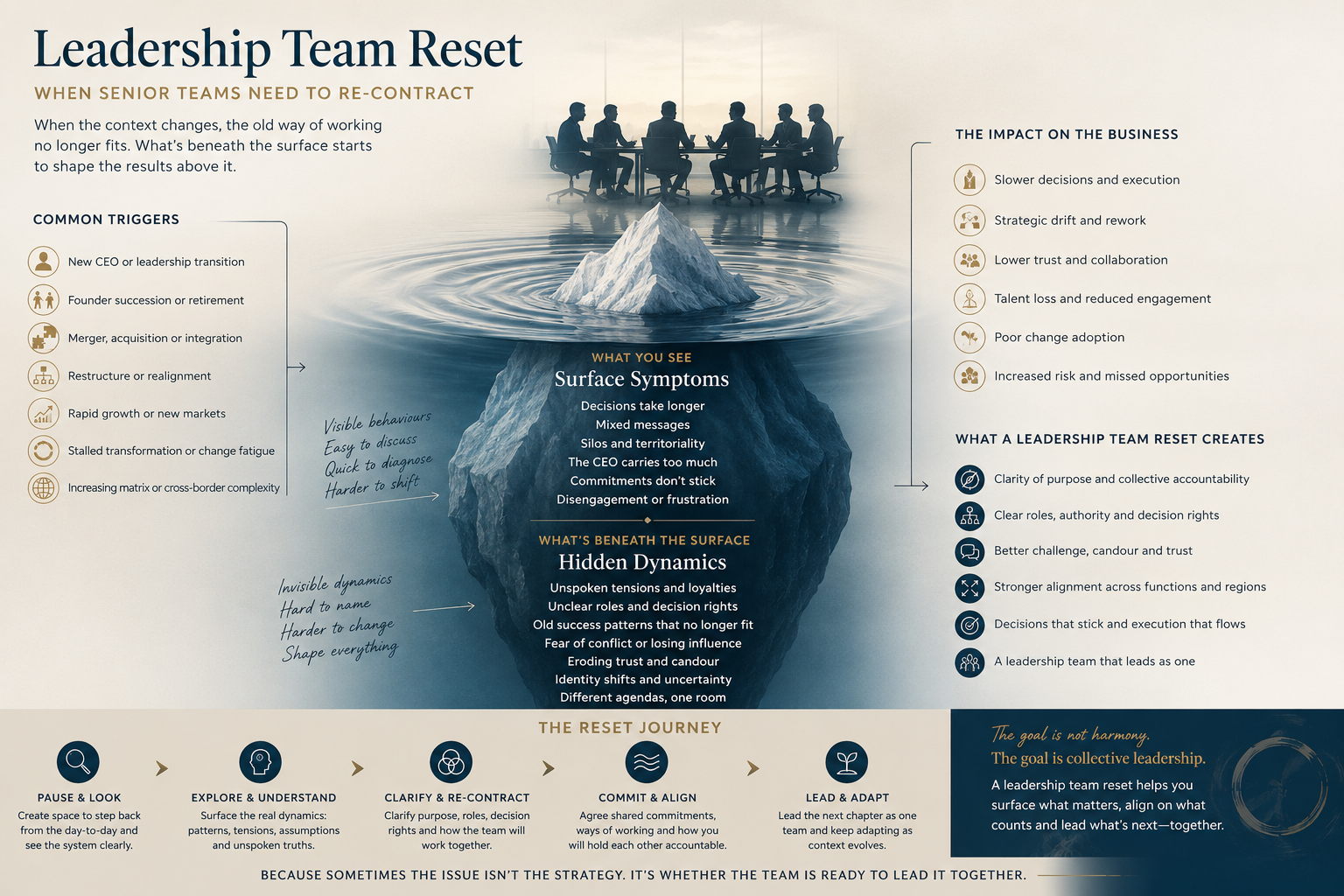
The Psychology of Organisational Transformation in Matrix Organisations: A Field Guide for Senior Leaders
If you’re accountable for a major organisational transformation – digital, operating model, culture, “future of work” – you’ve probably lived some version of this story:
• The strategy made sense.
• The business case was solid.
• The deck was tight.
• The programme team was capable.
And yet… 12–24 months in, progress is slow, politics are high, key people are exhausted – and the transformation is quietly rebranded, re-scoped or retired.
It’s tempting to blame “resistance to change”, “the wrong people”, or “poor execution”.
But in most complex, matrix organisations, transformation fails psychologically before it fails operationally.
This field guide gives senior leaders in matrix organisations three practical lenses – Individual, Team and System – plus concrete questions you can use to map the psychology of your own transformation.
This comes from working with hundreds of leaders driving large-scale transformation in global matrix organisations – and seeing the same patterns repeat. Take a look at executive coaching for transformation leaders page to discover more
💬 Coaching Cue: If you look at your current transformation honestly, what’s the uncomfortable truth that never quite makes it into the steering committee pack?
Why organisational transformation in matrix organisations is uniquely hard
All large organisations are political and emotional. Matrix organisations add three extra layers of difficulty:
Ambiguous power
Dual reporting lines.
Global vs regional vs functional authority.
“I’m accountable, but I don’t fully control the resources.”
Multiple strategic initiatives stacked on top of business as usual.
“Transformation” as an extra job, not a different job.
Constant pressure to deliver visible wins while fixing underlying systems.
Cross-cultural complexity
Different national cultures, professional cultures (IT vs Ops vs Finance), and legacy cultures from past acquisitions.
Different norms around hierarchy, challenge, conflict and risk.
On paper, you have a transformation plan. In reality, you are trying to change behaviour, identity, status and security across a messy, global human system.
To navigate that, you need to think about transformation at three psychological levels:
The individual leader
The leadership / transformation team
The wider organisational system
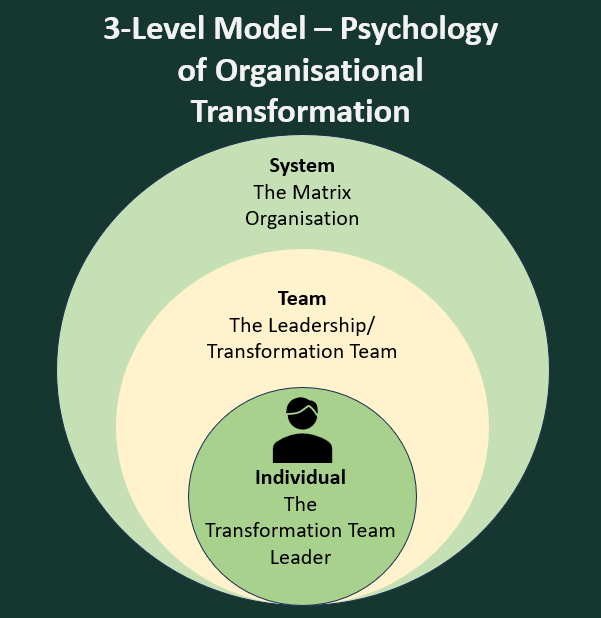
Figure: 3-level psychology of organisational transformation - starting with the intrapersonal to the interpersonal and the system as a whole
Level 1: The transformation leader’s inner game
Organisational transformation is not just an operational challenge. For the people leading it, it is an identity challenge.
Common psychological patterns in transformation leaders
You’ll recognise some of these – maybe in yourself:
Expert-to-enterprise shift
You were successful because of deep functional expertise (technology, operations, finance). Now you’re expected to operate as an enterprise-level leader – influencing across the system, not just inside your lane. That shift is psychologically uncomfortable.Over-responsibility and heroics
You care deeply. You step in, fix things, absorb problems. In a matrix, that can quietly turn you into the system’s shock-absorber – the person who makes an unworkable setup just about work through sheer effort.Perfectionism under scrutiny
High standards are good. But under board / ExCo pressure, perfectionism quickly becomes paralysis, over-control, or an inability to prioritise what actually matters for the transformation.Derailers under pressure
Under sustained pressure, the “dark side” of strengths shows up (take a look at how this shows up in our Hogan Coaching Programme):the visionary becomes over-optimistic and dismissive of risk,
the analytical leader becomes critical and nit-picky,
the caring leader avoids hard decisions to protect people.
Cognitive biases that quietly derail you
Even senior leaders aren’t immune to basic cognitive biases:
Confirmation bias – listening hardest to stakeholders who support the change, downplaying signals of real risk.
Status quo bias – underestimating how much you yourself are attached to existing ways of working, relationships and status.
Optimism bias – consistently overestimating how quickly people will change behaviour once the “rationale” is clear.
Practical questions for Level 1
If you’re honest, ask yourself:
Where am I over-functioning for the system – doing more than my fair share to make this transformation work?
Which strengths of mine become counter-productive under pressure?
What part of the status quo am I more attached to than I’m admitting – role, identity, control, relationships?
💬 Coaching Cue: If someone who knows you well described how you lead under pressure, what would they say is helping your transformation – and what might quietly be hurting it?
Level 2: The executive / transformation team as a system
Most organisational transformations stand or fall on a handful of leadership teams:
The Executive Committee / C-suite
The Transformation / Programme / Portfolio leadership team
Key functional / regional leadership teams
On PowerPoint, they’re aligned. In reality, they’re human systems with patterns.
If you want to go deeper on what really separates elite leadership teams from those that just “get by”, take a look at. High-Performing Leadership Teams: Behind the Scenes of Elite Executive Team Dynamics
Common team dynamics in transformation
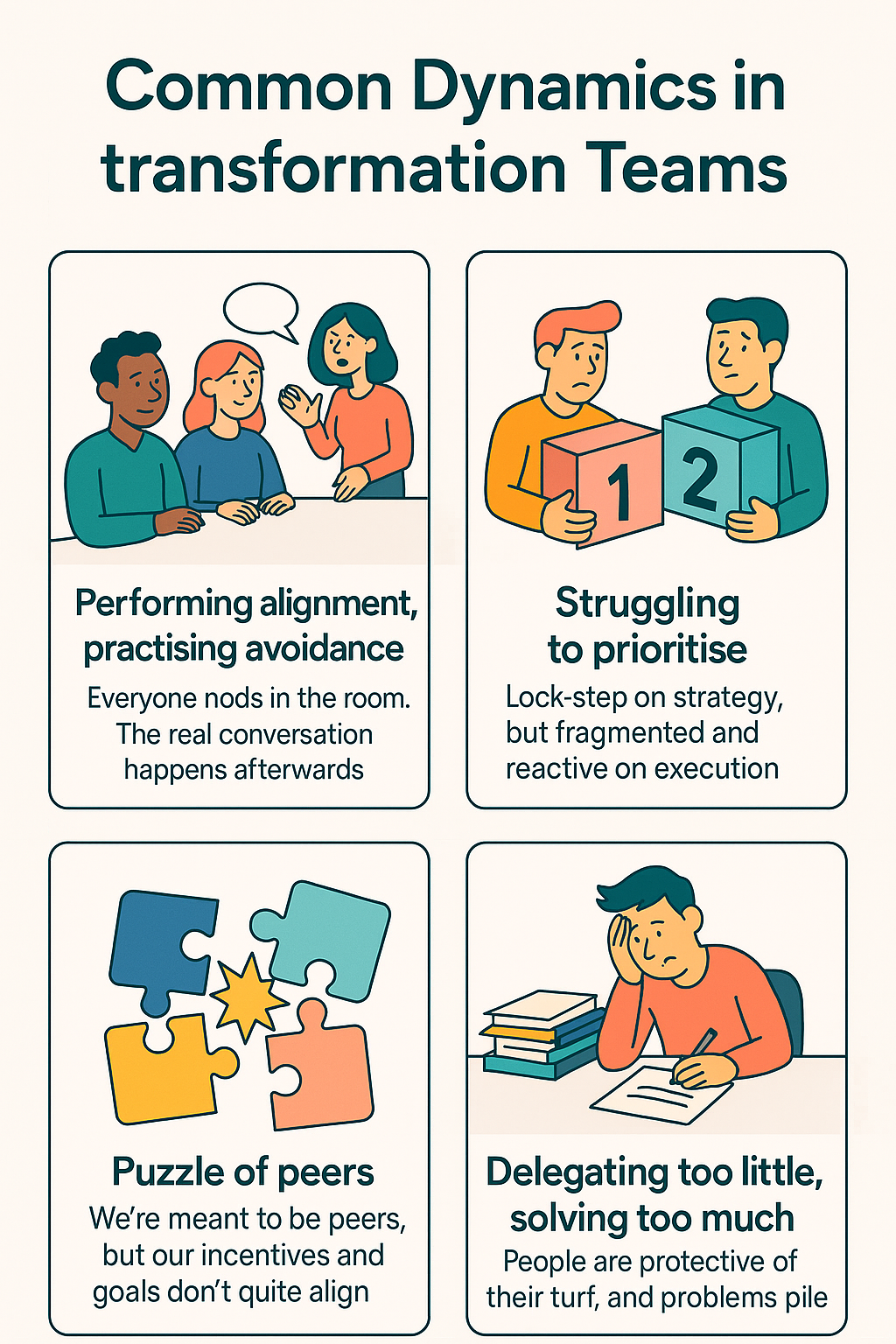
Figure: Common dynamics in transformation teams: performing alignment while practising avoidance, struggling to prioritise, the puzzle of peers, and delegating too little while solving too much.
Patterns I see repeatedly in matrix organisations:
Performing alignment; practising avoidance
In the room, everyone nods. The real conversation happens in smaller groups afterwards. Decisions unpick quietly, not publicly.Triangulation and “meeting after the meeting”
People talk about each other more than they talk to each other. Difficult messages are passed via third parties, not direct.Fake harmony, real resentment
Teams score well on “we get on” and “we’re collegial”, but badly on constructive challenge, accountability and follow-through. Conflict moves underground.Unequal psychological risk
Some people feel safe to speak up; others don’t. Typically:central HQ vs local countries,
dominant function vs support functions,
“insiders” vs perceived “outsiders” (new joiners, acquired units).
💬 Coaching Cue: What is the one conversation your leadership or transformation team keeps postponing – and what price are you already paying for that delay?
Why this matters
You can have the right structure and governance on paper. If your senior teams:
can’t disagree productively,
can’t make and stick to decisions,
can’t model the behaviours you’re asking from everyone else,
your transformation becomes a performance, not a reality.
Practical questions for Level 2
With your leadership / transformation team in mind:
What are the conversations we never quite get to, or keep postponing?
Who consistently speaks up – and who rarely does? What does that tell us?
Where do decisions actually get made – in the room, or in corridors and side chats?
Good team coaching and facilitation here is not about “offsites and bonding”. It’s about re-wiring how the team thinks, talks and decides under pressure.
Level 3: The matrix organisation as a living system
Matrix organisations are often sold as a way to be “more collaborative and agile”.
Psychologically, they create:
chronic role and goal conflict,
unclear authority, and
multiple, competing loyalties.
All of this shows up in your transformation.
The system-level forces you’re up against
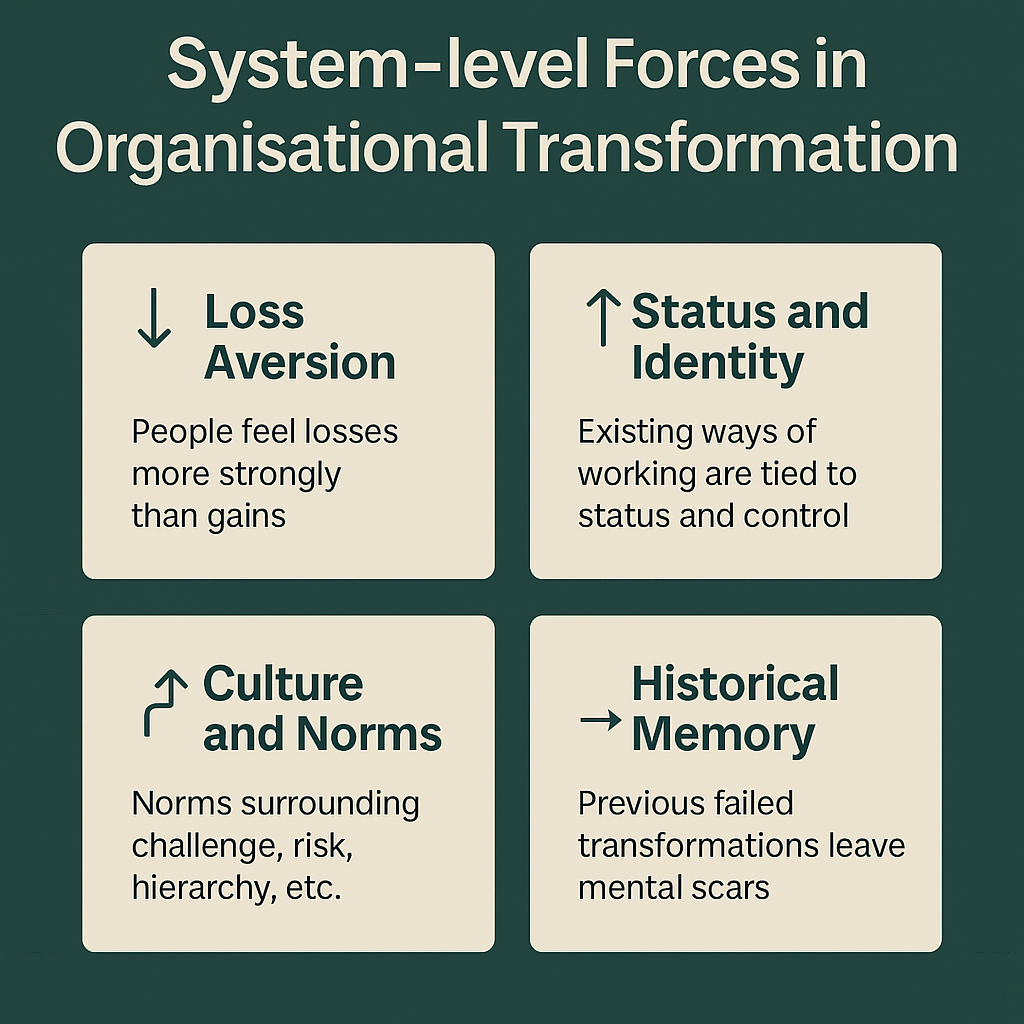
Figure: System-level forces in organisational transformation
A few of the big ones:
Loss aversion
People feel losses (status, control, certainty, local autonomy) more strongly than equivalent gains. From their perspective, transformation often means “my function loses power” or “my region loses headcount”, no matter what the slides say.Status and identity
For many senior leaders, their identity is tied to the current way of working:“I’m the person who knows how this system works.”
“I’m the one people come to for decisions.”
Transformation can feel like a threat to that identity – even when they intellectually support it.
Culture and norms
In some contexts, direct challenge is respected; in others, it’s dangerous. In some, escalation is normal; in others, it’s viewed as failure. Rolling out a standard “speak up” or “agile” template without attending to these underlying norms is a recipe for surface compliance and inner resistance.Historical memory
People remember previous “transformations” and “change initiatives”: the ones that quietly died, the ones that cost jobs, the ones that were leader vanity projects. That history sits in the room, unspoken.
💬 Coaching Cue: Who, specifically, stands to lose status, budget or control if this transformation succeeds – and how is that loss already showing up in their behaviour?
If you want to explore the lived experience of working in a matrix and the skills it demands in more depth, take a look at Thriving in Matrix Organisations.
Practical questions for Level 3
At a system level, ask:
Who stands to lose what if this transformation actually works – power, budget, autonomy, identity? Have we named that honestly?
Which cultural norms (national, functional, corporate) make it hard to do what we’re asking people to do?
What’s the emotional history of change here? Are we treating this as the first transformation in a vacuum, or acknowledging the past?
Systemic and psychodynamic work here is about making the invisible drivers of behaviour visible enough that you can design around them, not just push harder on comms and training.
Where the challenge is spread across sponsors, functions, stakeholders, routines and informal power, transformation consultancy can help map and shift the wider leadership system around the change.
Get practical psychology prompts for your current transformation
1–2 emails a month with questions, checklists and tools for organisational transformation leaders in matrix organisations.
Next step
If you’re leading change in a complex, matrix organisation:
I coach transformation leaders to build alignment, influence stakeholders, and keep delivery moving - without burning political capital.
Five psychological failure modes in organisational transformation
Across these three levels, there are some recurring “failure modes” I see in matrix organisations.
If you spot these early, you have options. If you don’t, they quietly drain momentum, budget and your credibility – long before anyone uses the word ‘failure’.
1. We planned the change, not the people
The transformation plan covers processes, systems and structures. There is no real plan for:
who needs to behave differently,
what those behaviours actually are,
what makes them realistic or unrealistic in the current environment.
Instead: treat behavioural change as a core workstream, not an afterthought. Identify the 5–10 leader behaviours that matter most and design experiments, support and measurement around them.
2. We upgraded the organisation chart, not the leadership habits
New boxes and reporting lines are designed. The old habits stay:
leaders still hoard decisions,
meetings still default to information-sharing,
conflict is still avoided or escalated, not worked through.
Instead: be explicit about what leadership habits must die for the new structure to live – and model those visibly at the top.
3. We underestimated politics and overestimated buy-in
Assuming that:
a rational case + a “compelling vision” = real commitment
…ignores loss aversion, status threats and informal power networks.
Instead: do a serious stakeholder and power map. Ask:
Who actually has the power to stall or accelerate this?
What do they fear losing?
What would “winning” look like for them?
Then design your engagement strategy around that reality, not the org chart.
4. We ignored culture and cross-cultural dynamics
Global templates are rolled out with minimal adaptation to:
local norms around authority and risk,
language and communication styles,
different understandings of “good leadership”.
Instead: treat intercultural psychological safety as a transformation risk factor. Hold real conversations with local leaders about how people challenge, escalate and raise risk in their context – and adjust your expectations and formats accordingly.
5. We treated transformation as a project, not an identity shift
Transformation is run as a project with a start and end date, milestones and RAG status. Underneath, people are being asked to:
redefine what good looks like in their role,
let go of familiar ways of working,
question long-standing beliefs about “how this place works”.
Instead: acknowledge openly that transformation is an identity shift for the organisation and for key groups. Build spaces (coaching, team work, structured reflection) where people can think and feel their way through that shift, not just tick off tasks.
Take a look at our Executive and Team Coaching Programmes to understand more
A simple psychological checklist for transformation leaders
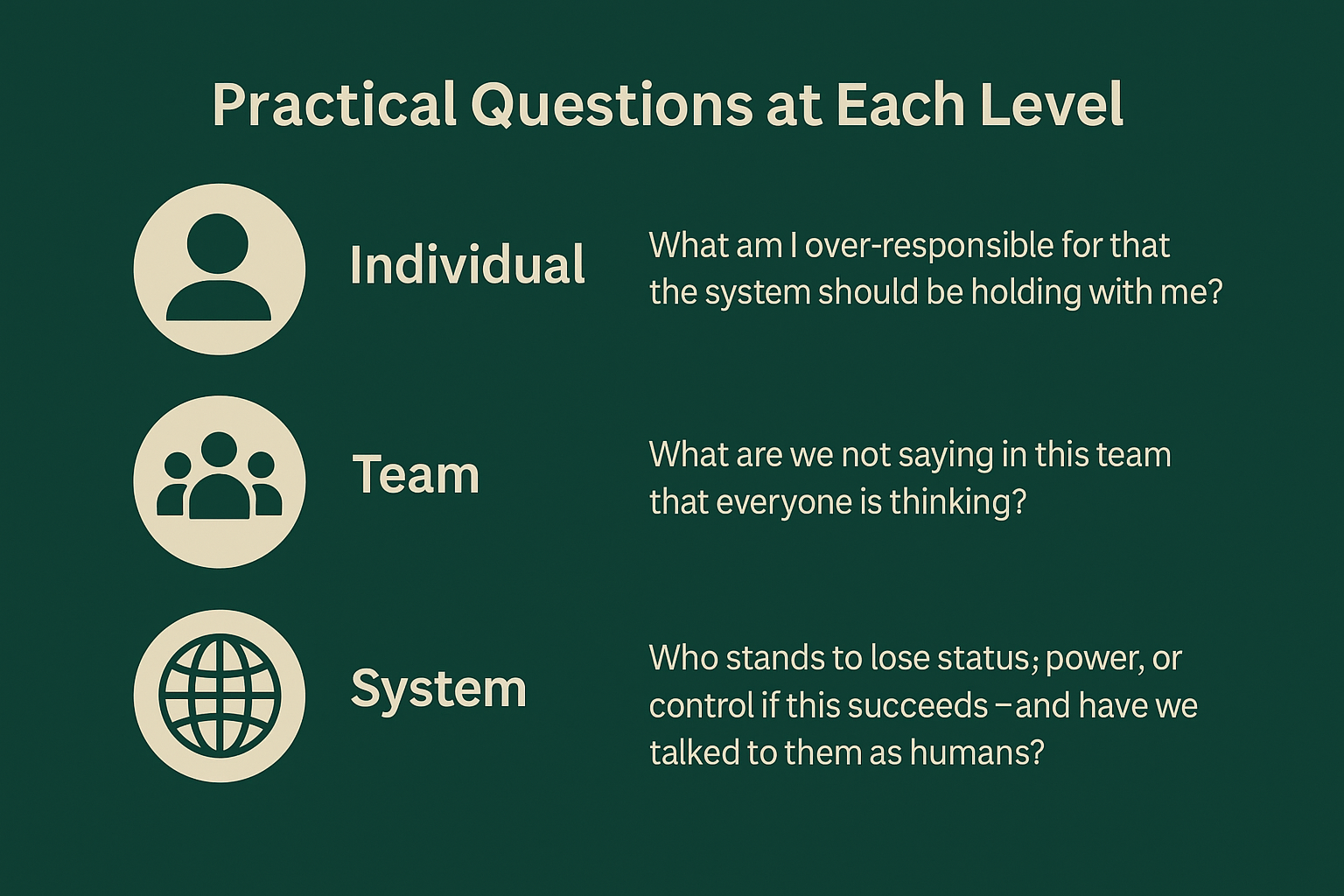
Figure: Practical questions for transformation leaders to ask at the individual, team and system levels.
You don’t need a PhD in psychology to use this field guide. You do need to look at your transformation through these three lenses on purpose.
Here’s a starting checklist you can use with your team or on your own:
Individual (your inner game - intrapersonal)
What am I over-responsible for that the system should be holding with me?
Where do my strengths become liabilities under pressure in this role?
Who tells me the uncomfortable truth – and when was the last time they did?
Team (leadership / transformation team - interpersonal)
What are we not saying in this team that everyone is thinking?
How do we behave when we disagree? (Avoid, smooth over, escalate, or work it through?)
Who in this team feels safest to challenge me – and who doesn’t feel safe at all?
System (matrix organisation - systemic)
Who stands to lose status, power, or control if this succeeds – and have we talked to them as humans, not just stakeholders?
What cultural norms (national, functional, corporate) are we asking people to go against?
If we asked people on the front line, “what’s really changing?” what would they say – and would we like the answer?
You don’t need to fix everything at once. But ignoring these questions guarantees you’ll be surprised later.
FAQ: Frequently asked questions for transformation leaders
Q1. Why focus on the psychology of organisational transformation when I already have a solid plan and governance?
Because most failures don’t come from the plan; they come from how people think, feel and behave under pressure. Research on change shows that a large share of transformation efforts underperform or fail, often due to human factors such as resistance, loss aversion and leadership behaviour, rather than flaws in the technical design of the change.
This article gives you lenses (Individual, Team, System) to spot those psychological dynamics early and lead them deliberately, not just hope the plan carries you.
Q2. What makes organisational transformation in matrix organisations different from “normal” change?
Matrix organisations add ambiguity (dual reporting, shared accountability), chronic overload (multiple programmes on top of business as usual) and cross-cultural complexity. Studies on matrix structures highlight exactly these pain points: unclear authority, conflicting priorities and communication challenges across global and functional lines.
That combination means you’re not just changing processes – you’re asking people to renegotiate power, identity and loyalty across a messy system.
Q3. How can I use this field guide practically as a senior leader?
Two ways. First, as a diagnostic: pick one level (Individual, Team or System) and work through the questions with brutal honesty, either alone or with a trusted colleague. Second, as a conversation tool: lift a few questions into your next exec / transformation team meeting and see what people are willing to name. You don’t need to answer every question at once; you do need to surface what everyone can already feel.
Q4. Where does executive coaching actually help in this context – and where doesn’t it?
Executive coaching helps when it’s anchored in your real transformation mandate: clarifying your role, surfacing your patterns under pressure, changing how your team works, and mapping/stewarding the politics of the matrix. It doesn’t help if it’s treated as a private self-help space with no link to the organisational work, or as a way to “fix” individuals while ignoring team and system dynamics. The most useful coaching keeps all three levels in view.
So what do you do with this?
If you’re a senior leader or Head of Transformation in a matrix organisation, this is the work:
• See the psychological dynamics early.
• Name them in the right rooms.
• Design your leadership, your team’s habits and your engagement approach with them in mind – not in denial of them.
You already have a strategy, a plan and a slide deck.
The leaders who land complex organisational transformation in the matrix are the ones who are willing to work on the psychology of the system with the same seriousness as they work on the Gantt chart.
💬 Coaching Cue: If this transformation failed two years from now, what would you wish you had spoken up about or acted on six months earlier than you did?
🔍 Explore how I work with organisational transformation leaders
Get the details on my Executive Coaching approach for transformation leaders in matrix organisations.
👉 Executive coaching for transformation leaders
🔒 Book a confidential consultation
30 minutes to map the psychology of your transformation and see whether it would be useful to work together – no obligation.
👉 Book a confidential consultation
📚 References
Beer, M. and Nohria, N. (2000) ‘Cracking the code of change’, Harvard Business Review.
Davis, S.M. and Lawrence, P.R. (1978) ‘Problems of matrix organizations’, Harvard Business Review.
Errida, A. & Lotfi, B. (2021) ‘The determinants of organizational change management success: Literature review and case study’, International Journal of Engineering Business Management, 13, pp. 1–15.
Keller, S. and Aiken, C. (2009) ‘The inconvenient truth about change management’, McKinsey Quarterly.
Khaw, K.W., Alnoor, A., Al-Abrrow, H., Tiberius, V., Ganesan, Y. & Atshan, N.A. (2022) ‘Reactions towards organizational change: A systematic literature review’, Current Psychology.
Lukinaitė, E. (2017) ‘Mindset of employees working in a matrix organisational structure’, Business: Theory and Practice.
Oreg, S. & Berson, Y. (2019) ‘Leaders’ impact on organizational change: Bridging theoretical and methodological chasms’, Academy of Management Annals, 13(1), pp. 272–307.
Rehman, N. (2021) ‘The psychology of resistance to change’, Frontiers in Psychology, 12.
Stouten, J., Rousseau, D.M. & De Cremer, D. (2018) ‘Successful organizational change: Integrating the management practice and scholarly literatures’, Academy of Management Annals, 12(2), pp. 752–788.
Sy, T. & D’Annunzio, L.S. (2005) ‘Challenges and strategies of matrix organizations: Top-level and mid-level managers’ perspectives’, Human Resource Planning, 28(1), pp. 39–48.

Under the Surface
A monthly briefing on the hidden dynamics shaping senior leadership, teams and change…
Read Next…