Change fatigue at work: signs, hidden costs, and what to say instead
If risks keep arriving late, and delivery depends on “energy” rather than clarity, you are not dealing with a motivation problem. You might be dealing with change fatigue.
Change fatigue at work builds when change demands outstrip time, control, and energy (Bernerth, Walker and Harris, 2011). It rarely shows up as open resistance. More often it looks like quiet withdrawal: compliance without commitment, surface agreement, and a growing sense that nothing sticks.
When people are tired from constant reprioritisation, overlapping initiatives, and yet another “change wave”, leaders often try to protect momentum by leaning harder on optimism (Johnson et al., 2016; de Vries and de Vries, 2023). Not as a slogan, but as an organisational norm: upbeat updates, solution-before-problem, and subtle pressure to be “constructive”.
That is where toxic positivity creeps in: not as hope, but as reality suppression. It can silence risk, delay bad news, and replace honest sense-making with reassurance.
This guide is for leaders navigating heavy change: what change fatigue looks like, why it fuels toxic positivity, the hidden costs to delivery, and the language that keeps truth-telling alive without turning the room into a complaint festival. If you are leading a major transformation programme, there’s a dedicated section below on how this pattern shows up in programme governance and steering committee dynamics.
If you’re leading change in a matrix, you’ll also value my field guide to the psychology of transformation in matrix organisations.
In this guide…
Spot the signs (behavioural, emotional, operational)
Name the risk early (scripts you can use in the next meeting)
Reduce fatigue without slowing delivery (five levers leaders actually control)
💬 Coaching Cue: What is the uncomfortable truth that is not making it into your leadership update?
What is change fatigue at work?
Change fatigue is what happens when an organisation’s capacity to absorb change is exceeded for long enough that people stop engaging fully (Bernerth, Walker and Harris, 2011; Meyer and Stensaker, 2006). In the organisational change literature, it is commonly described as a build-up of apathy, powerlessness, and emotional exhaustion when change demands outstrip resources like time, control, and energy (Bernerth, Walker and Harris, 2011). See the Coaching & Behaviour Change Glossary for related concepts (change fatigue, decision fatigue, cognitive load).
It is not simply “resistance”. It is often an adaptive response to overload, for example:
too many changes running at once
constant priority shifts with unclear trade-offs
high cognitive load from new processes, systems, and ways of working
low autonomy or decision clarity, so effort feels wasted
repeated “this time it’ll be different” messaging without felt support
The result is rarely dramatic rebellion. It is more often drift: meetings full of motion, little traction afterwards, and an increase in quiet coping behaviours such as delay, avoidance, and doing the minimum needed to stay out of trouble.
Signs of change fatigue at work
Change fatigue is easy to miss because it hides behind “fine.” Look for these signals:
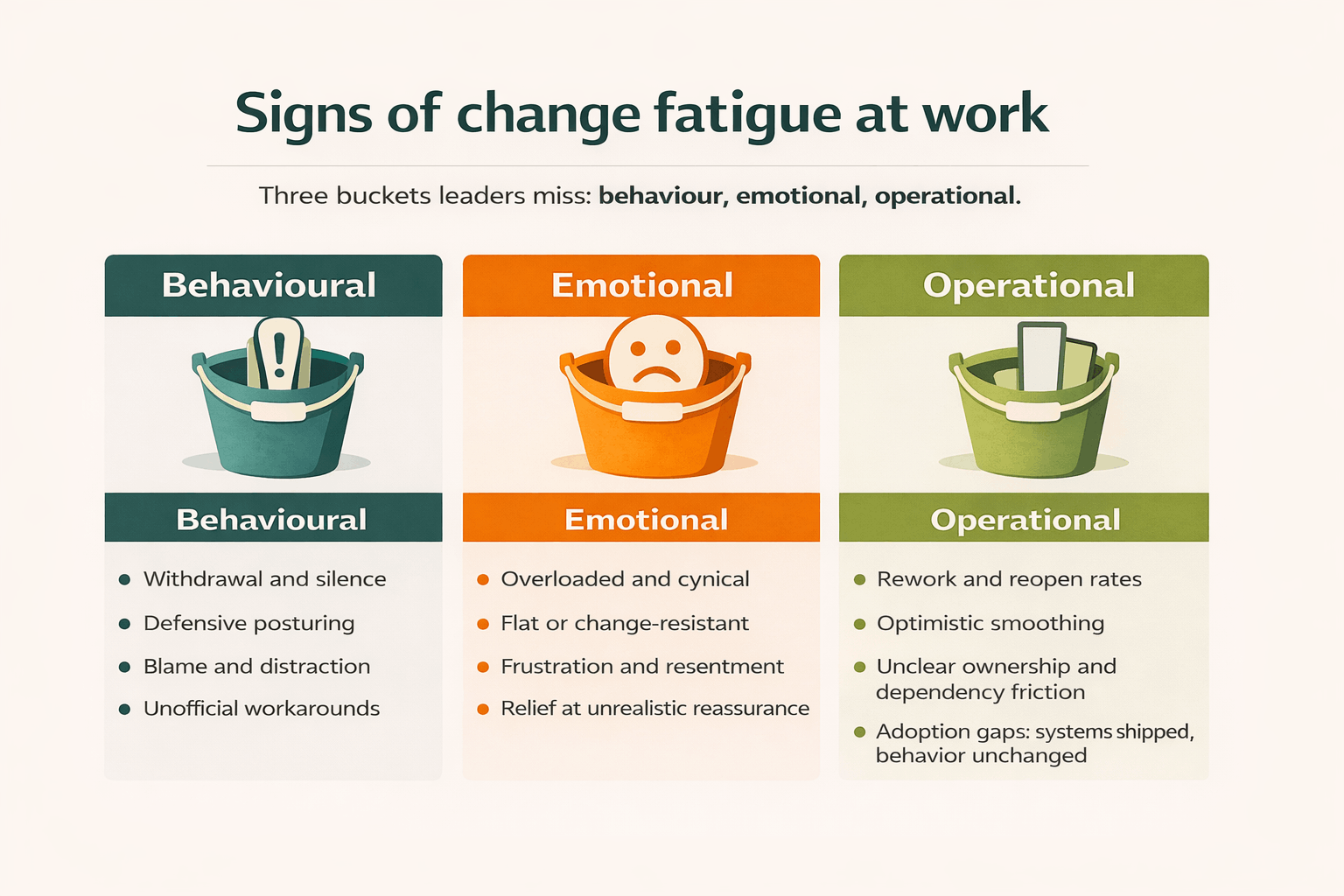
Signs of Change Fatigue at Work: Behavioural, Emotional and Operational Signals
Behavioural signals
People stop challenging assumptions in senior meetings
Attendance is high, engagement is low
Stakeholders agree quickly, then delay execution
Teams default to “we’ll do it later” or “we’re waiting on X”
Decision-making slows or becomes overly cautious
Workarounds multiply
Emotional signals
Irritability, flatness, detachment, cynicism
Reduced tolerance for ambiguity
“Learned helplessness” language (“nothing sticks here”)
Burnout signalling (“I can’t take another change initiative”)
If what you’re seeing is stress reactivity and shutdown, this is relevant:Resilience Coaching for Leaders.
Operational signals
Increased rework and reopen rates
Slippage hidden by optimistic reporting
Unclear ownership and escalating dependency friction
Adoption gaps: systems shipped, behaviour unchanged (Johnson, Bareil, Giraud and Autissier, 2016).
For a practical behaviour-stickiness playbook, see Tiny Habits for Leaders: Make Change Stick
The tell: when progress depends on “energy” rather than “clarity,” you’re in danger.
Next step
If change fatigue is showing up as silence, spin, or late surprises:
You need a confidential, high-trust space to get accurate, surface what is not being said, and choose the next two moves that restore traction. If it helps, start with a short conversation to clarify what is true and agree next steps.
For transformation leaders: where change fatigue hides in programme governance
In transformation, change fatigue often spikes when governance creates constant motion without real trade-offs, particularly in contexts of repeated structural change and uncertainty (de Vries and de Vries, 2023). Look for these amplifiers:
overlapping initiatives with shared dependencies, but no sequencing
weekly reprioritisation that forces teams to start again
optimistic reporting that smooths risk until it becomes expensive
unclear decision rights that create churn and rework
sponsor pressure for certainty when the data is still emerging
What to say instead: scripts for leaders
Use these in leadership updates, risk reviews, and transformation governance conversations.
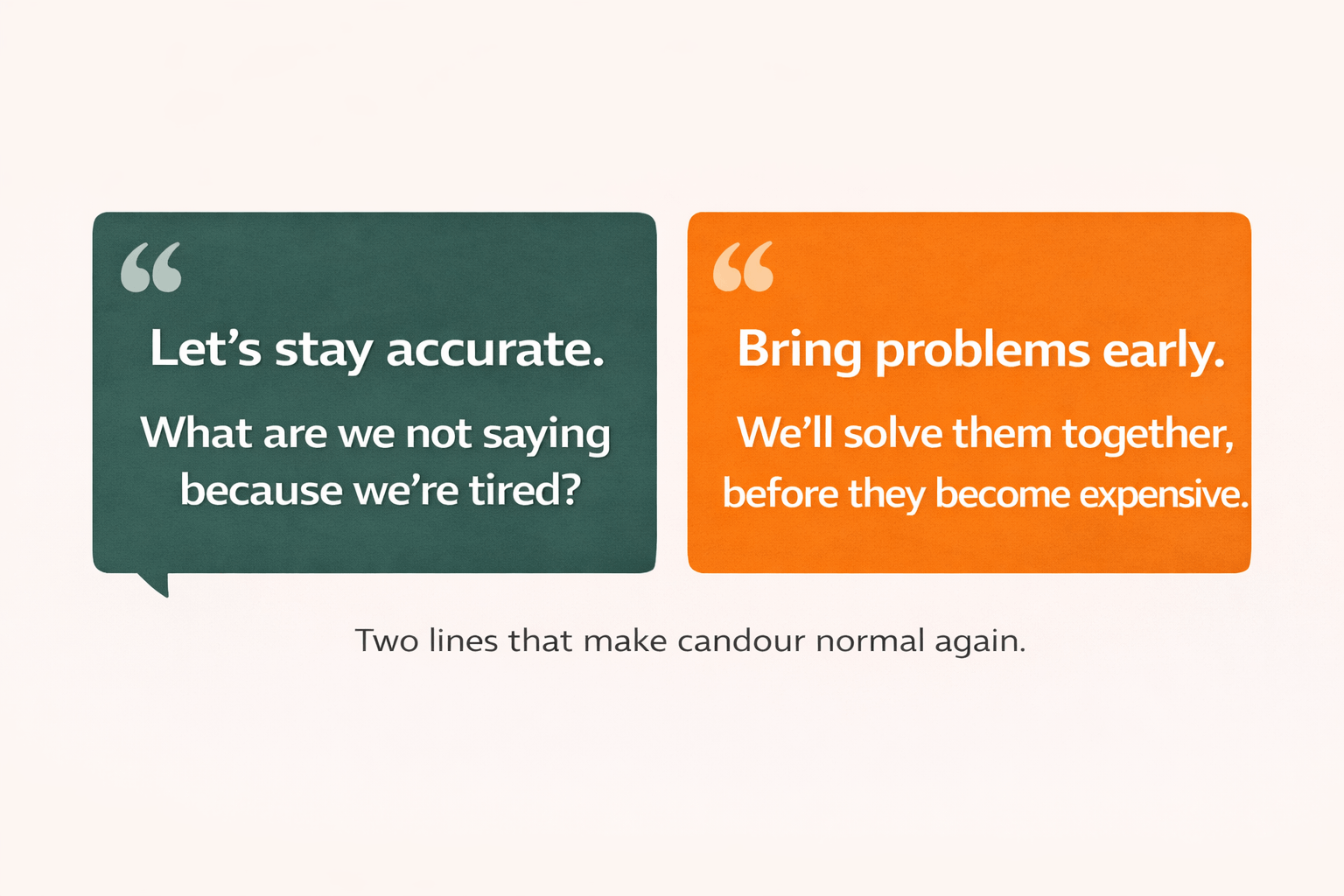
Instead of: “Let’s keep it positive.”
Say: “Let’s stay accurate. What are we not saying because we’re tired?”
Instead of: “No negativity in this meeting.”
Say: “This is a risk review. What’s one concern we need to surface early?”
Instead of: “Don’t bring problems without solutions.”
Say: “Bring problems early. We’ll solve them together - before they become expensive.”
Instead of: “That’s just resistance.”
Say: “What’s the signal in that concern - capability, capacity, clarity, or credibility?”
Instead of: “We’ve communicated this already.”
Say: “Where is confusion persisting - and what would make it clearer in one sentence?”
Instead of: “We’re nearly there.”
Say: “What’s the last 20% that’s exhausting people - and what support would actually help?”
Instead of: “We need alignment.”
Say: “We need real commitment. What are you not bought into yet?”
These lines make truth-telling the norm, without turning the room into a complaint festival.
If this is a repeated pattern in your Executive Committee or programme team, team coaching can help reset the norms, not just the language.
Toxic positivity at work is usually an unspoken norm, not a slogan
In change programmes, toxic positivity is rarely voiced as “stay positive.” It shows up as an injunctive norm: an unspoken expectation about what a “good” transformation citizen should do and say. People learn it fast - optimism and certainty are rewarded; doubt, fatigue, and frustration are treated as unhelpful or disloyal.
It also operates like an emotional display rule: certain emotions are “acceptable” in the room (confidence, energy, solution-focus), while others are implicitly discouraged (ambivalence, sadness, irritation, fear). When that rule is strong, people don’t stop feeling the emotions - they stop expressing them where it matters.
The predictable outcome is a climate of silence: concerns move into side conversations, risks are softened into vague language, and you get “alignment theatre” agreement in the meeting, inertia afterwards. Organisational silence is well-described as a barrier to change because it blocks information needed to detect and correct problems (Morrison and Milliken, 2000).
What it looks like in practice
Risks are raised as “minor issues” or parked as “details”
Meetings rush to reassurance and solutions before the problem is named
People privately vent, but publicly conform
Honest challenge is reframed as “negativity” or “lack of resilience”
Bad news arrives late, when it’s expensive
If you recognise this pattern, the work isn’t “more positivity.” It’s rebuilding a culture of accuracy: making it safe and expected to surface reality early, without blame or drama.
The unconscious dynamics: when anxiety creates “social defenses”
Here’s the layer most transformation content misses.
When uncertainty and pressure rise, groups and organisations don’t just “cope” consciously- they often mobilise defensive patterns to manage anxiety. In classic organisational psychodynamics, these can become social defense systems: routines and structures that protect people from embarrassment, threat, or anxiety - while also preventing learning and adaptation (Menzies, 1960).
In transformation, toxic positivity often behaves like a defense:
It reduces discomfort quickly (“we’re fine”).
It restores a sense of control (“we’ve got this”).
It avoids conflict (“let’s not go there”).
It keeps anxiety out of awareness.
Psychodynamically, this can resemble manic defenses (denial, omnipotence, idealisation): when painful realities are met with a push toward certainty, activity, or upbeat certainty.
And once a defense becomes “how we do things here,” it becomes hard to challenge - because challenging it reintroduces the anxiety it was designed to manage.
A practical group-dynamics lens (useful, not academic)
Bion’s work on groups describes how groups under pressure can shift from “work group” mode into basic assumption modes (dependency, fight–flight, pairing) (Bion, 1961).
In transformation, you’ll recognise them instantly:
Dependency: “Just tell us the answer / the sponsor will fix it.”
Fight–flight: “This programme is the problem / let’s escape to a new initiative.”
Pairing: “If we just hire X / launch Y, everything will be saved.”
If you want the “elite team” version of this, read High-Performing Leadership Teams.
None of this makes people “bad.” It makes them human under pressure. Your job as a leader is to bring the group back to the work: reality, trade-offs, and responsibility.
Why change fatigue fuels toxic positivity
When the system is tired, leaders feel pressure to:
protect morale
keep momentum
prevent panic
project confidence
That’s understandable. But under fatigue, the system can’t metabolise cheerleading. It needs capacity, clarity, and honest sense-making.
Toxic positivity becomes attractive because it’s quick:
it reduces immediate discomfort
it creates the appearance of alignment
it avoids conflict
it restores a sense of control
But it has a cost: it trades short-term reassurance for long-term risk.
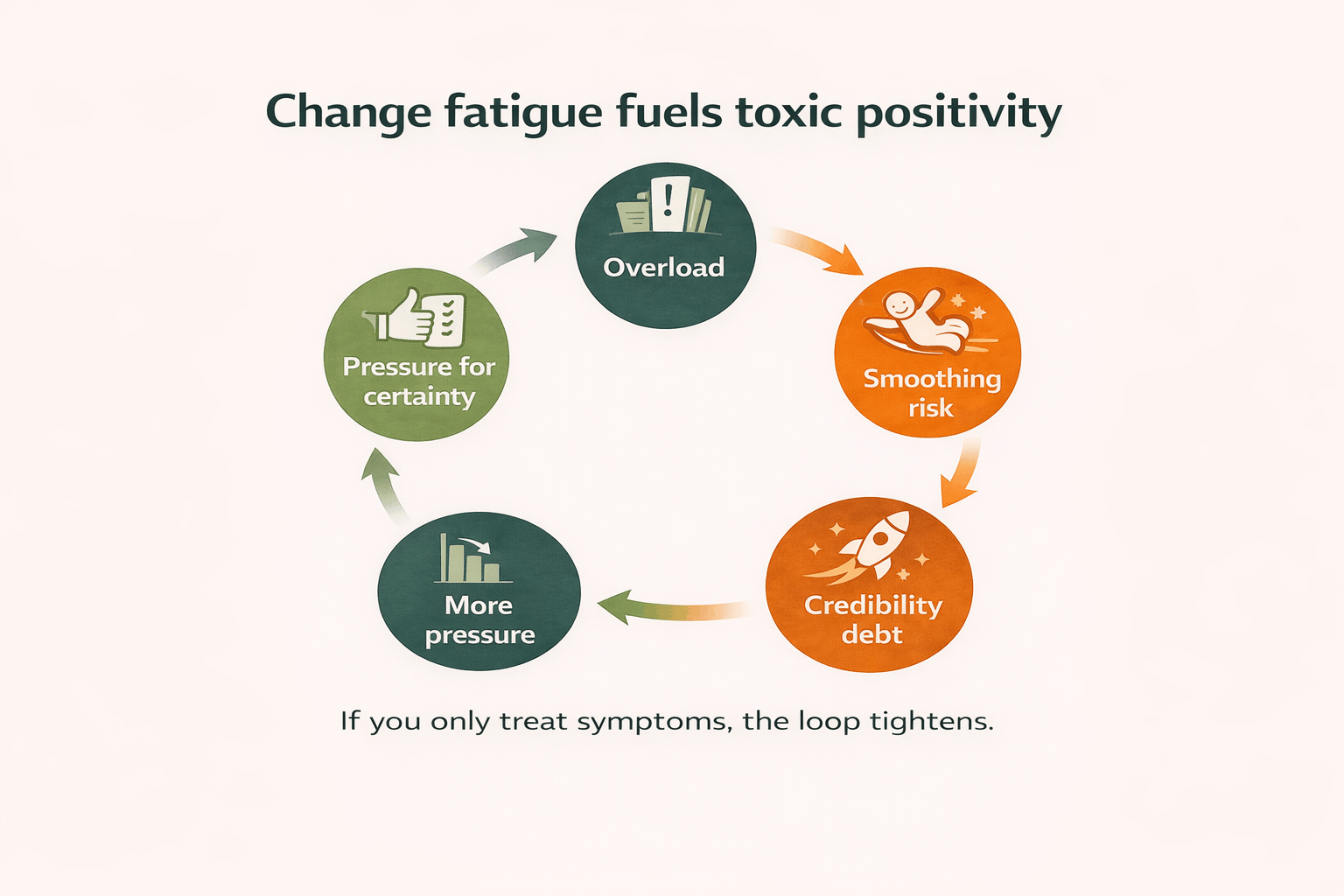
If you only treat symptoms, the loop tightens.
The hidden costs: what toxic positivity breaks at work
1) Risk discovery happens late
If the culture discourages hard truth, risks don’t disappear, they delay.
2) Decision quality declines
Teams make “positive” decisions with incomplete information. Reality comes back later as churn: revisiting, rework, escalation.
3) Psychological safety erodes
When people sense invalidation (“don’t be negative”), they protect themselves by staying quiet (Morrison and Milliken, 2000).
4) Commitment turns into compliance
People nod, then delay, avoid, or quietly resist—not because they’re “resistant,” but because they’re exhausted and unconvinced.
5) Leaders burn political capital
Overly optimistic messaging creates credibility debt. Each time reality contradicts the narrative, trust drops.
Healthy optimism vs toxic positivity in change leadership
Healthy optimism is not “positive vibes.” It’s accurate realism + agency.
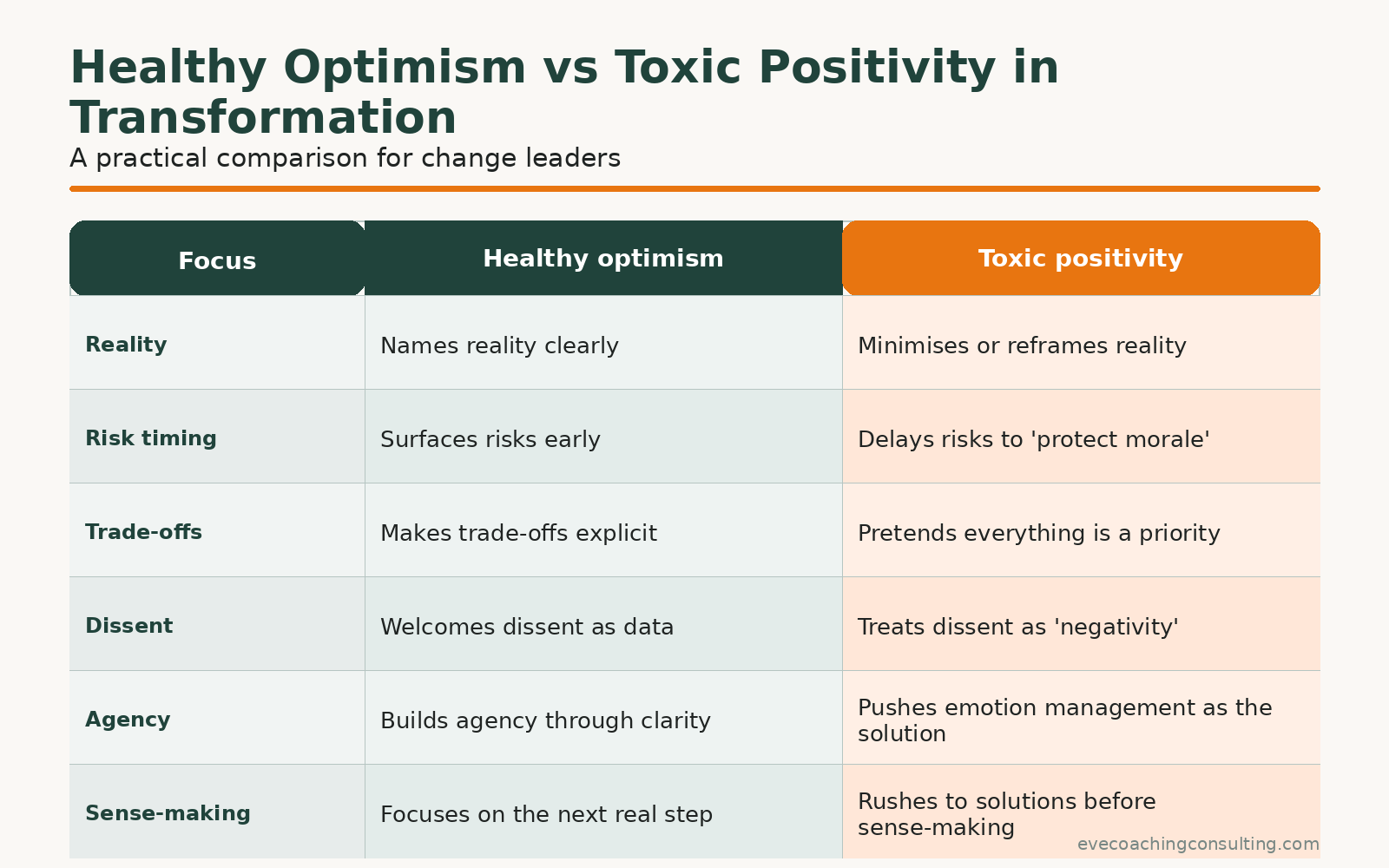
Use this as a quick diagnostic: if your comms are leaning “toxic,” you’re trading reassurance for late risk.
When that pattern is present, the fix is not better motivation or louder positivity. It is changing the environment people are working in, so candour and follow-through are safe and possible under pressure.
Mindset matters, but conditions decide whether change sticks
Mindset matters. But when change fatigue is high, mindset is rarely the limiting factor. People may want to engage, yet if capacity is blown, priorities keep shifting, and candour gets subtly punished, new behaviours will not sustain.
By “conditions”, I mean the practical environment for change: capacity, clarity, decision rights, incentives, and psychological safety. These are the levers leaders can shape to make the desired behaviour the easiest behaviour.
Positivity alone does not reduce change fatigue or create follow-through. Sustainable behaviour change depends on both intention and the conditions around the behaviour: clarity, capacity, confidence, agency, psychological safety and a realistic path to action. This is where behaviour change models are useful. They help leaders look beyond attitude and ask a more practical question: what is making this change easier or harder for people to act on consistently?
Acknowledge emotions (without turning work into therapy)
If leaders only permit “confidence,” you don’t get emotional control - you get emotional suppression (which leaks out as passive resistance, conflict, or burnout).
Leadership move: name what’s present, then move to action.
“There’s uncertainty here. Let’s be precise about what we know and don’t know.”
“This is frustrating. What’s the constraint we’re working within?”
Identify repeating patterns (not personalities)
Dysfunction loops are predictable:
optimistic reporting → late surprises
unclear decision rights → churn
too many initiatives → fatigue
vague accountability → drift
Leadership move: diagnose patterns, not blame people.
Make “undiscussables” discussable
Organisations develop defensive routines to avoid embarrassment or threat - often automatically. Naming the pattern is the intervention.
“We tend to smooth risks. Let’s list the top three plainly.”
Build habits that replace positivity with accuracy
risk reviews that reward candour
decision logs that prevent reopening
meeting norms that separate sense-making from action
a visible “stop doing” list that protects capacity
Habit change strategies can be a useful approach within behaviour change.
A practical 10-minute reset for leaders
When you feel the pull toward spin:
Name the pressure: “I want to reassure them.”
Ask what’s true: “What reality are we avoiding?”
Define the risk: “If we don’t name it now, what happens later?”
Choose one accurate sentence: “Here’s where we are, and here’s what we’re doing next.”
Invite one challenge: “What’s one thing I’m not seeing?”
This keeps you confident and accurate.
How to reduce change fatigue without slowing delivery
If you want less fatigue, don’t ask for more resilience. Change the load.
Make trade-offs explicit
Reduce initiative overlap (sequencing beats stacking) (Meyer and Stensaker, 2006; Heckmann, Steger and Dowling, 2016).
Create a “stop doing” list that protects capacity. Where change fatigue is not just an individual resilience issue, but a sign of wider leadership system strain, transformation consultancy can help senior leaders make sense of what is happening beneath the surface and what needs to shift.
Build a real listening loop (tight feedback + visible response)
Reward candour (if speaking up changes nothing, silence wins)
Conclusion: the goal isn’t positivity - it’s accuracy with agency
In transformation, optimism is valuable when it’s grounded in reality. But when change fatigue rises, organisations often create an unspoken rule: “be upbeat, don’t be difficult.” That’s when toxic positivity becomes a delivery risk.
The answer isn’t more cheerleading, it’s truth-telling, clarity, and conditions that make behavioural change possible.
Ready to move this forward?
If you want momentum with accuracy:
I coach transformation leaders to create a calm, candid space for the difficult truths, the clean decisions, and the conversations that unlock real commitment in complex change.
FAQ: Change fatigue at work
-
Change fatigue at work is the build-up of apathy, powerlessness and emotional exhaustion when change demands repeatedly outstrip time, control and energy, so people disengage even if they still comply (Bernerth et al., 2011).
-
Look for quiet withdrawal: low challenge in meetings, fast agreement with slow follow-through, rising cynicism, increased rework, and “we’ll do it later” language. Operationally, you’ll see adoption gaps: systems shipped, behaviour unchanged.
-
Longer than leaders think if nothing structurally changes. It drops fastest when you reduce overlap, restore decision clarity, and visibly stop lower-value work.
-
They overlap, but they’re not identical. Burnout is a broader, work-related syndrome involving exhaustion and reduced efficacy. Change fatigue is specifically tied to sustained, excessive change load and credibility debt from repeated initiatives that do not stick.
-
Change saturation is about volume and overlap of change hitting a system. Change fatigue is the human outcome when that load persists: disengagement, exhaustion, and reduced agency.
-
Resistance is often framed as unwillingness. Change fatigue is frequently capacity depletion and loss of belief that effort will pay off. It is more “I can’t, and I’m not sure it will make a difference”.
-
Under pressure, leaders try to protect morale and momentum. If optimism and certainty are rewarded while doubt is punished, people learn to smooth reality. Risks go underground and show up late as surprises.
-
Treat cynicism as data. Ask what repeated experience it points to, then make one concrete trade-off that restores credibility: stop a lower priority initiative, clarify decision rights, or remove a recurring friction that wastes effort.
-
Try scripts like: “Let’s stay accurate. What are we not saying because we’re tired?” and “Bring problems early. We’ll solve them together before they become expensive.” Your aim is a norm of candour without blame.
-
Reduce overlap and make trade-offs explicit. Sequencing beats stacking. Add a visible “stop doing” list, tighten feedback loops, and reward early escalation. Fatigue drops when clarity and agency rise.
-
You can measure it with validated survey items from the change fatigue literature (Bernerth, Walker and Harris, 2011; Cox et al., 2022) and track operational proxies such as rework, reopen rates, decision cycle time, adoption metrics, and voluntary attrition in change-critical teams.
-
Pause when the programme relies on “energy” rather than clarity, when reporting becomes overly optimistic, and when risks surface late and repeatedly. A short reset that restores priorities, capacity, and decision rights often speeds delivery overall.
📚References
Argyris, C. (1990) Overcoming Organizational Defenses. Boston: Allyn & Bacon.
Bernerth, J.B., Walker, H.J. and Harris, S.G. (2011) ‘Change fatigue: Development and initial validation of a new measure’, Work & Stress, 25(4), pp. 321–337.
Bion, W.R. (1961) Experiences in Groups. London: Tavistock.
Cox, C.B., Gallegos, E., Pool, G.J., Gilley, K.M. and Haight, N. (2022) ‘Mapping the nomological network of change fatigue: Identifying predictors, mediators and consequences’, Journal of Organizational Change Management, 35(4/5), pp. 718–733.
Elving, W.J.L., Hansma, L.D. and de Boer, M.G. (2011) ‘BOHICA: bend over, here it comes again... construction and test of a change fatigue instrument’, Teorija in Praksa, 48(6), pp. 1628–1647.
Heckmann, N., Steger, T. and Dowling, M. (2016) ‘Organizational capacity for change, change experience, and change project performance’, Journal of Business Research, 69(2), pp. 777–784.
Herold, D.M., Fedor, D.B. and Caldwell, S.D. (2007) ‘Beyond change management: A multilevel investigation of contextual and personal influences on employees’ commitment to change’, Journal of Applied Psychology, 92(4), pp. 942–951.
Johnson, K.J., Bareil, C., Giraud, L. and Autissier, D. (2016) ‘Excessive change and coping in the working population’, Journal of Managerial Psychology, 31(3), pp. 739–755.
Johnson, K.J. (2016) ‘The dimensions and effects of excessive change’, Journal of Organizational Change Management, 29(3), pp. 445–459.
Linnenborn, V. and Borchert, M. (2025) ‘Lead Yourself through Change: How self-leadership buffers the impact of change fatigue on employee outcomes’, The Journal of Applied Behavioral Science, 61(3), pp. 499–536.
Menzies, I.E.P. (1960) ‘A case-study in the functioning of social systems as a defence against anxiety’, Human Relations, 13(2), pp. 95–121.
Meyer, C.B. and Stensaker, I.G. (2006) ‘Developing capacity for change’, Journal of Change Management, 6(2), pp. 217–231.
Morrison, E.W. and Milliken, F.J. (2000) ‘Organizational silence: A barrier to change and development in a pluralistic world’, Academy of Management Review, 25(4), pp. 706–725.
Ouedraogo, N. and Ouakouak, M.L. (2021) ‘Antecedents and outcome of employee change fatigue and change cynicism’, Journal of Organizational Change Management, 34(1), pp. 158–179.
Rafferty, A.E. and Griffin, M.A. (2006) ‘Perceptions of organizational change: A stress and coping perspective’, Journal of Applied Psychology, 91(5), pp. 1154–1162.
Wanous, J.P., Reichers, A.E. and Austin, J.T. (2000) ‘Cynicism about organizational change: Measurement, antecedents, and correlates’, Group & Organization Management, 25(2), pp. 132–153.
de Vries, M.S.E. and de Vries, M.S. (2023) ‘Repetitive reorganizations, uncertainty and change fatigue’, Public Money & Management, 43(2), pp. 126–135.
🔍 Explore how I work with organisational transformation leaders
Get the details on my Executive Coaching approach for transformation leaders in matrix organisations.
👉 Executive coaching for transformation leaders
🔒 Book a confidential consultation
30 minutes to map the psychology of your transformation and see whether it would be useful to work together – no obligation.
👉 Book a confidential consultation

Under the Surface
A monthly briefing on the hidden dynamics shaping senior leadership, teams and change…
Read next…