Executive Communication Under Pressure: Why Senior Influence Starts Before the Meeting
You are presenting to a senior stakeholder group. The recommendation is clear. The evidence is credible. The risks have been considered.
Then someone says:
“I’m not convinced.”
What happens next often reveals more about executive presence than the polished part of the presentation.
Senior communication is not tested when the room agrees with you. It is tested when the room questions your judgement, challenges the evidence, pushes for more certainty, or pulls you into detail. In those moments, communication is no longer only about content. It becomes a live demonstration of clarity, composure, judgement and influence.
But there is a trap.
Many leaders treat the pressure moment as something to handle in the meeting. The best senior communicators know that the ability to handle pressure usually starts before the meeting begins.
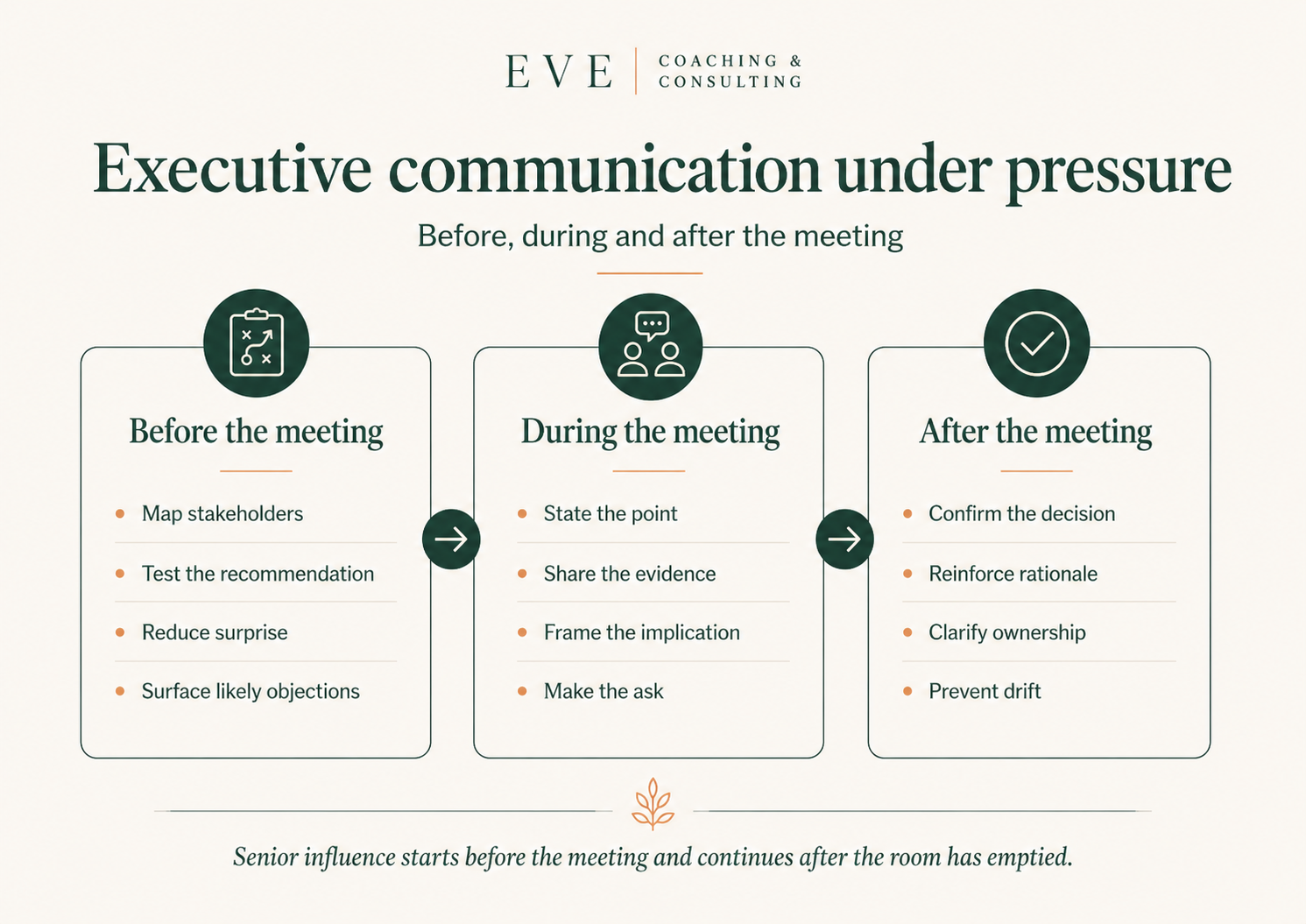
They map the room. They anticipate resistance. They test the recommendation. They reduce avoidable surprise. They prepare the message and the stakeholder system around the decision.
Executive communication under pressure is not simply about speaking well. It is about helping senior stakeholders think, decide and act when the stakes are high.
Key idea: Senior communication is not about saying more. It is about reducing uncertainty so others can think clearly and decide.
What senior stakeholders are really judging
When a Director or senior leader presents to senior stakeholders, the official topic may be a project, proposal, transformation, investment case, risk, budget or organisational issue.
But the room is rarely judging the content alone.
Senior stakeholders are also asking themselves:
Does this person understand the strategic context?
Can they simplify complexity without over-simplifying it?
Have they anticipated the risks?
Do they understand the politics of implementation?
Can they handle challenge without becoming defensive?
Do I trust their judgement?
This is where technically strong leaders can sometimes struggle as they move into more senior roles. Earlier in their career, credibility may have been built through depth, expertise and detailed knowledge. At senior level, those strengths still matter, but they are no longer enough.
Senior stakeholders rarely need every detail. They need the right detail, at the right moment, connected to the decision in front of them.
The shift is from:
“Let me show you everything I know.”
To:
“Let me help you make a better decision.”
That is a different communication discipline.
It is also one of the places where executive presence becomes visible. Not as polish. Not as performance. But as the ability to create clarity when the room is assessing risk, power, politics and consequence.
Why communication breaks down under pressure
Rambling is often misunderstood. It is not usually a lack of intelligence. It is often what happens when a capable leader is trying to think, defend, organise, reassure and speak at the same time.
Under pressure, working memory becomes overloaded. Cognitive load theory suggests that working memory has limited capacity, especially when people are processing complex information and solving problems at the same time. In a senior meeting, that load increases because the leader is not only managing the content. They are also managing the room, the politics, the time pressure and their own credibility.
Anxiety can also affect attentional control. When the stakes rise, attention can shift from the task itself to threat monitoring:
How am I being judged?
What if I get this wrong?
What if the CFO challenges the numbers?
What if I lose the room?
That is when communication starts to drift.
A leader may give too much background, answer the wrong question, repeat the same point in different words, overuse data to prove credibility, or avoid making a clear recommendation.
The irony is that behaviours designed to protect credibility often reduce it.
Senior stakeholders may interpret rambling as lack of clarity, lack of confidence or lack of strategic judgement. That may not be fair, but it is often how the room experiences it.
A useful working rule is this:
Rambling is often not a communication problem. It is a pressure-regulation problem showing up through speech.
The neuroscience matters here, but only if we keep it practical. The prefrontal cortex supports higher-order functions such as planning, judgement, impulse control, flexible thinking and perspective-taking. Under stress, these functions can become harder to access.
In plain English: pressure can make the senior brain temporarily less senior.
A leader who is normally thoughtful may become reactive. A leader who is normally concise may over-explain. A leader who is normally collaborative may become controlling. A leader who is normally confident may become overly cautious.
This is why executive presence is not simply a style issue. It is also a regulation issue.
The leader’s task is not to eliminate pressure. That is unrealistic. The task is to stay sufficiently regulated to retain access to judgement, language, curiosity and perspective.
The pressure patterns that weaken executive presence
Senior communication often fails in predictable ways.
| Pressure pattern | How it sounds | What it costs |
|---|---|---|
| Over-explaining | “Let me give you the background...” | The room loses the point |
| Defending | “We already considered that...” | The leader sounds less open |
| Appeasing | “Yes, absolutely, we can look again...” | The recommendation weakens |
| Controlling | “The only sensible option is...” | Stakeholders may resist |
| Avoiding | “There are a few moving parts...” | The real issue stays unnamed |
| Performing | Over-polished confidence | Presence feels less authentic |
These patterns often appear when a leader feels exposed. They may be trying to restore safety, protect credibility, avoid conflict or keep approval in the room. For some leaders, structured insight through Hogan Assessment and Executive Coaching can help reveal reputation under pressure and recurring derailers.
This is where psychology can help, provided it is used carefully.
Attachment theory should not be used to label colleagues or diagnose senior stakeholders. But it can offer a useful lens for understanding how people seek safety and connection under uncertainty.
In senior communication, these dynamics can show up as relational strategies under pressure.
Some leaders move towards approval. They over-explain, over-check, seek reassurance or struggle to end an answer cleanly.
Some leaders move towards distance. They under-communicate, intellectualise, withhold emotion or avoid inviting challenge.
Some leaders move towards control. They close down uncertainty, dominate the room or treat challenge as a threat to authority.
A more secure leadership stance is different. It stays clear, connected, boundaried and open to scrutiny.
It can say:
“That is a fair challenge. Here is how I am thinking about the risk.”
Transactional Analysis, developed by Eric Berne, offers another useful lens. One of its core ideas is that people can communicate from different ego states, often described as Parent, Adult and Child.
The point is not to turn a senior meeting into a therapy session. The point is to notice the transaction happening in the room.
Pressure can pull people out of Adult-to-Adult communication.
Transactional Analysis offers a useful lens for noticing how senior conversations can shift under pressure.
| Mode | How it may sound in a senior meeting |
|---|---|
| Critical Parent | “Why has this not been sorted already?” |
| Adapted Child | “Sorry, yes, I probably should have explained that better.” |
| Rebellious Child | “Well, we have already done everything we can.” |
| Adult | “The issue is clear. The remaining question is which risk we are willing to accept.” |
For example, a senior stakeholder asks:
“Why are we only hearing about this now?”
A defensive response might be:
“We did flag this earlier, but perhaps it did not get picked up.”
That may be factually true, but it risks sounding defensive.
A stronger Adult response would be:
“The risk became material last week when two readiness indicators moved outside tolerance. The decision now is whether we delay, de-scope or accept the increased risk. My recommendation is to delay by four weeks.”
That answer does not blame, plead or over-explain. It returns the room to decision-quality conversation.
Why senior influence starts before the meeting
The best senior communicators do not wait until the meeting to discover resistance.
By the time a senior stakeholder group meets, much of the influence work has either already happened or already failed. The formal meeting may be where a decision is made, but it is rarely where all the persuasion begins.
This is the meeting before the meeting.
Before the meeting, the leader needs to understand the formal decision system and the informal influence system. For example - for transformation leaders, this work is often the difference between formal approval and real alignment.
| Question | Why it matters |
|---|---|
| Who has formal authority? | Who can approve, block or reshape the decision |
| Who has informal influence? | Who shapes the room before and after the meeting |
| Who is likely to object? | So resistance is not a surprise |
| What are they protecting? | Budget, reputation, control, speed, risk or team capacity |
| What do they need to believe? | The real persuasion task |
| What evidence will they trust? | Data, precedent, customer impact, risk analysis or sponsor judgement |
| What trade-off must be named? | Senior stakeholders respect clear trade-offs |
Many objections in senior meetings are not objections to the idea. They are objections to being surprised by the idea.
Leadership cue: The formal meeting should rarely be the first time a senior stakeholder hears a high-stakes recommendation.
If a stakeholder hears a risky recommendation for the first time in a public setting, the social and political threat may be high. They may resist not because the proposal is weak, but because they feel exposed, excluded or forced to respond before they have processed the implications.
Pre-meeting influence is not manipulation. Done well, it is responsible leadership.
It reduces avoidable threat. It gives stakeholders time to think. It helps the leader understand what is unclear, what is missing and where resistance may sit.
It also protects the quality of the actual meeting. Instead of discovering predictable objections in public, the leader can use the meeting to test trade-offs, make decisions and align around action.
The psychology of pressure and surprise
Pressure changes the way people listen.
A senior stakeholder may appear to be assessing a proposal rationally, but they are also assessing what the proposal means for risk, status, control, resources, reputation and accountability. If the recommendation arrives as a surprise, the threat response can rise quickly.
That does not mean the stakeholder is being difficult. It may mean they are processing the proposal as a potential threat to something they are responsible for protecting.
This is where neuroscience and psychology help, provided we do not overcomplicate them.
Cognitive load increases when people are asked to process complex information, evaluate risk and make decisions at the same time. Add public visibility, time pressure and organisational politics, and the room can become overloaded quickly.
Threat response adds another layer. When people feel exposed or surprised, their attention may narrow. They may become more defensive, more critical, more controlling or more cautious. In a senior meeting, this can sound like scepticism, but underneath it may be a demand for safety, clarity or control.
Attachment theory offers a useful relational lens here. Under uncertainty, people often seek safety in different ways. One stakeholder may want more detail before agreeing. Another may distance themselves. Another may challenge hard to regain a sense of control. The point is not to diagnose them. The point is to recognise that resistance is often relational as well as rational.
Transactional Analysis adds another practical lens. Surprise can pull a meeting out of Adult-to-Adult dialogue and into less useful patterns. A stakeholder may move into Critical Parent:
“Why has this not been sorted already?”
The presenter may then slip into Adapted Child:
“Sorry, yes, I probably should have explained that earlier.”
The more effective move is to return the conversation to Adult:
“The risk became material last week. The decision now is whether we delay, de-scope or accept the increased risk. My recommendation is to delay by four weeks.”
This is why pre-meeting influence matters. It reduces unnecessary surprise. It gives stakeholders time to process. It allows concerns to surface before they become public resistance.
A useful rule is:
If the idea is high-stakes, do not let the meeting be the first time the stakeholder has to make sense of it.
The meeting should be where decisions are tested and made, not where predictable threat responses are triggered for the first time.
Next step
If high-stakes stakeholder conversations are becoming more visible, political or complex, coaching can help.
Executive presence coaching creates a confidential space to work on communication under pressure, stakeholder influence, emotional regulation and the shift from technical credibility to enterprise-level impact.
How to prepare senior stakeholders before you present
Before presenting to senior stakeholders, do not only prepare the deck. Prepare the room.
That means speaking with key people in advance, especially those who have power, influence, concern or exposure.
Useful pre-meeting questions include:
“I want to test the recommendation with you before the steering group. Where do you think the resistance will come from?”
“If I bring this proposal next week, what would you need to see to feel confident supporting it?”
“What concern would you not want us to miss?”
These conversations help the leader find out:
what is unclear
who feels excluded
what evidence is missing
where the real objection sits
whether the decision is politically viable
what language will land (including where stakeholders span countries, cultures or regions, this may also become a cross-cultural executive coaching issue.)
what trade-off needs to be made explicit
This is senior influence. Not politics in the manipulative sense. Politics in the realistic sense of understanding the human system around the decision.
Before a high-stakes meeting, ask yourself five uncomfortable questions:
Who can kill this decision?
Who can quietly undermine it afterwards?
Who needs to feel consulted before being asked to agree?
What objection would be embarrassing if raised for the first time in the meeting?
What trade-off must be named before the room names it for me?
A strong deck does not compensate for a cold stakeholder system. If the room has not been prepared, even a clear recommendation can fail.
How to communicate clearly during the meeting
Once the meeting begins, the leader needs structure. Not because structure is impressive, but because structure reduces cognitive load for everyone in the room.
A simple structure is:
Point. Evidence. Implication. Ask.
Point
Say what you think.
“My recommendation is that we delay the launch by four weeks.”
Evidence
Give the minimum evidence needed to support the point.
“Two regions are below readiness threshold and escalation routes are not yet clear.”
Implication
Explain why it matters.
“If we launch now, we may protect the date but increase rework, stakeholder noise and operational disruption.”
Ask
Name the decision or support required.
“I am asking for approval to move the launch date and confirm executive sponsorship for the readiness plan.”
This structure is powerful because it forces judgement. It also reduces the temptation to use detail as armour.
A useful rule for senior leaders is:
Detail should be available, not dumped.
Put the detail in the appendix. Bring it into the conversation only when needed.
When presenting to senior leaders, avoid building slowly towards the answer. Start with the decision, recommendation or tension. Then use evidence to support it.
Senior stakeholders do not want a mystery tour. They want to know where you are taking them.
How to handle senior stakeholder objections
Objections are not interruptions. They are diagnostic data. They are rarely just resistance. They often reveal the risk, uncertainty or missing confidence that needs to be addressed.
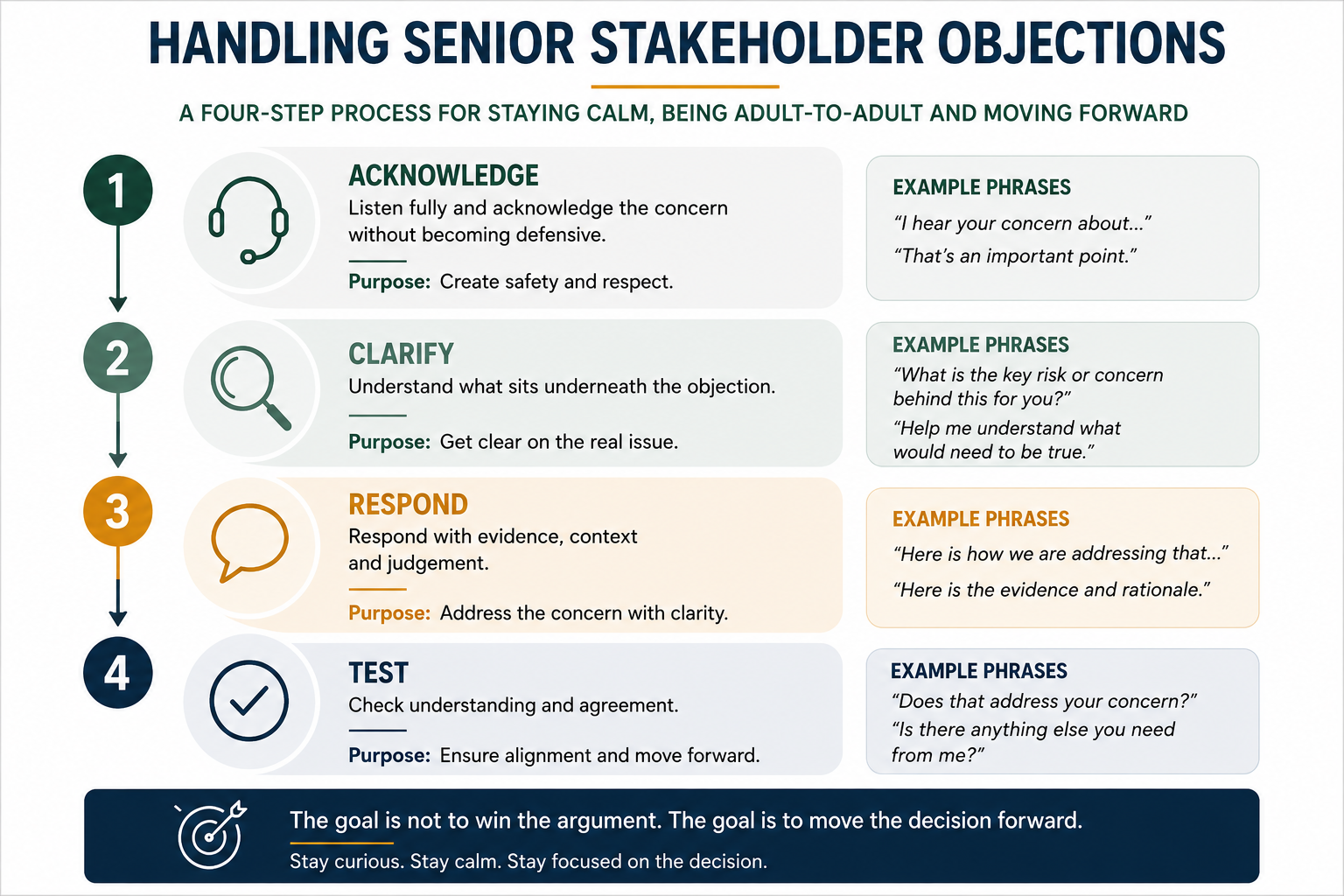
A senior stakeholder objection usually tells you one of five things:
| Objection | What may sit underneath |
|---|---|
| “This feels expensive.” | Value, affordability or risk of wasted spend |
| “Why now?” | Urgency has not been established |
| “I’m not convinced.” | Evidence or logic is not yet strong enough |
| “Have we considered other options?” | Stakeholders want to see judgement, not advocacy |
| “The organisation is not ready.” | Concern about adoption, capacity or change fatigue |
The mistake is to answer too quickly.
A better sequence is:
Acknowledge. Clarify. Respond. Test.
Example:
“That is a fair concern. Is your worry mainly about cost, timing or confidence in execution?”
This does two things. It shows composure, and it prevents you from answering the wrong objection.
Then respond with judgement:
“My assessment is that timing is the bigger risk. The cost is visible, but the cost of delay is currently hidden in rework, escalation and leadership time.”
Then test:
“Does that address the concern, or is there another risk you want us to examine?”
That final question matters. It keeps the conversation Adult-to-Adult. It also prevents false agreement.
Objection: “I’m not convinced.”
Weak response:
“I understand. Perhaps I can go back through the detail.”
Stronger response:
“That is helpful to know. Is the concern about the evidence, the recommendation or the execution risk? My view is that the evidence supports the recommendation, but the execution risk needs active sponsorship.”
Objection: “Why now?”
Weak response:
“Because it is becoming urgent.”
Stronger response:
“Because this has moved from an internal tension to a delivery risk. Six weeks ago, the issue was manageable within the project team. It is now affecting decision speed and stakeholder confidence.”
Objection: “This feels expensive.”
Weak response:
“We believe the benefits justify the cost.”
Stronger response:
“The question I would suggest we test is whether the cost of action is higher or lower than the cost of delay. At the moment, delay is already showing up in rework, escalation and senior leadership time.”
Objection: “Have we considered other options?”
Weak response:
“Yes, we looked at a few.”
Stronger response:
“Yes. We considered three options: continue as we are, make a targeted adjustment, or redesign the full approach. I am not recommending the full redesign because it is disproportionate. I am recommending the targeted adjustment because it addresses the core issue with less disruption.”
Objection: “The organisation is not ready.”
Weak response:
“I think people will come on board.”
Stronger response:
“I would separate readiness from willingness. Some teams are not yet willing, but the readiness gaps are identifiable and manageable. That is why I am recommending phased implementation with clear adoption measures.”
What to do after the meeting to prevent decision drift
Senior influence does not end when the meeting ends.
A common mistake is to leave the room with verbal agreement but no real commitment. People nod. The decision appears to be made. Then momentum fades.
After the meeting, strong communicators:
confirm the decision in writing
summarise the rationale
name unresolved concerns
clarify owners and timelines
follow up with key influencers
watch for passive resistance
keep the message consistent
This matters because alignment decays. People leave the meeting and return to their own pressures, incentives and interpretations.
If the message is not reinforced, the decision can become blurred.
After a high-stakes meeting, a useful follow-up might say:
“Thank you for the discussion today. The agreed decision is to delay the launch by four weeks, with readiness gates reviewed weekly. The rationale is to reduce adoption risk and avoid greater disruption later. The open concern is regional capacity, which we will review with sponsors by Friday.”
Clear follow-up protects the decision.
It also demonstrates executive presence after the room has emptied. The leader is not simply a strong presenter. They are stewarding the decision.
Executive presence is how you help the room think
Executive presence is often reduced to confidence, gravitas or polish. But in senior stakeholder settings, executive presence is more practical than that.
It is how you help the room think, decide and act under pressure.
A leader with presence does not simply perform confidence. They create clarity. They regulate themselves. They listen without collapsing. They challenge without becoming combative. They simplify without becoming simplistic.
In senior stakeholder communication, executive presence is not just how a leader sounds. It is how they create clarity, confidence and movement under pressure.
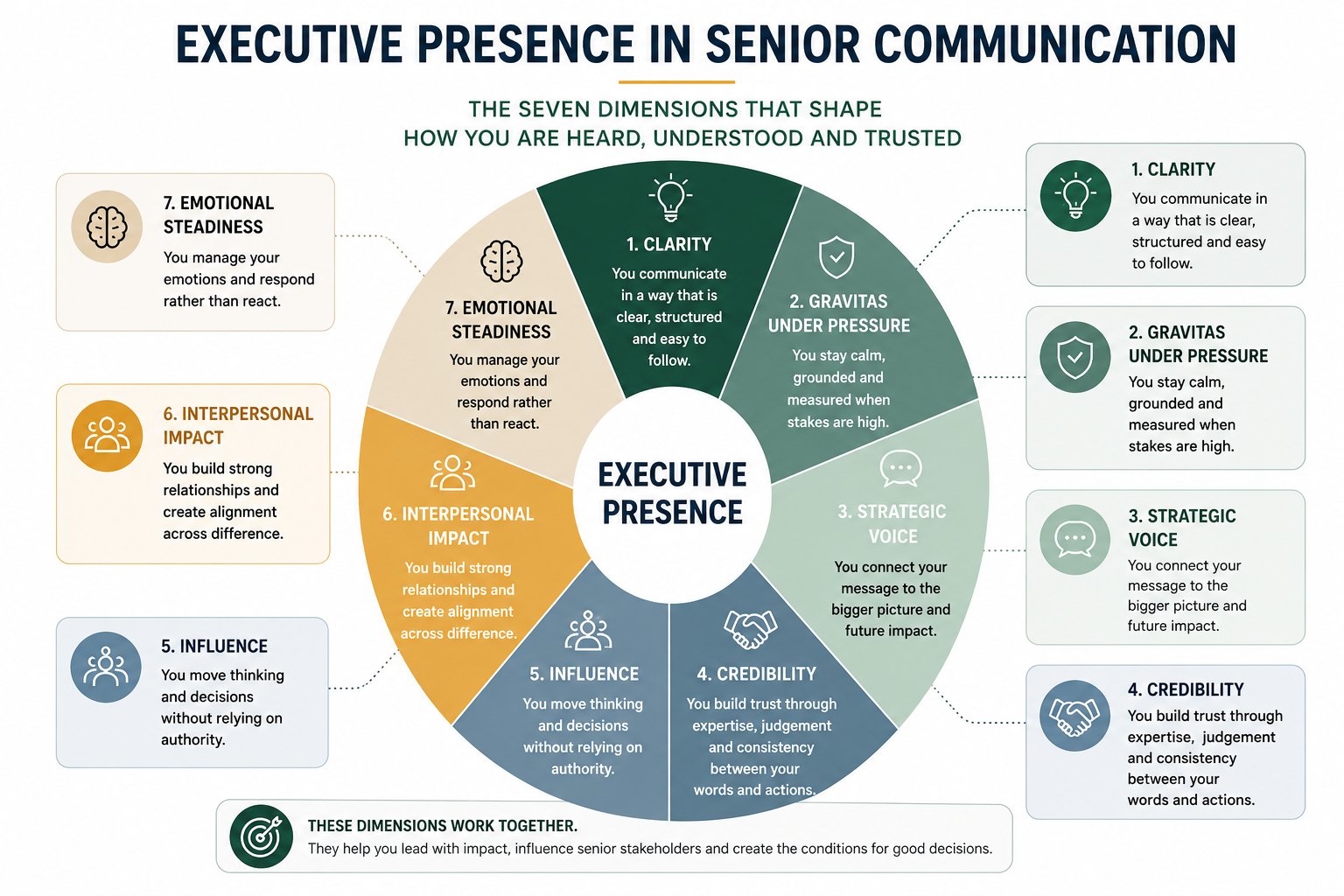
If you want a quick snapshot of where your presence is helping or holding you back, try the executive presence assessment.
| Executive presence dimension | How it shows up in senior communication |
|---|---|
| Clarity | The leader can state the point, decision or recommendation without unnecessary detail. |
| Gravitas under pressure | The leader stays calm, grounded and structured when challenged. |
| Strategic voice | The leader moves the conversation from detail to decision, trade-off and consequence. |
| Credibility | Evidence is connected to judgement, not used as a data dump. |
| Influence | The leader frames choices in a way that helps stakeholders align around action. |
| Interpersonal impact | The leader reads the room, responds to concern and keeps the conversation Adult-to-Adult. |
| Emotional steadiness | The leader names risk without sounding defensive, alarmist or avoidant. |
This is especially important for leaders moving from technical credibility into enterprise influence. At earlier career stages, expertise is often demonstrated through depth. At senior levels, expertise is demonstrated through discrimination: knowing what matters, what does not, and what decision is now required.
The senior leader does not need to know less.
They need to communicate differently.
A checklist for executive communication under pressure
Before an important stakeholder conversation, ask:
What decision do I need from this room?
What is my recommendation in one sentence?
Who needs to be spoken to before the meeting?
Who is likely to object, and what are they protecting?
What evidence will this audience trust?
What trade-off must I name directly?
Where might I over-explain?
What will I say if challenged?
What is the clearest ask?
Where do I need to pause and stop talking?
The last question is not trivial.
Many leaders damage otherwise strong communication by continuing to speak after the point has landed. Silence can feel risky, but it often signals confidence.
Senior communication is not about saying more. It is about staying clear when the stakes rise.
The real test is not whether a leader can deliver a polished presentation. The test is whether they can remain thoughtful, structured and influential when questioned.
That work starts before the meeting, continues during the meeting, and is reinforced after the meeting.
Because in senior rooms, people are not only listening to your words.
They are watching your judgement under pressure.
Next step
If high-stakes stakeholder conversations are becoming more visible, political or complex, coaching can help:
Executive presence coaching creates a confidential space to work on communication under pressure, stakeholder influence, emotional regulation and the shift from technical credibility to enterprise-level impact.
FAQ: Executive communication under pressure
-
Executive communication under pressure is the ability to stay clear, structured and influential when stakes are high. It often matters most when a senior leader is questioned, challenged or asked to justify a recommendation. The goal is not to sound polished. It is to help senior stakeholders understand the issue, assess the trade-offs and make a better decision.
-
Senior leaders often ramble when they are trying to think, defend, organise and reassure at the same time. Under pressure, cognitive load increases and attention can shift towards self-monitoring or threat. The result may be too much background, repeated points or overuse of detail. Rambling is often not a lack of intelligence. It is a pressure-regulation issue showing up through speech.
-
Start with the decision, recommendation or tension. Then give the evidence, explain the implication and make a clear ask. A useful structure is: Point, Evidence, Implication, Ask. Senior stakeholders usually do not need every detail. They need the right detail, connected to the decision in front of them.
-
Influence often starts before the meeting because senior stakeholders need time to process risk, implications and trade-offs. If a high-stakes recommendation is heard for the first time in a public meeting, people may feel surprised, exposed or forced to respond defensively. Pre-meeting conversations help surface concerns early and reduce avoidable resistance.
-
Do not answer too quickly. First, acknowledge the objection. Then clarify what sits underneath it: cost, timing, risk, evidence, authority or confidence in execution. Then respond with judgement and test whether the concern has been addressed. A useful sequence is: Acknowledge, Clarify, Respond, Test.
-
Executive presence is not just how a leader sounds or looks. In senior stakeholder settings, it shows up in how they create clarity, stay grounded under challenge, frame trade-offs and help the room think. Strong executive communication makes presence practical: it turns gravitas, credibility and influence into observable leadership behaviour.
📚References
Arnsten, A.F.T. (2009) ‘Stress signalling pathways that impair prefrontal cortex structure and function’, Nature Reviews Neuroscience, 10, pp. 410-422.
Berne, E. (1964) Games People Play: The Psychology of Human Relationships. New York: Grove Press.
Eysenck, M.W., Derakshan, N., Santos, R. and Calvo, M.G. (2007) ‘Anxiety and cognitive performance: attentional control theory’, Emotion, 7(2), pp. 336-353.
Grice, H.P. (1975) ‘Logic and conversation’, in Cole, P. and Morgan, J.L. (eds.) Syntax and Semantics 3: Speech Acts. New York: Academic Press, pp. 41-58.
Karpman, S.B. (1968) ‘Fairy tales and script drama analysis’, Transactional Analysis Bulletin, 7(26), pp. 39-43.
Mayseless, O. and Popper, M. (2019) ‘Attachment and leadership: review and new insights’, Current Opinion in Psychology, 25, pp. 157-161.
Minto, B. (2009) The Pyramid Principle: Logic in Writing and Thinking. London: Pearson.

Under the Surface
A monthly briefing on the hidden dynamics shaping senior leadership, teams and change…
Read next…