Developing Emotional Intelligence: A Practical Guide for Senior Leaders
The leadership skill beneath composure, trust and influence under pressure
Emotional intelligence is often described as self-awareness, empathy and managing emotions. That is useful, but incomplete.
In senior leadership, emotional intelligence becomes visible in more demanding moments: when pressure rises, a stakeholder challenges you, a team goes quiet, a difficult message needs to be said, or your intention and impact no longer match.
This guide explains how emotional intelligence develops and gives practical exercises to strengthen how you notice, understand and respond to emotional and relational information under pressure.

Emotional intelligence becomes visible when pressure changes the room.
In this guide you’ll learn:
what emotional intelligence is, and what it is not
why EI matters more as leadership becomes more senior
the four practical branches of emotional intelligence
seven exercises to build composure, room-reading, trust and influence
how emotional intelligence coaching can accelerate the shift
Emotional intelligence is not about becoming softer. It is about becoming more accurate, more composed and more intentional when leadership pressure is high.
Emotional intelligence in senior leadership: quick definition
Emotional intelligence in senior leadership is the ability to notice emotional and relational information, understand what it may mean, and choose a useful response under pressure. It helps leaders stay composed, read the room, handle difficult conversations, build trust and influence others more effectively.
Key takeaways
Emotional intelligence is not the same as being nice.
For senior leaders, EI shows up most clearly under pressure.
The four-branch model of emotional intelligence provides a useful practical structure.
Leaders can develop EI by improving self-awareness, room-reading, emotional interpretation and response choice.
Emotional intelligence strengthens trust, influence, decision-making and difficult conversations.
Coaching can help when a leader’s intent and impact are no longer aligned.
How to develop emotional intelligence: 7 practical exercises
Here are seven practical exercises senior leaders can use to develop emotional intelligence.
The room-reading review
After important meetings, notice where energy rose, dropped or became tense.The trigger map
Identify the situations where your tone, pace, certainty or defensiveness changes.The intent versus impact review
Compare what you meant to communicate with how others may have experienced you.Emotion as data
Ask what anxiety, frustration, silence or resistance may be signalling.The response gap
Practise pausing before your automatic reaction takes over.Difficult conversation rehearsal
Prepare how to challenge clearly without aggression or avoidance.Repair faster
Learn to return to moments where trust, tone or impact may have gone wrong.
Each exercise is simple. The work is in practising them repeatedly in real leadership situations, especially when pressure, ambiguity or disagreement are present.
Why emotional intelligence matters more as leadership becomes more senior
As leaders become more senior, the work changes.
Earlier in a career, technical skill, delivery and personal effort often create credibility. At senior levels, those things still matter, but they are no longer enough.
Senior leadership involves more ambiguity, competing priorities, political complexity and relational risk. Leaders have to influence without full control. They need to work across functions, geographies, cultures, stakeholders and power structures. They have to handle disagreement without damaging trust.
In that context, emotional intelligence becomes a leadership capability.
It affects how a leader:
responds when challenged
listens when under pressure
notices tension in the room
handles disagreement
gives difficult feedback
repairs trust after a poor interaction
stays clear when others are anxious, frustrated or defensive
understands the gap between their intention and their impact
This is why emotional intelligence is not a soft skill. It is a senior leadership skill.
The real test of emotional intelligence is not how a leader behaves when things are calm. It is what happens when pressure changes the room.
Emotional intelligence is not just empathy
Empathy matters, but emotional intelligence is broader than empathy.
A leader can be empathetic and still avoid the conversation that needs to happen. They can understand someone’s feelings and still fail to hold a boundary. They can be kind and still be unclear. They can be considerate and still lose authority.
Emotional intelligence includes empathy, but it also includes discernment, self-regulation, timing, judgement and courage.
In senior leadership, emotional intelligence often means being able to say something difficult in a way that can be heard. It means staying open without becoming passive. It means challenging without humiliating. It means being human without losing clarity.
The emotionally intelligent leader is not the leader who avoids discomfort. It is the leader who can work constructively with discomfort.
A practical four-part model for developing emotional intelligence
One useful evidence-based way to understand emotional intelligence is the four-branch ability model associated with Peter Salovey, John Mayer and David Caruso. In practical leadership terms, this model focuses on four abilities:
perceiving emotion
using emotion to support thinking
understanding emotion
managing emotion
The Mayer-Salovey-Caruso Emotional Intelligence Test, known as the MSCEIT, was designed to measure these four branches of emotional intelligence. The model treats EI as an ability: a way of perceiving, reasoning with and managing emotional information.
For leaders, this is useful because it takes emotional intelligence beyond personality labels. It is not about whether someone is a “good person” or a “people person”. It is about what they can notice, understand and do in emotionally charged situations.
The four branches can be translated into four practical leadership capabilities:
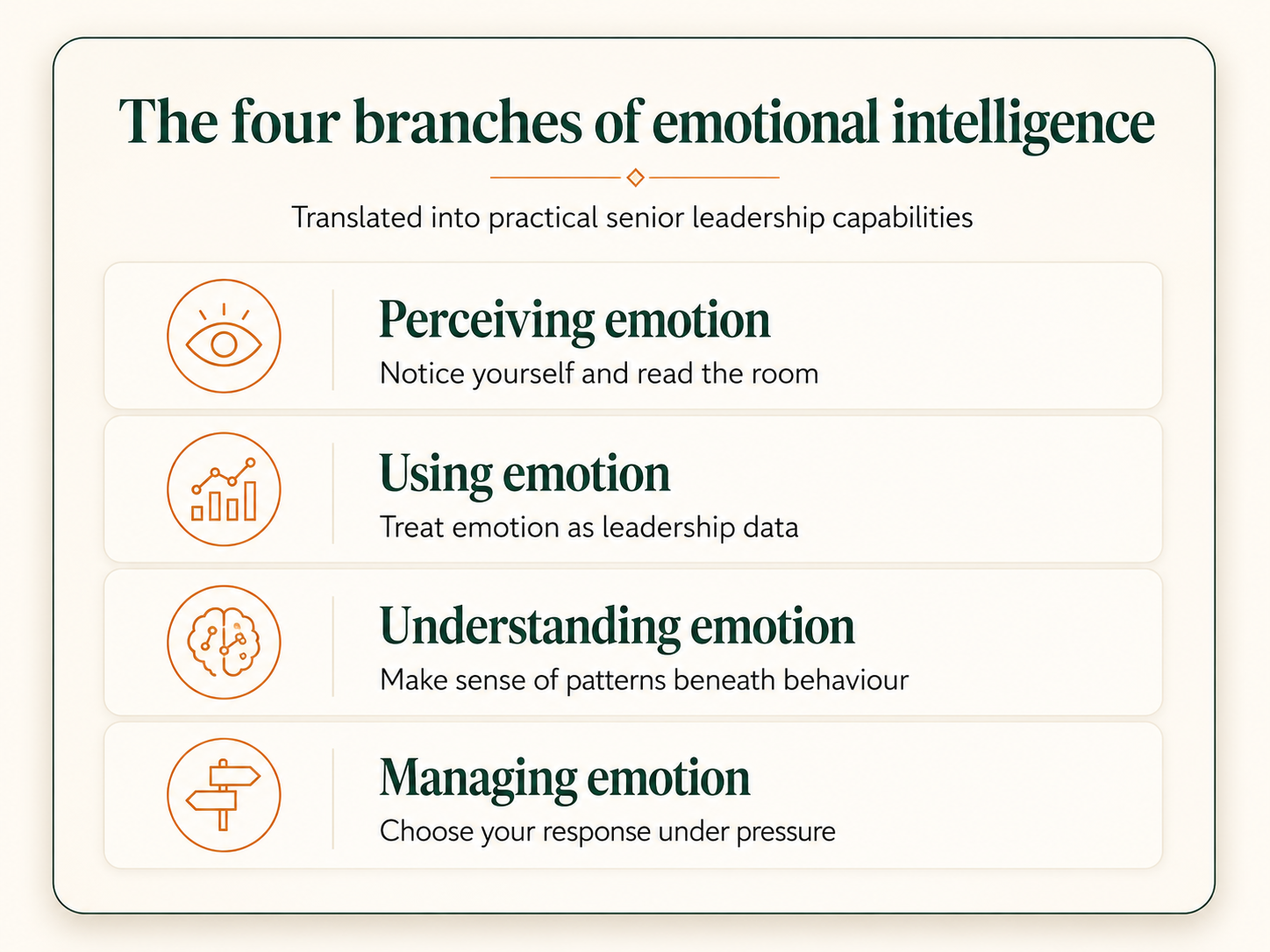
A practical four-part model for developing emotional intelligence in senior leadership.
1. Perceiving emotion: noticing yourself and reading the room
The first part of emotional intelligence is the ability to perceive emotion accurately.
For senior leaders, this starts with self-awareness, but it does not stop there. It also includes the ability to notice what is happening in the room.
That means noticing:
your own physical signs of pressure
changes in your tone, pace or facial expression
when you start to over-explain, withdraw or push harder
when people become quiet
when agreement may actually be compliance
when energy drops
when a topic creates tension
when a stakeholder’s words and body language do not fully match
This is not about trying to read minds. It is about becoming more attentive to emotional and relational signals.
Senior leaders often move quickly. They scan for facts, risks, decisions and actions. But emotional information is also data. If a room becomes quiet after a proposal, that matters. If a stakeholder repeatedly says “fine” but does not commit resources, that matters. If people nod in the meeting but challenge the decision afterwards, that matters.
Emotionally intelligent leaders notice these signals earlier.
Practical exercise: the room-reading review
After an important meeting, ask yourself:
Where did energy rise or drop?
Who became quieter?
What topic changed the mood?
Where did I push, avoid or over-explain?
What did I intend people to experience?
What might they actually have experienced?
What was said clearly?
What may have remained unsaid?
This exercise trains the leader to notice the difference between the content of a meeting and the emotional reality of a meeting.
2. Using emotion: treating emotion as leadership data
The second branch of emotional intelligence is using emotion to support thinking.
This is one of the most useful ideas for senior leaders because it challenges a common leadership habit: treating emotion as noise.
In many organisations, emotion is pushed aside. Leaders may tell themselves to “stay rational”, “focus on the facts” or “not get emotional”. The problem is that emotion often contains information.
Anxiety may indicate uncertainty, risk or lack of trust.
Frustration may indicate blocked accountability.
Defensiveness may indicate status threat.
Disengagement may indicate fatigue, cynicism or loss of belief.
Excitement may indicate real commitment, or sometimes premature optimism.
The point is not to act on every emotion. The point is to ask what the emotion may be signalling.
A leader who ignores emotion may miss important data. A leader who is ruled by emotion may act impulsively. Emotional intelligence sits between those two extremes.
It allows the leader to ask:
What is being felt here?
What might this emotion be trying to protect?
What information does it contain?
What would be unwise to ignore?
What response would help the work move forward?
This is especially important in change and transformation work. Resistance is rarely only intellectual. People may understand the logic of change and still feel threatened by what it means for identity, status, competence, control or belonging.
When leaders treat emotion as data, they are more likely to understand the real work beneath the surface.
Practical exercise: emotion as data
Before reacting to a difficult moment, pause and ask:
What emotion is present in me?
What emotion may be present in others?
What might this emotion be pointing towards?
Is this about risk, status, fairness, trust, uncertainty or loss?
What would be a useful response rather than an automatic one?
This does not slow leadership down. It often makes leadership more accurate.
When leadership impact changes under pressure
If your intention is clear but your impact is not landing, more explanation may not be the answer.
The useful work is often to understand what happens in the moment: your triggers, tone, pace, assumptions and how others experience you when pressure rises.
3. Understanding emotion: making sense of patterns beneath behaviour
The third branch of emotional intelligence is understanding emotion.
This means being able to make sense of emotional patterns, not just individual reactions.
In senior leadership, behaviour is rarely random. A difficult reaction may be connected to a previous disappointment. A defensive response may be connected to perceived loss of control. A quiet team may not be aligned; they may be avoiding conflict. A stakeholder who keeps challenging the detail may be trying to manage anxiety about risk.
This is where emotional intelligence becomes more systemic.
Leaders need to understand how emotions move through teams and organisations. Anxiety can travel quickly. So can mistrust. So can confidence. A senior leader’s mood, tone and behaviour can shape the emotional climate around them more than they realise.
For example:
If a leader becomes sharp under pressure, the team may stop raising risks early.
If a leader avoids conflict, unresolved tension may move into side conversations.
If a leader reacts defensively to feedback, people may protect them from the truth.
If a leader repeatedly changes direction without acknowledging uncertainty, people may lose trust.
If a leader is calm but emotionally unavailable, others may experience distance rather than steadiness.
Understanding emotion means looking beneath behaviour and asking what pattern may be playing out.
Practical exercise: beneath the behaviour
When someone reacts strongly, ask:
What is the visible behaviour?
What might be the emotional driver?
What might they be protecting?
What may they fear losing?
What previous experience could this situation resemble?
What does this reaction tell me about the wider system?
What conversation is probably being avoided?
This is not about diagnosing people. It is about leading with better judgement.
4. Managing emotion: choosing your response under pressure
The fourth branch of emotional intelligence is managing emotion.
This is the part most people associate with emotional intelligence: self-control, composure and regulation. But for senior leaders, managing emotion is not simply about staying calm.
Sometimes the emotionally intelligent response is to slow down.
Sometimes it is to challenge.
Sometimes it is to name tension.
Sometimes it is to apologise.
Sometimes it is to hold a firm boundary.
Sometimes it is to stop rescuing others from discomfort.
The key is choice.
Under pressure, many leaders have predictable patterns. Some become forceful. Some become overly detailed. Some become detached. Some become pleasing. Some avoid the issue. Some become impatient. Some try to solve too quickly. Some lose curiosity.
Emotional intelligence creates a gap between trigger and response.
That gap allows a leader to ask:
What is happening in me?
What does this situation need from me?
What would my automatic response be?
What response would be more useful?
What impact do I want to create?
Managing emotion does not mean suppressing emotion. Suppression often leaks out through tone, facial expression, impatience or passive aggression. Managing emotion means recognising what is happening and choosing behaviour that fits the leadership task.
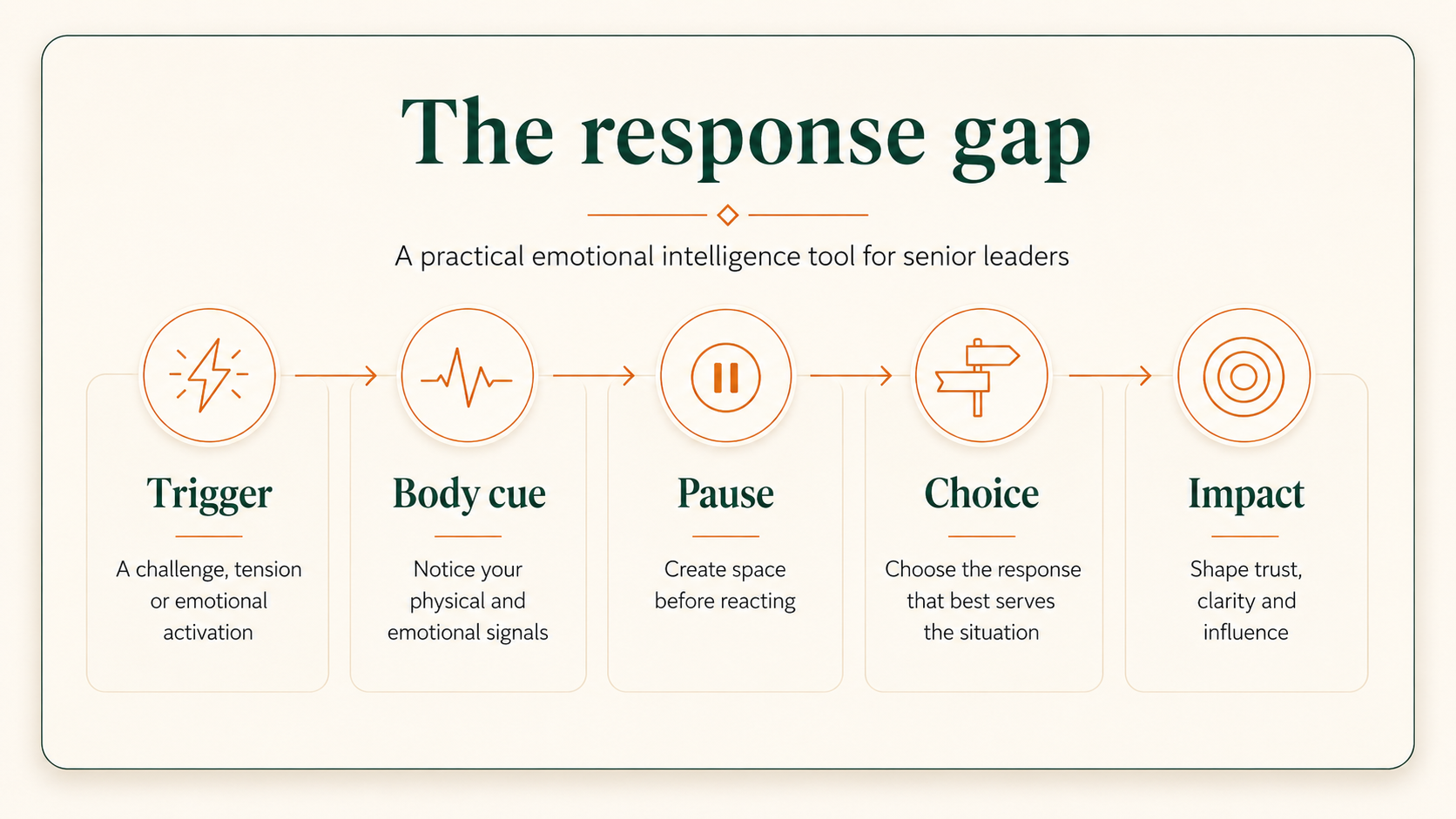
Practical exercise: the response gap
Before a difficult meeting or conversation, write down:
My likely trigger:
My usual unhelpful move:
The impact that may create:
The response I want to practise:
The sentence I will use if tension rises:
For example:
My likely trigger: being challenged in front of others
My usual unhelpful move: becoming too forceful or overly detailed
The impact that may create: others may experience me as defensive
The response I want to practise: pause, ask one clarifying question, then respond
The sentence I will use if tension rises: “That is useful challenge. Let me slow down and understand the concern properly.”
That is emotional intelligence in action.
How low emotional intelligence shows up in senior leadership
Low emotional intelligence does not always look dramatic.
In senior leaders, it can show up in subtle but costly ways.
For example:
people stop giving honest feedback
meetings become polite but unproductive
challenge happens outside the room rather than inside it
the leader’s intent and impact drift apart
difficult conversations are delayed
conflict becomes personal
trust is damaged by tone rather than content
teams comply rather than commit
stakeholders become harder to influence
pressure creates reactivity, avoidance or over-control
This is why emotional intelligence matters commercially. It affects decision-making, speed, trust, collaboration, psychological safety and leadership credibility.
A leader does not need to be liked by everyone. But they do need enough trust and emotional credibility for people to speak honestly, engage with challenge and follow through when the work becomes difficult.
Emotional intelligence and executive presence
Emotional intelligence and executive presence are closely connected.
Executive presence is partly about how a leader is experienced by others: their credibility, authority, confidence, clarity and impact. Emotional intelligence shapes that experience.
A leader who cannot read the room may miss the moment to speak.
A leader who cannot regulate pressure may sound defensive.
A leader who cannot understand stakeholder concerns may appear politically naive.
A leader who cannot repair trust may lose influence even when they are technically right.
This is why emotional intelligence is often part of executive presence coaching. Presence is not just how someone looks or speaks. It is how they manage themselves, relate to others and create confidence under pressure.
Read more: <a href="/executive-presence-coaching">Executive Presence Coaching</a>
Emotional intelligence is not the same as being nice
This point is worth repeating because it is where many leaders misunderstand EI.
Emotionally intelligent leaders are not simply agreeable, warm or endlessly empathetic.
In senior leadership, emotional intelligence often means being able to:
raise difficult issues clearly
challenge poor behaviour
give honest feedback
hold boundaries
disappoint people respectfully
stay steady when others are anxious
repair trust when something has gone wrong
distinguish between empathy and avoidance
remain human without losing authority
A leader can be emotionally intelligent and still be direct.
A leader can be empathetic and still say no.
A leader can care about people and still hold them accountable.
In fact, without emotional intelligence, challenge often becomes either too harsh or too diluted. The emotionally intelligent leader can stay connected and clear at the same time.
How to develop emotional intelligence as a senior leader
Emotional intelligence can be developed, but not usually through theory alone.
Reading about EI may create insight. But insight is not the same as behavioural change. Senior leaders develop emotional intelligence by working on real situations where pressure, identity, relationships and organisational expectations are active.
Here are seven practical ways to develop emotional intelligence.
1. Map your triggers
Notice the situations where your behaviour changes.
Common leadership triggers include:
feeling challenged
being interrupted
losing control of the agenda
being misunderstood
receiving vague feedback
sensing resistance
dealing with slow progress
being exposed in front of senior stakeholders
feeling that others are not taking ownership
Ask yourself:
What situations activate me?
What do I do when that happens?
Do I speed up, shut down, push harder, rescue, avoid or over-explain?
What impact does that create?
A trigger map helps you see your pattern before the pattern runs you.
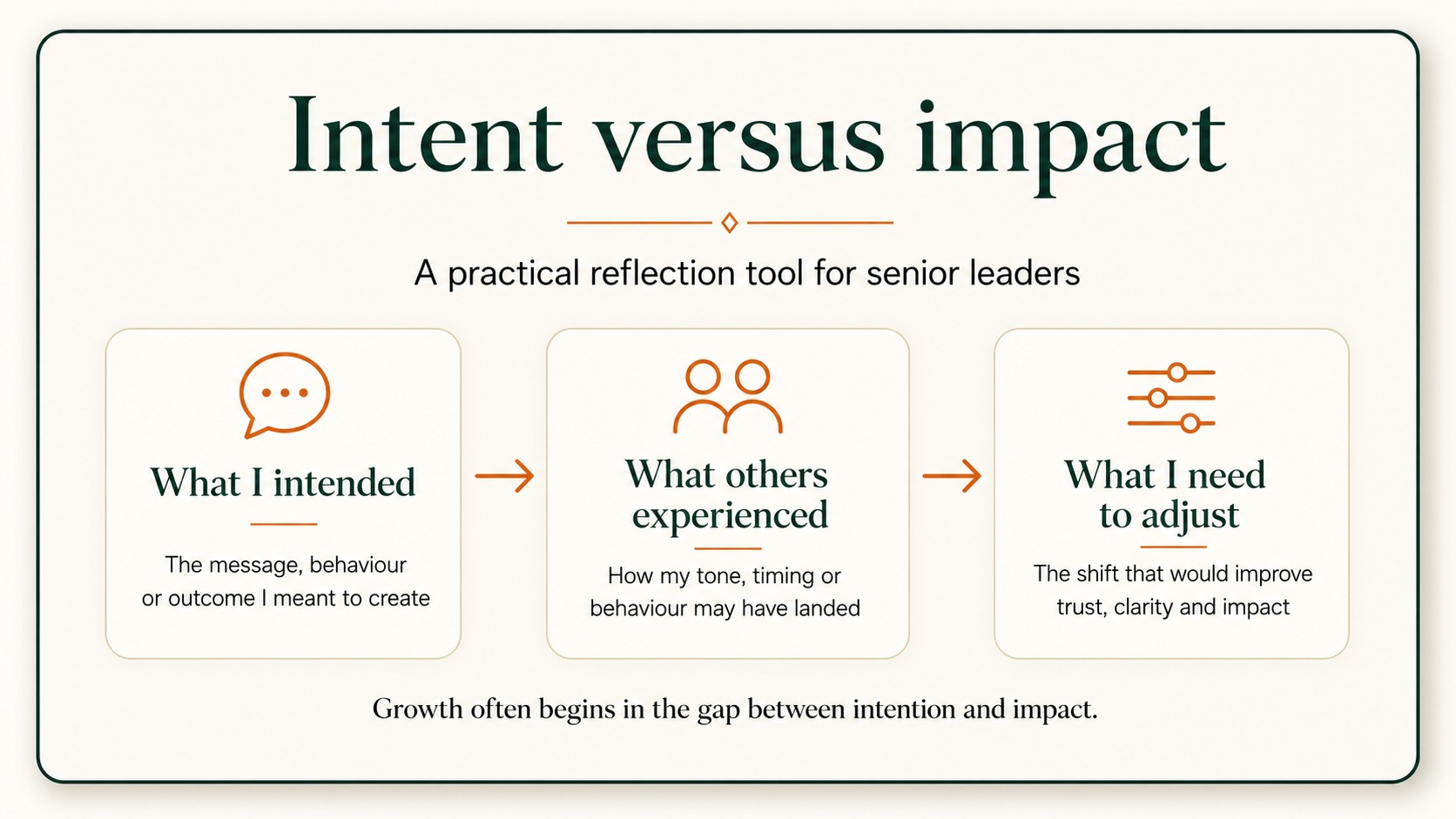
2. Review intent versus impact
Many senior leaders judge themselves by their intention. Others experience them through their impact.
The gap between intent and impact is often where emotional intelligence work begins.
After an important interaction, ask:
What did I intend?
What may others have experienced?
Where might there have been a gap?
What feedback have I heard before?
What do people probably not say to me directly?
This is especially useful for leaders who receive feedback such as:
“can be intimidating”
“needs to listen more”
“too direct”
“not visible enough”
“does not always read the room”
“can become defensive”
“needs to bring people with them”
The feedback may not be perfectly phrased, but it usually contains useful data.
3. Slow down your first response
Under pressure, the first response is often the least intelligent response.
It may be fast, familiar and emotionally driven.
Practise creating a small pause before responding. That pause does not need to be dramatic. It may be as simple as breathing, asking one question, or saying:
“Let me think about that for a moment.”
“What is the main concern behind that?”
“Can you say more about what is not working?”
“I want to understand the impact before I respond.”
“Let us slow this down.”
The pause gives the leader room to choose.
4. Practise reading the room
Room-reading is not mystical. It is disciplined observation.
In meetings, notice:
who speaks first
who speaks last
who does not speak
when people look down
when energy changes
when humour appears
when the topic gets moved on too quickly
when the formal conversation and informal conversation differ
Then ask:
What is the group avoiding?
Where is there real commitment?
Where is there polite agreement?
What might need to be named?
This is particularly important in leadership teams, transformation meetings and cross-functional work.
5. Ask better feedback questions
Generic feedback often produces generic answers.
Instead of asking “Do you have any feedback?”, ask more specific questions:
“When pressure rises, what do you notice in my leadership style?”
“Where do I create confidence?”
“Where might I unintentionally create caution or distance?”
“What do I do that helps people speak honestly?”
“What do I do that might make challenge harder?”
“What is one thing I could do differently in senior meetings?”
The quality of feedback often depends on the quality of the question.
6. Rehearse difficult conversations
Emotionally intelligent leadership is tested in difficult conversations.
Do not rely on instinct alone. Rehearse.
Before the conversation, clarify:
What is the real issue?
What do I need to say clearly?
What emotional reaction might this create?
What reaction might it create in me?
What do I need to avoid doing?
What would a clear and respectful opening sentence be?
A useful structure is:
name the issue
describe the impact
invite their perspective
stay with the tension
agree the next step
For example:
“I want to talk about something that may be uncomfortable. In recent meetings, I have noticed commitments being made and then not followed through. The impact is that trust across the team is starting to weaken. I would like to understand what is happening from your perspective and agree how we address it.”
That is not soft. It is clear, direct and relationally intelligent.
7. Repair faster
Even emotionally intelligent leaders get things wrong.
They misread the room. They speak too sharply. They avoid something for too long. They become impatient. They miss the emotional significance of a moment.
The difference is that emotionally intelligent leaders repair faster.
Repair might sound like:
“I do not think I handled that well.”
“I was too quick to respond.”
“I can see my tone may have got in the way.”
“I want to come back to something from yesterday.”
“I missed the concern behind what you were saying.”
“Let me try that again.”
Repair is not weakness. It is trust maintenance.
When emotional intelligence coaching helps
Emotional intelligence coaching can be particularly useful when a senior leader:
becomes reactive, defensive or overly forceful under pressure
avoids difficult conversations until issues become harder to repair
struggles to read the room in high-stakes meetings
receives feedback that their intent and impact do not always match
needs to build trust across complex stakeholder relationships
is technically or commercially strong but needs more influence through people
is leading through conflict, change, uncertainty or organisational politics
wants to strengthen executive presence, stakeholder confidence and leadership impact
Coaching helps because emotional intelligence is not developed in the abstract. It is developed through real leadership moments.
The work may include:
reviewing live leadership situations
identifying trigger patterns
exploring feedback themes
practising difficult conversations
strengthening emotional regulation
improving stakeholder awareness
understanding group and system dynamics
translating insight into behavioural change
The aim is not to turn the leader into someone else. It is to help them become more skillful, intentional and trustworthy under pressure.
Final thought
Emotional intelligence is not about becoming softer.
It is about becoming more accurate, more composed and more intentional in the moments where leadership has the greatest impact.
For senior leaders, the real test is not whether they understand emotional intelligence as an idea. It is whether they can use it when the room is tense, the decision is difficult, the stakeholder is frustrated, the feedback is uncomfortable or trust is at risk.
That is where emotional intelligence becomes leadership leverage.
When emotional intelligence becomes a leadership issue
If pressure is changing how a leader listens, speaks, decides or relates, the issue may not be capability. It may be impact under stress.
Emotional intelligence coaching helps senior leaders understand their patterns, regulate their response, read the room more accurately and build trust when the work is demanding.
Related reading
FAQ: Frequently asked questions about emotional intelligence in leadership
-
Emotional intelligence in leadership is the ability to notice, understand and manage emotional and relational information in yourself and others. It helps leaders stay composed, read the room, build trust, handle difficult conversations and influence effectively under pressure.
-
Yes. Emotional intelligence can be developed through feedback, reflection, practice, coaching and repeated attention to real leadership situations. It is not developed simply by learning a model. It improves when leaders become more aware of their patterns and practise different responses under pressure.
-
No. Empathy is part of emotional intelligence, but it is not the whole of emotional intelligence. Senior leaders also need self-regulation, judgement, courage, boundary-setting, conflict skill and the ability to use emotional information intelligently.
-
Emotional intelligence matters because senior leadership is relational, political and emotionally demanding. Leaders need to influence across difference, handle conflict, maintain trust, make decisions under pressure and create conditions where people can speak honestly.
-
Emotional intelligence supports executive presence because it shapes how a leader is experienced by others. A leader who can stay composed, listen under pressure, read the room and respond with clarity is more likely to create confidence and trust.
-
Emotional intelligence training often introduces concepts, tools and general techniques. EI coaching is more personalised. It works with a leader’s real situations, feedback, triggers, stakeholder relationships and behaviour under pressure.
-
Emotional intelligence coaching is particularly useful for senior leaders, executives, directors and high-potential leaders whose technical capability is strong, but whose next stage of impact depends on influence, trust, composure, communication and relationship management.
📚References
Brackett, M.A. and Salovey, P. (2006) ‘Measuring emotional intelligence with the Mayer-Salovey-Caruso Emotional Intelligence Test (MSCEIT)’, Psicothema, 18(Suppl.), pp. 34–41.
Côté, S. (2014) ‘Emotional intelligence in organizations’, Annual Review of Organizational Psychology and Organizational Behavior, 1, pp. 459–488. .
Goleman, D. (1995) Emotional Intelligence: Why It Can Matter More Than IQ. New York: Bantam Books.
Joseph, D.L. and Newman, D.A. (2010) ‘Emotional intelligence: An integrative meta-analysis and cascading model’, Journal of Applied Psychology, 95(1), pp. 54–78.
Mayer, J.D. and Salovey, P. (1997) ‘What is emotional intelligence?’, in Salovey, P. and Sluyter, D.J. (eds.) Emotional Development and Emotional Intelligence: Educational Implications. New York: Basic Books, pp. 3–31.
Mayer, J.D., Roberts, R.D. and Barsade, S.G. (2008) ‘Human abilities: Emotional intelligence’, Annual Review of Psychology, 59, pp. 507–536.
Mayer, J.D., Salovey, P. and Caruso, D.R. (2004) ‘Emotional intelligence: Theory, findings, and implications’, Psychological Inquiry, 15(3), pp. 197–215.
Miao, C., Humphrey, R.H. and Qian, S. (2017) ‘A meta-analysis of emotional intelligence and work attitudes’, Journal of Occupational and Organizational Psychology, 90(2), pp. 177–202.
O’Boyle, E.H. Jr, Humphrey, R.H., Pollack, J.M., Hawver, T.H. and Story, P.A. (2011) ‘The relation between emotional intelligence and job performance: A meta-analysis’, Journal of Organizational Behavior, 32(5), pp. 788–818.
Salovey, P. and Mayer, J.D. (1990) ‘Emotional intelligence’, Imagination, Cognition and Personality, 9(3), pp. 185–211.

Under the Surface
A monthly briefing on the hidden dynamics shaping senior leadership, teams and change…
Read next…