Leadership Team Reset: 7 Signs Your Senior Team Has Outgrown Its Old Way of Working
Senior leadership teams often keep functioning long after their way of working has stopped being fit for purpose.
The meetings continue. The agenda looks sensible. The strategy is discussed. Everyone is experienced, capable and busy.
But the quality of the work starts to change.
Decisions take longer. Important disagreements are softened or moved outside the room. People leave with slightly different interpretations of what was agreed. The CEO, MD or founder finds themselves doing more of the alignment work than they should. Functional leaders say they support the enterprise agenda, while still protecting the priorities of their own area.
None of this necessarily looks dramatic.
In fact, that is the danger.
A senior team can appear stable while its collective leadership is quietly weakening.
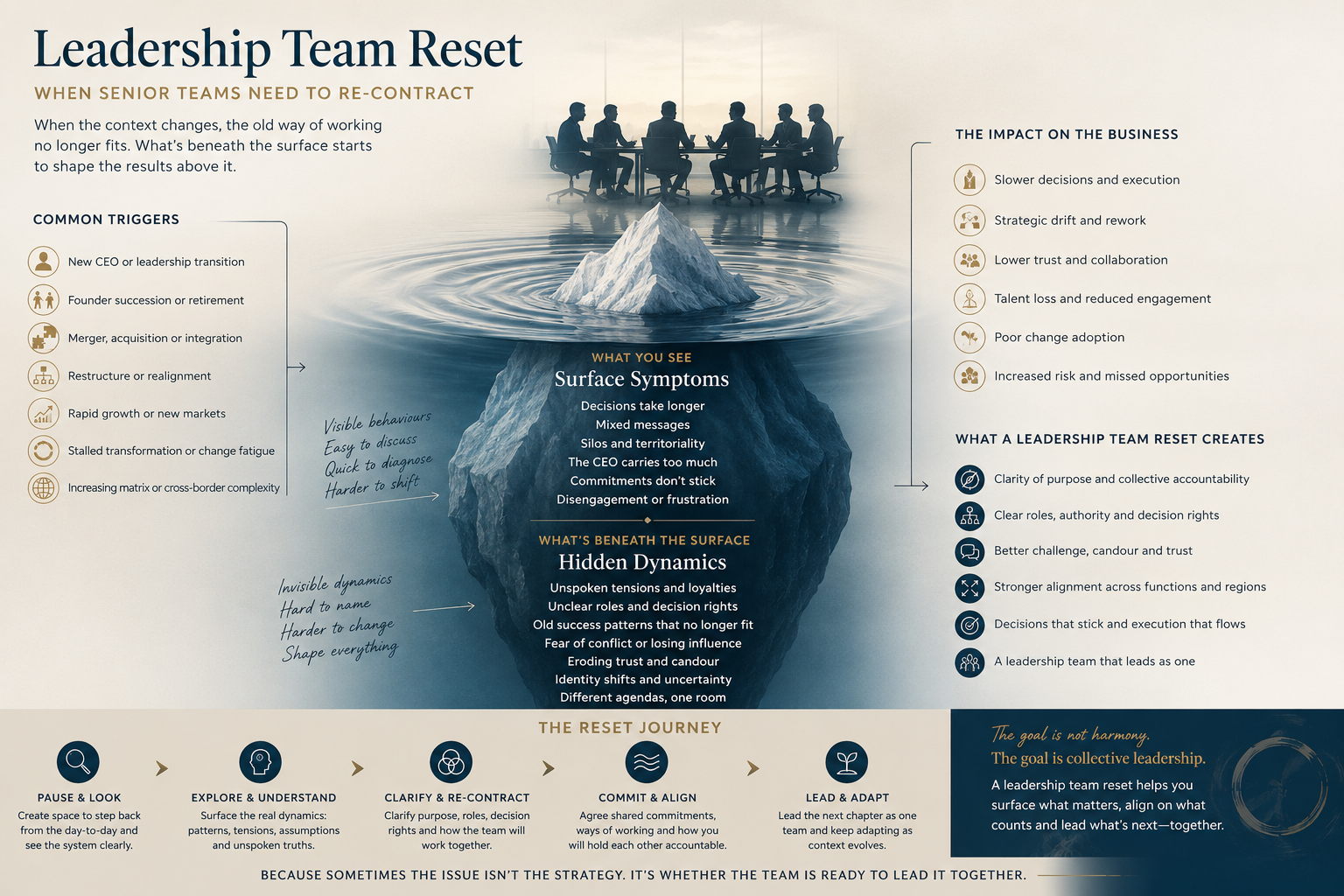
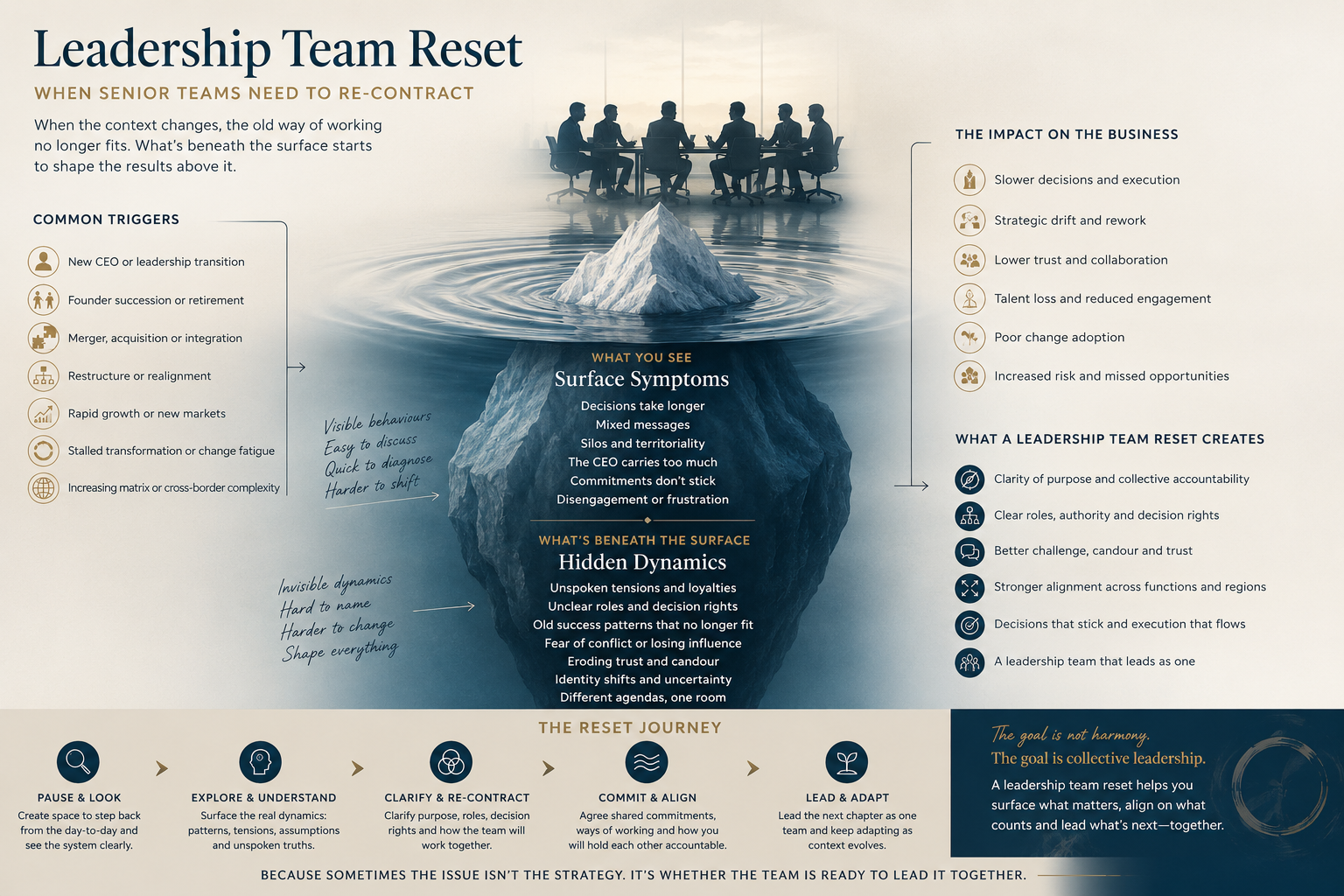
This often happens after a change in context: a new CEO, founder succession, senior leader retirement, merger, restructure, rapid growth, stalled transformation or a shift into a more complex matrix. The team may have the same title and many of the same people, but the work has changed.
A leadership team reset is needed when the team’s old ways of deciding, challenging, collaborating and holding accountability no longer match the complexity of the business.
This is not about team bonding or another away day.
It is about helping the senior team pause, look honestly at how it is operating, and re-contract around the work it now needs to do.
Quick answer: what is a leadership team reset?
A leadership team reset is a structured process that helps a senior team review and renew how it works together.
It focuses on the conditions that shape collective performance: purpose, roles, authority, decision rights, trust, challenge, accountability and the hidden dynamics that influence how the team behaves under pressure.
A useful reset helps the team ask:
What is the real work of this leadership team now?
What has changed in our context?
Where are old habits no longer serving us?
What decisions need clearer ownership?
What conversations are we avoiding?
How do we lead as one team across functions, regions and priorities?
What do we need to re-contract around before the next phase of work?
A reset brings the leadership team back to the work it exists to do.
For a broader evidence-led explanation of why capable senior teams underperform, read High-Performing Executive Teams: Why Individual Capability Is Not Enough.
Leadership Team Reset: When Senior Teams Need to Re-contract
When do senior teams need a reset?
Senior teams often need a reset after disruption, transition or growth.
Sometimes the trigger is visible. A new CEO joins. A merger takes place. A restructure changes reporting lines. A transformation programme starts to lose momentum.
Sometimes the trigger is quieter. A long-standing senior leader retires. Several new executives join over a short period. The business grows faster than its operating rhythm. The team becomes more global, more matrixed or more politically complex.
Common triggers include:
New CEO, MD or divisional leader
Authority, expectations and loyalties shift. Watch for: people waiting to see what is safe to say, old loyalties staying active, or the team over-adapting to the new leader.
Founder succession or retirement
Dependency, identity and informal power are disturbed. Watch for: the team struggling to take up authority without the founder, or continuing to organise itself around the founder’s preferences.
Senior leader retirement
Knowledge, influence and role boundaries change. Watch for: informal power moving quickly, competition for influence, or people stepping into roles that have not been agreed.
Several new executives joining
The team needs to re-contract, not just onboard individuals. Watch for: old and new members forming camps, with different assumptions about pace, trust and decision-making.
Merger, acquisition or integration
Us-and-them dynamics can appear quickly. Watch for: acquiring and acquired leaders protecting their own history, status, culture or version of the future.
Restructure
Roles, reporting lines and who decides what can become unsettled. Watch for: caution, territorial behaviour, or uncertainty about where authority now sits.
Rapid growth
Old informal ways of working stop scaling. Watch for: slower decisions, the CEO becoming a bottleneck, and previously effective habits creating confusion.
Stalled transformation
Alignment, belief and accountability may be weakening. Watch for: leaders publicly supporting the change while privately questioning feasibility, ownership or priorities.
Matrix or global complexity
Functions and regions may interpret priorities differently. Watch for: central alignment on paper, but local, functional or regional realities pulling execution in different directions.
Board pressure or crisis
Anxiety, defensiveness and blame can increase. Watch for: narrowed thinking, risk avoidance, blame, or the team waiting for direction from the most powerful person.
These moments disturb the informal system of the team.
Power shifts. Loyalties move. Roles become uncertain. Old assumptions are challenged. People begin to test what is safe to say, who really has authority, and whether the team is genuinely committed to the same outcomes.
The formal structure may change quickly. The working relationships, habits and assumptions often take longer to adjust.
A common leadership team reset scenario
Imagine a senior leadership team after a period of major change.
The organisation has a new strategy. Two new executives have joined. A long-standing leader has retired. The business is now operating across more regions and the transformation agenda has become more urgent.
On paper, the team is strong.
In practice, the team is starting to fragment.
The new leaders are still learning the informal rules. The longer-serving members carry history that is not fully visible. Some people are loyal to the previous strategy. Others want to move faster. Regional leaders agree in principle, then adapt the message locally. Functional leaders support enterprise priorities, but quietly defend their own targets.
No one has to be behaving badly for the pattern to become costly.
The team has not yet re-contracted for the new reality.
Without a reset, these dynamics can become embedded. Decisions slow down. Trust weakens. The CEO becomes the integrator of every tension. The wider organisation receives mixed messages.
A leadership team reset creates the space to make these dynamics visible before they become the culture.
7 signs your leadership team needs a reset
1. Decisions do not stick
The team appears to agree, but the decision weakens after the meeting.
People reinterpret what was agreed. Implementation slows. The same issue returns again and again. Leaders leave the meeting with different versions of the decision.
This is often not a problem of intelligence. It is usually a problem of clarity, commitment or unspoken disagreement.
The question is not just “did we decide?”
The better question is: did we create enough shared understanding and commitment for the decision to hold?
In transformation work, this is especially costly. A decision that does not stick at senior level becomes confusion, delay and resistance further down the organisation.
2. The meeting after the meeting becomes more honest than the meeting
Side conversations are not always unhealthy.
Senior leaders need space to reflect, test ideas and process complexity. The problem comes when the real conversation consistently happens outside the room.
When this happens, the leadership team is no longer the place where the real work is being done.
This often signals low trust, unclear authority, fear of conflict or uncertainty about what can safely be challenged.
In cross-cultural teams, this can be more complex. Different norms around directness, hierarchy, silence, disagreement and saving face can shape what is said openly and what is held back.
A leadership team reset can help make these differences discussable without blaming individuals or cultures.
3. The CEO is carrying too much of the team
The CEO, MD or senior sponsor becomes the person who resolves tensions, integrates priorities and keeps the team aligned.
At first, this can look efficient.
Over time, it creates dependency.
The team waits. The leader rescues. Accountability moves upwards. Senior colleagues become spokespeople for their functions rather than co-owners of the enterprise.
This is one of the most important warning signs in senior team dynamics.
The issue is not whether the CEO is strong. The issue is whether the team has enough collective leadership to avoid making the CEO the container for everything.
A reset helps the team ask: what should the CEO hold, and what must the team hold collectively?
When the pattern is becoming visible
If decisions are slowing, side conversations are becoming more honest than the meeting, or the CEO is carrying too much alignment work, the issue may not be another communication problem.
The useful work is often to understand what the senior team is signalling through its behaviour: where authority is unclear, trust is under strain, decision rights are blurred, or accountability is being carried by too few people.
4. Functions protect their own priorities
Finance protects finance. Commercial protects commercial. HR protects HR. Operations protects operations. Regional leaders protect local realities. Technical leaders protect technical truth.
None of this is irrational. Each leader has real responsibilities.
The problem comes when functional loyalty overwhelms enterprise leadership.
In matrix organisations, this is one of the defining leadership challenges. Senior leaders have to represent their areas without becoming trapped inside them. They need to hold both the legitimate needs of their function or region and the collective work of the enterprise.
When this does not happen, the team may look aligned at the top while the organisation experiences competing priorities underneath.
5. Conflict is either too polite or too personal
Some leadership teams avoid conflict.
They maintain harmony, but leave the real issues untouched.
Others personalise conflict.
The issue becomes the difficult CFO, the dominant founder, the resistant HRD, the cautious technical leader or the commercial team that “never listens”.
Both patterns are risky.
Avoidance keeps the team comfortable but stuck. Personalisation makes one person or function carry a wider team issue.
A reset helps the team move from blame to shared responsibility.
The aim is not to remove tension. Senior teams need tension. Strategy, transformation and innovation all involve trade-offs.
The aim is to make tension useful rather than political, hidden or destructive.
6. New members join, but the team does not re-contract
A new executive does not simply join the team.
They change the team.
Power shifts. Influence changes. Old alliances are disturbed. New questions emerge around credibility, belonging and authority.
If several new leaders join, the team may split into old and new, legacy and future, head office and local, acquired and acquiring.
This is why individual onboarding is not enough.
The team needs to re-contract, not just welcome the new person.
What does this team now exist to do?
How will authority work?
What expectations need to be reset?
What old habits no longer fit?
What does the new team need from the longer-serving members, and what do they need from the new arrivals?
Without these conversations, the new team can unconsciously recreate the old one.
7. The team is still using an old success formula
Many leadership teams become trapped by what once made them successful.
A founder-led team may need to move from loyalty to the founder towards shared enterprise leadership.
A growth-stage team may need to move from entrepreneurial pace to clearer decision rights.
A technical leadership team may need to move from expertise to influence.
A transformation team may need to move from programme control to systemic change leadership.
The old way may not be wrong. It may simply no longer be enough.
This is often where senior leaders feel the strain most personally. The behaviours that built credibility in one context may not create the same impact in the next.
A leadership team reset helps the team distinguish between what should be preserved and what now needs to evolve.
What needs to be reset?
A useful leadership team reset works below the surface, but stays firmly connected to business performance.
The aim is not to turn the team into a therapy group. The aim is to help the team lead the organisation more effectively.
Six areas usually need attention.
Purpose
What work can only this team do?
Roles
Are people clear about what role they are now in?
Authority
Who has the right to decide, challenge or sponsor?
Collective decisions
Which decisions need collective ownership?
Trust and challenge
What needs to be said that is not being said?
Accountability
What must the team hold collectively, not just individually?
Purpose and task
Senior teams need clarity about why they exist as a team.
This sounds obvious, but many leadership teams are clearer about individual accountabilities than collective purpose.
A senior team is not just a reporting forum. It should be the place where enterprise-level judgement, trade-offs and leadership are exercised.
Useful questions include:
What work can only this team do?
What are we collectively accountable for?
Where do we need to act as one leadership team?
What should not be on this team’s agenda?
What are we avoiding because it is difficult, political or uncomfortable?
Without a clear shared task, senior teams become meeting structures rather than leadership systems.
Roles, authority and decision rights
Many senior team problems are really role and authority problems.
Who has the right to decide? Who needs to be consulted? Who owns the risk? Who is acting as adviser, approver, sponsor or decision-maker?
When these boundaries are unclear, frustration grows.
People either overstep, withdraw or wait for the most powerful person to decide.
Slow decision-making is rarely just a process issue. It is often a trust issue, a role issue or a conflict issue.
Some teams revisit decisions because they never truly committed. Others escalate too much to the CEO. Others confuse consultation with consensus. Others avoid naming the real trade-off.
A reset helps the team clarify which decisions require collective ownership, which sit with individual executives, where the CEO needs to decide and how disagreement will be handled before and after the decision.
Trust, candour and challenge
Senior teams do not need artificial harmony.
They need enough trust to disagree well.
At senior level, psychological safety is not about comfort. It is about whether people can speak honestly about risks, mistakes, concerns, tensions and competing views in service of the work.
A team that cannot challenge itself will be challenged by the market, the board, customers, employees or events.
A reset should ask:
What is difficult to say in this team?
Where do we soften the message?
Where do we confuse politeness with trust?
Where do we need more directness?
Where has challenge become unsafe, political or personal?
Whose voice is missing or under-used?
The goal is not endless debate. The goal is productive challenge that improves judgement and execution.
Accountability
Accountability in senior teams is often misunderstood.
It is not only about each executive delivering their own area. It is also about holding each other to the collective work of the enterprise.
This is where many teams struggle.
Senior leaders may avoid challenging peers because they do not want to damage relationships, expose tensions or appear to interfere. The result is that accountability rolls upwards to the CEO.
A reset helps the team define what peer accountability should look like in practice.
What will we hold each other to?
How will we challenge drift?
How will we name under-delivery?
How will we repair when trust is damaged?
How will we stop difficult issues being carried by one person?
The test is simple: does the team hold itself to account, or does it wait for the CEO, board or crisis to do it?
Why this matters in matrix and transformation environments
In matrix organisations, senior leaders often carry multiple loyalties.
They may be accountable to a function, region, product line, programme, market or global business unit. They are expected to collaborate across boundaries, but they are also measured on local or functional performance.
This creates real tension.
A leader may support enterprise alignment while still feeling pressure to defend their own area. A regional leader may support the global strategy while worrying that local realities are being missed. A transformation leader may need pace and consistency while operational leaders feel delivery pressure, risk and fatigue.
The issue is not that these tensions exist.
The issue is whether the leadership team can work with them openly enough.
This is why systemic team coaching is particularly relevant. It helps the team see not only how members relate to each other, but also how the team relates to stakeholders, customers, the board, employees and the wider organisational context.
How team coaching supports a leadership team reset
A leadership team reset can be done badly.
A weak version becomes a pleasant offsite with flipcharts, personality profiles and vague commitments.
A stronger version creates a structured space where the team can examine how it is really operating.
Leadership team coaching helps the team notice:
how decisions are really made
who speaks and who stays quiet
where authority sits
what conversations are avoided
how disagreement is handled
where accountability rolls upwards
how the team relates to the wider organisation
what patterns repeat under pressure
Good team coaching does not replace leadership. It helps the team take up leadership more fully.
For a practical guide to what the work involves, when it is useful and what to expect, see Executive Team Coaching: What It Is, How It Works and When Senior Teams Need It.
For senior teams, this matters because their patterns do not stay inside the room.
If the senior team avoids conflict, the organisation learns avoidance.
If the senior team works in silos, the organisation works in silos.
If the senior team sends mixed messages, the organisation learns confusion.
If the senior team handles tension well, the organisation has a better chance of doing the same.
Is your senior team going through a reset?
If your senior team is facing transition, growth, restructure, succession, stalled transformation, cross-cultural complexity or increasing matrix pressure, it may be time to look at how the team is really working.
A leadership team diagnostic can help identify where alignment, trust, decision-making, accountability and hidden dynamics need attention before disruption becomes embedded.
Leadership team coaching creates a confidential, structured space for senior teams to work on the conversations, patterns and decisions that shape collective performance.
Because sometimes the issue is not the strategy.
It is whether the team is ready to lead it together.
FAQ: Leadership Team Reset
Q. What is a leadership team reset?
A leadership team reset is a structured process that helps a senior team review and renew how it works together. It focuses on purpose, roles, authority, decision-making, trust, accountability and the patterns that shape collective performance.
Q. When should a senior leadership team consider a reset?
A reset is often useful after a new CEO, founder succession, senior leader retirement, restructure, merger, acquisition, rapid growth, stalled transformation or a period of increasing conflict, drift or slow decision-making.
Q. Is a leadership team reset the same as team building?
No. Team building often focuses on relationships, morale or shared experience. A leadership team reset focuses on how a senior team leads the business together, makes decisions, handles tension and creates collective accountability.
Q. How does team coaching help a leadership team reset?
Team coaching creates a structured space for the team to examine how it is really operating, surface hidden dynamics, improve decision-making, strengthen trust and clarify how it will work together in the next phase.
Q. What are the signs that a leadership team needs coaching?
Common signs include decisions not sticking, side conversations becoming more honest than formal meetings, the CEO carrying too much alignment work, functional priorities overriding enterprise priorities, conflict becoming avoided or personalised, and the team continuing to use old habits in a changed context.
Is your senior team ready for its next chapter?
A leadership team reset can help senior teams pause, see the patterns beneath the surface, and re-contract around the work they now need to do together.
Eve Coaching and Consulting provides leadership team coaching and diagnostic work for senior teams navigating transition, growth, complexity and change. The focus is practical and psychologically informed: clearer purpose, stronger decision-making, healthier challenge and more collective accountability.
📚References and further reading
Armstrong, D. (2005) Organization in the mind: psychoanalysis, group relations and organizational consultancy. Edited by R. French. London: Karnac.
Bion, W.R. (1961) Experiences in groups and other papers. London: Tavistock Publications.
Clutterbuck, D., Gannon, J., Hayes, S., Iordanou, I., Lowe, K. and MacKie, D. (eds.) (2019) The practitioner’s handbook of team coaching. Abingdon: Routledge.
Edmondson, A.C. (1999) ‘Psychological safety and learning behavior in work teams’, Administrative Science Quarterly, 44(2), pp. 350-383.
Hackman, J.R. (2002) Leading teams: setting the stage for great performances. Boston, MA: Harvard Business School Press.
Hawkins, P. (2021) Leadership team coaching: developing collective transformational leadership. 4th edn. London: Kogan Page.
Hawkins, P. (2022) Leadership team coaching in practice: case studies on creating highly effective teams. 2nd edn. London: Kogan Page.
Keller, S. and Meaney, M. (2018) Successfully transitioning to new leadership roles. McKinsey & Company. Available at: https://www.mckinsey.com/capabilities/people-and-organizational-performance/our-insights/successfully-transitioning-to-new-leadership-roles (Accessed: 30 May 2026).
Kozlowski, S.W.J. and Ilgen, D.R. (2006) ‘Enhancing the effectiveness of work groups and teams’, Psychological Science in the Public Interest, 7(3), pp. 77-124.
Mathieu, J., Maynard, M.T., Rapp, T. and Gilson, L. (2008) ‘Team effectiveness 1997-2007: a review of recent advancements and a glimpse into the future’, Journal of Management, 34(3), pp. 410-476.
Menzies Lyth, I.E.P. (1960) ‘A case-study in the functioning of social systems as a defence against anxiety: a report on a study of the nursing service of a general hospital’, Human Relations, 13(2), pp. 95-121.
Obholzer, A. and Roberts, V.Z. (eds.) (1994) The unconscious at work: individual and organisational stress in the human services. London: Routledge.
Schippers, M.C., Edmondson, A.C. and West, M.A. (2014) ‘Team reflexivity as an antidote to team information-processing failures’, Small Group Research, 45(6), pp. 731-769.
Tannenbaum, S.I. and Cerasoli, C.P. (2013) ‘Do team and individual debriefs enhance performance? A meta-analysis’, Human Factors, 55(1), pp. 231-245.
Wageman, R., Nunes, D.A., Burruss, J.A. and Hackman, J.R. (2008) Senior leadership teams: what it takes to make them great. Boston, MA: Harvard Business Press.
Watkins, M.D. (2013) The first 90 days: proven strategies for getting up to speed faster and smarter. Updated and expanded edn. Boston, MA: Harvard Business Review Press.
West, M.A. (2012) Effective teamwork: practical lessons from organizational research. 3rd edn. Oxford: Blackwell Publishing.

Under the Surface
A monthly briefing on the hidden dynamics shaping senior leadership, teams and change…
Read next…