Choosing the Right Leadership Development Intervention: Coaching, Training, Mentoring or Something Else?
One of your strongest leaders is ready for a bigger role.
There is just one problem.
The expertise, drive and behaviours that helped them succeed so far are starting to create difficulties at the next level.
Perhaps they dominate rather than influence. Become defensive when challenged. Hold on to too much. Over-rely on expertise. Struggle to adapt their communication. Or leave important stakeholders less confident than their results suggest they should.
They are valuable. You do not want to lose them.
So what development do they actually need?
Coaching? Training? Mentoring? A 360? Team development? Something else entirely?
That question matters because similar-looking leadership problems can have very different causes.
A knowledge gap requires a different response from an ingrained behavioural pattern. Lack of experience is different from lack of self-awareness. And what appears to be a problem with one leader may actually sit partly within a relationship, leadership team or wider organisational system.
Executive coaching can be highly effective. So can training, mentoring, assessment, team development and organisation development.
None is universally the right answer.
The better starting point is:
What needs to change, what is maintaining the current situation, and where does the issue actually sit?
Good leadership development starts with diagnosis before prescription.
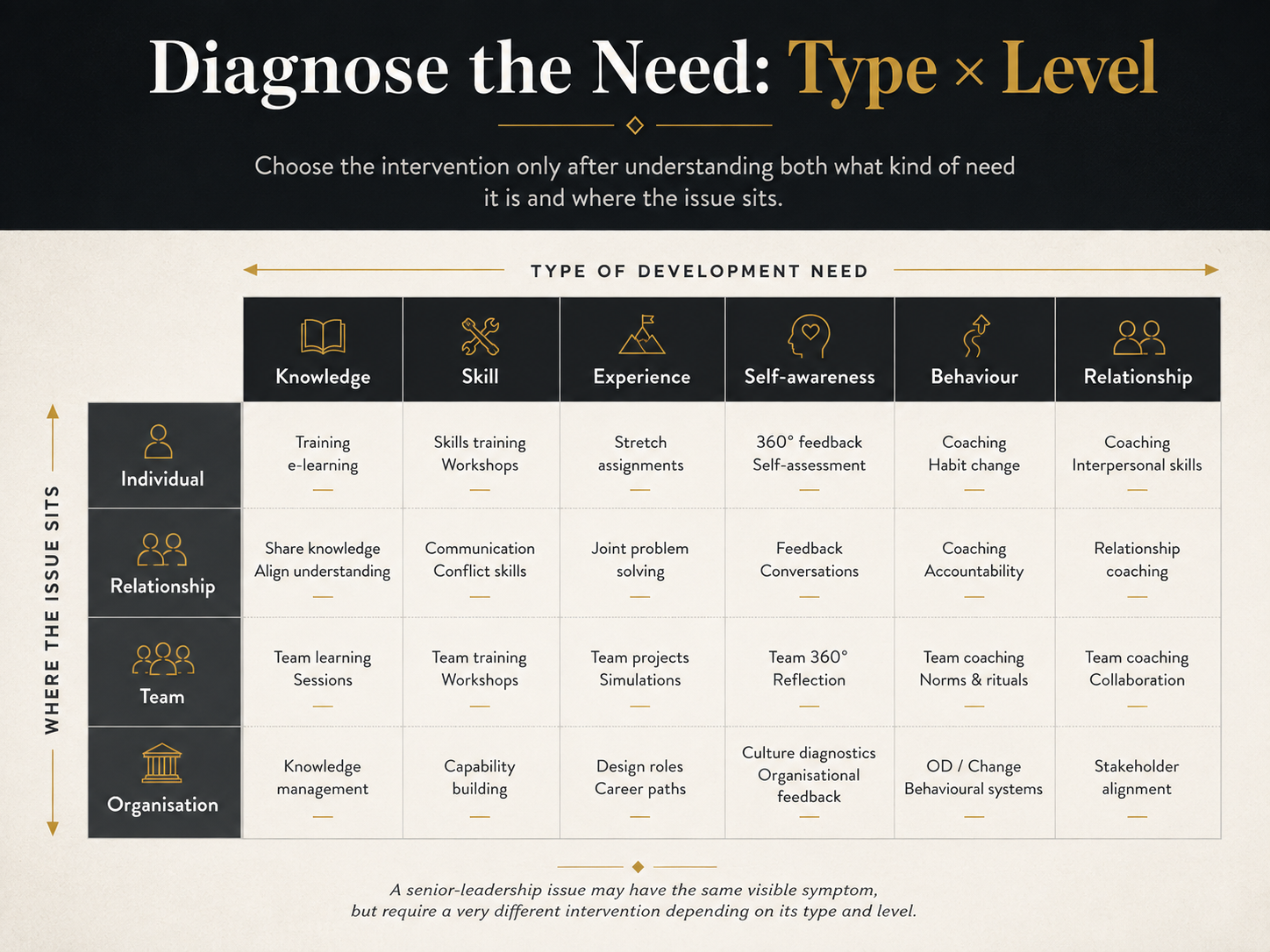
A leadership challenge needs to be understood both by the type of development required and the level at which the issue sits. The matrix helps diagnose the need. It does not prescribe a single intervention.
Why choosing the right leadership development intervention matters
Consider a familiar piece of leadership feedback:
“They need to delegate more.”
That sounds straightforward.
It may not be.
The leader may never have learnt how to delegate effectively. That suggests a skills intervention.
They may be new to leading through several management layers and need perspective from someone who has made that transition. Mentoring could be valuable.
They may understand delegation perfectly well but, under pressure, become uncomfortable with uncertainty, lower their trust in others and take control back. That is much more likely to benefit from coaching.
Their direct reports may also have learnt to escalate difficult decisions rather than accept accountability. Now we have a team dynamic.
Or perhaps decision rights are unclear, mistakes carry disproportionate consequences and senior leaders frequently overturn delegated decisions. Reluctance to delegate may then be partly rational.
Same visible behaviour. Five different diagnoses. Five potentially different responses.
The important question is therefore not simply:
“Would coaching help?”
It is:
“What is really causing or maintaining this behaviour?”
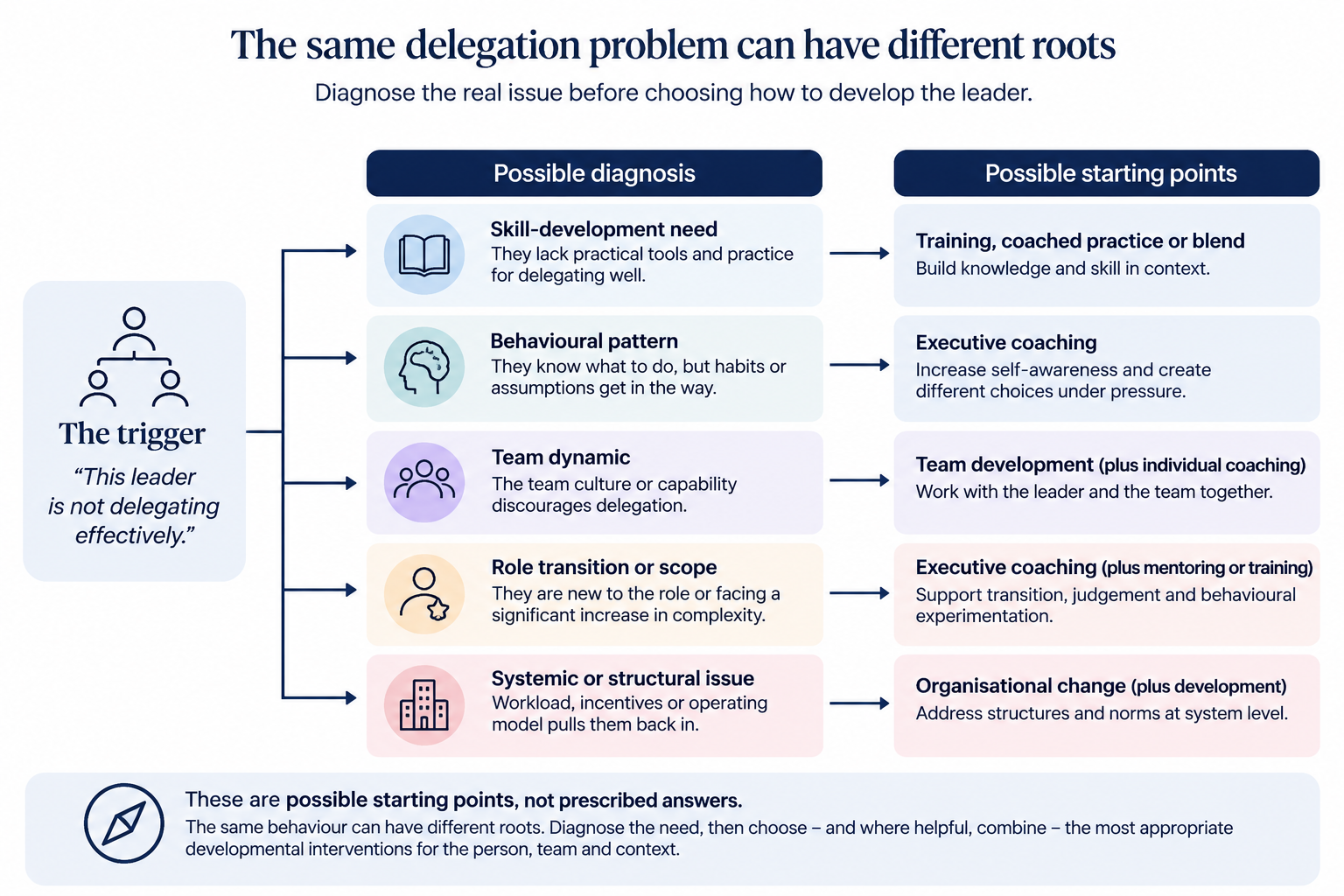
The same visible behaviour can have very different causes, which is why diagnosis should come before choosing the intervention.
Not every leadership challenge is a coaching problem
Coaching has become an established element of senior leadership development, but it should not become the default response to every difficult development need.
If someone needs to learn something, teach them.
If they need access to relevant experience and advice, give them access to it.
Those distinctions are useful, but they are centres of gravity rather than rigid boundaries. Training, mentoring and professional coaching can all involve learning, reflection, challenge and skill development. The question is what each is primarily being used to achieve, and how it is being used in the particular context.
If there is a genuine performance-management issue, manage it.
If the same behaviour keeps emerging between members of a leadership team, consider the team.
If organisational structures, incentives or leadership behaviour are sustaining the problem, examine the system.
And where the challenge involves self-awareness, behavioural flexibility, judgement, assumptions, relationships, transition or how a capable leader responds under pressure, coaching may be particularly valuable.
What do we mean by a leadership development intervention?
“Intervention” can sound rather clinical.
Here it simply means a deliberate action intended to create a defined developmental or organisational change.
That might include:
training and deliberate practice
mentoring
360-degree feedback
experiential learning or stretch assignments
facilitated dialogue
leadership team development or team coaching
changes to organisational processes, structures or incentives
organisation development or wider transformation work
These are not all equivalent types of intervention. Training, mentoring and coaching are developmental processes. 360 feedback and psychometric assessment often provide data or hypotheses that feed a wider development process. Team and organisation development work at different levels of the system. In practice, several may be deliberately combined.
CIPD uses the term across both learning and organisation development, encompassing individual, group and organisational approaches.
The label matters less than whether the intervention is well diagnosed, appropriately chosen and competently delivered.
What makes a leadership development intervention effective?
Choosing coaching rather than training is only part of the decision.
A poorly designed coaching engagement remains a poor intervention.
So does an excellent training programme aimed at the wrong challenge.
There are several fundamentals that make any leadership development intervention more likely to create meaningful change.
1. Diagnose the development need before choosing the solution
Start by understanding the gap between the current situation and the desired one.
CIPD's guidance on learning needs analysis similarly begins with understanding current and future capability needs, including gaps in knowledge, skills and attitudes, rather than immediately selecting a learning method.
This sounds obvious.
Yet organisations can easily reverse the logic.
They have bought a leadership programme, commissioned a coaching provider or adopted a particular assessment and then start looking for people to put through it.
The more useful question is:
What evidence do we have about what is getting in the way?
2. Define what should be different as a result
“Develop greater executive presence.”
“Become more strategic.”
“Improve collaboration.”
“Communicate more effectively.”
These may be legitimate development themes, but they are not yet sufficiently clear outcomes.
What would actually be different?
Perhaps the leader would communicate their recommendation earlier and more succinctly with the executive committee.
Perhaps they would stop solving operational problems themselves and create greater accountability one level below.
Perhaps members of the leadership team would surface disagreement before a decision rather than reopening it afterwards.
The clearer the desired change, the easier it becomes both to choose the intervention and to judge whether it worked.
3. Match the intervention to the type, level and mechanism of change
A useful diagnosis has at least two dimensions.
First:
What kind of development need is this?
Knowledge? Skill? Experience? Judgement? Self-awareness? Behaviour? Relationships?
Then:
Where does the issue primarily sit?
With the individual? Between people? Within the leadership team? Or in the wider organisation?
Those two questions are more useful than simply asking whether someone “needs coaching”.
Then ask what is most likely to help change occur. Does the person need knowledge, deliberate practice, feedback, greater self-awareness, exposure to relevant experience, behavioural experimentation, a different way of making sense of the situation, relational work, or change in the surrounding system?
The same development need can sometimes be addressed through more than one route.
4. Consider the context in which new behaviour has to survive
Leadership behaviour does not happen in a vacuum.
People operate inside systems of goals, incentives, authority, relationships, norms and consequences.
Research into training transfer has repeatedly demonstrated that what happens after learning matters. Motivation and characteristics of the work environment influence whether learning appears later in workplace behaviour (Blume et al., 2010).
That gives HR another useful question:
If this person changes, what around them will support that change, and what may pull them back towards their previous behaviour?
5. Build in application, practice and feedback
Insight is not behaviour change.
Neither is attendance.
Large-scale research on leadership training suggests that well-designed programmes can improve learning, transfer and organisational outcomes, but design matters. Needs analysis, practice, feedback and spaced learning are among the factors associated with better outcomes (Lacerenza et al., 2017).
Whatever intervention is chosen, people need opportunities to apply learning to the reality of their work.
6. Engage the leader and the people who matter
Development should not simply be done to a leader.
Their understanding of the situation matters.
Their goals matter.
Their interpretation of the feedback matters.
Their motivation matters.
Passmore and Lai (2019), for example, highlight the importance of the coachee's motivation alongside the coaching relationship and broader social and psychological context.
This does not mean the leader gets to define reality entirely on their own.
HR, line managers and other stakeholders may see patterns that the leader cannot yet see.
But diagnosis works better as a process of inquiry than as a verdict handed to somebody.
7. Decide how you will know whether anything changed
The weakest evaluation question is:
“Did they enjoy it?”
A more meaningful question is:
“What is different?”
Is the leader behaving differently?
Are important stakeholders experiencing them differently?
Has decision-making changed?
Are direct reports taking greater accountability?
Is the leadership team functioning differently?
Has the development changed something that actually matters?
Not every intervention needs an artificial financial ROI calculation.
But it should normally be possible to describe what reasonable evidence of progress would look like.
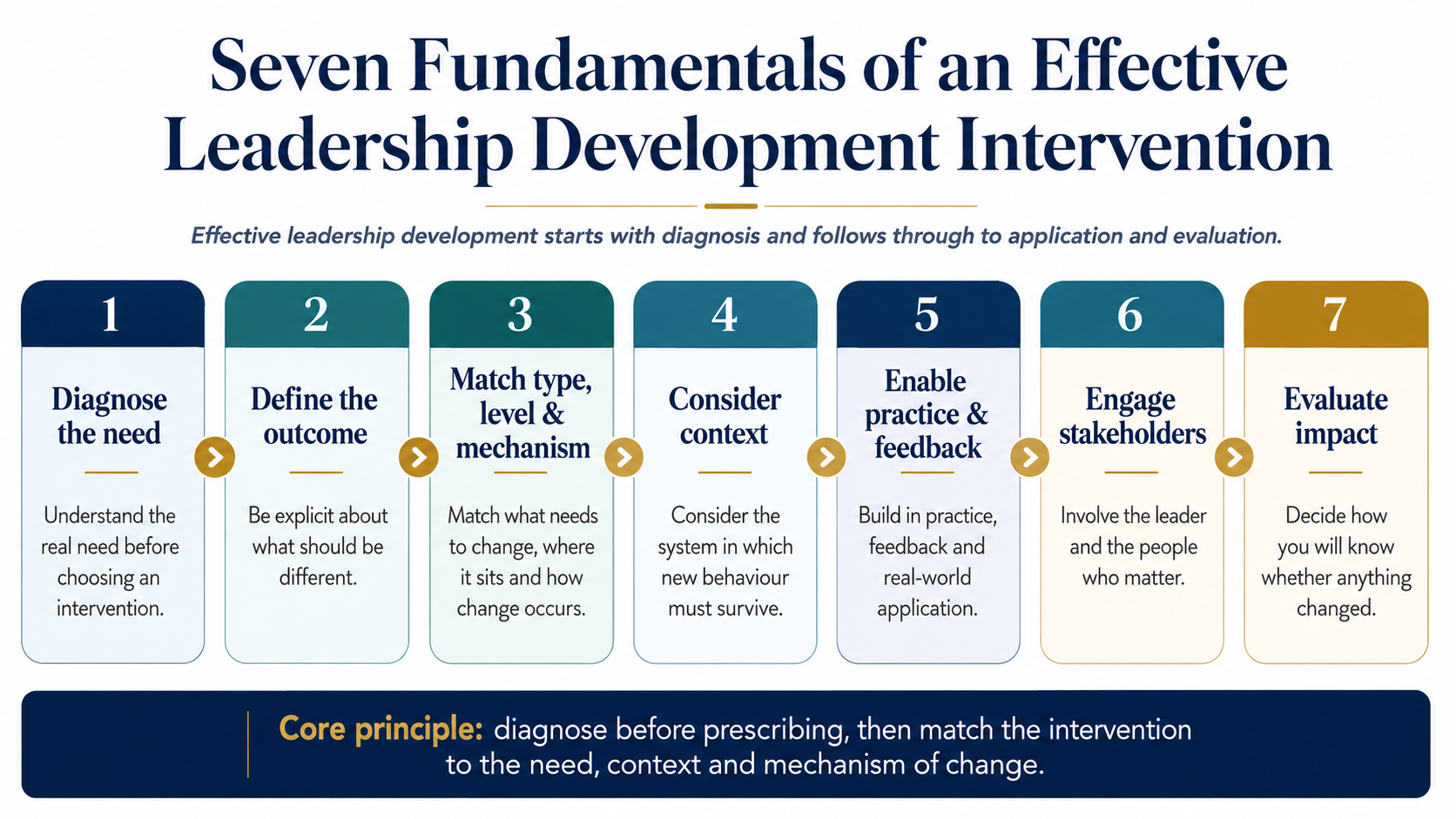
Effective leadership development starts with a clear need and builds through context, application, stakeholder engagement and evaluation.
Diagnose the need: what needs to change and where does the issue sit?
This is the centre of the decision.
What type of development need is it?
A useful first diagnosis is to consider whether the primary need involves:
Knowledge: Does the leader know what they need to know?
Skill: Can they perform the behaviour effectively?
Experience: Have they encountered sufficient relevant situations to develop judgement?
Self-awareness: Do they understand their patterns and how others experience them?
Behaviour: Is there a gap between what they know and what they consistently do?
Judgement: Are they navigating genuinely complex choices for which there is no simple technical answer?
Relationships: Does the difficulty emerge primarily through interactions with particular people or groups?
These are not rigid boxes. Leadership challenges often involve several at once.
At what level does the issue sit?
Next ask whether it is principally:
Individual: associated mainly with one person's capability, thinking or behaviour.
Relational: created or maintained between people.
Team: repeatedly produced through collective patterns.
Organisational: materially affected by structures, incentives, norms, processes or the wider leadership environment.
This distinction matters because an individual intervention may still help at every level, but it may not be sufficient.
Treat the diagnosis as a hypothesis, not a verdict
This is an important qualification.
A framework like this should be used as a decision aid, not a diagnostic algorithm.
HR may believe:
“He needs to listen more.”
The leader may believe:
“Nobody makes a decision unless I step in.”
Their manager may see something different again.
Those perspectives are data.
Good diagnosis involves understanding them, testing assumptions and developing a sufficiently credible picture of what is happening before deciding how to intervene.
Coaching vs training: which is the right development approach?
Training and professional coaching can both develop leadership capability, including skills. Their centres of gravity, however, are different.
Training usually begins with defined learning objectives and content that can be taught and practised systematically. Professional coaching begins with the individual leader, their goals and the context in which they need to perform.
When leadership training is the better intervention
Training is particularly efficient when the central requirement is defined knowledge, a readily teachable technique or a capability that needs to be developed consistently across a group.
Examples might include:
financial or commercial knowledge
negotiation techniques
presentation skills
feedback frameworks
change methodologies
specific management processes
new technical or regulatory knowledge
There is good evidence that well-designed leadership training can be effective. Lacerenza and colleagues' meta-analysis, covering 335 independent samples, found positive effects across learning, transfer and results.
So the distinction should never become:
training is superficial; coaching is deep.
If a capability can be taught clearly and efficiently, there is little value in pretending that somebody must discover it through questioning alone. But professional coaching is not restricted to asking questions. A coach may share relevant knowledge, introduce a framework or psychological technique, offer observations and feedback, rehearse a situation or support deliberate practice where this serves the client’s goals.
The difference is that these inputs sit within a bespoke developmental partnership. The coach works with the leader to understand what is relevant, how it applies in their context and what happens when they try to use it, rather than simply delivering a predetermined curriculum.
Consider a senior leader preparing for a difficult stakeholder conversation. In coaching, they might learn a useful conversational framework, explore what makes this particular relationship difficult, challenge assumptions about the stakeholder, rehearse different approaches, receive feedback and then review what happened when they tried it.
Or a leader who becomes defensive when challenged might learn a simple cognitive, attentional or somatic technique that helps create a little more space before responding. The coach may explain and practise the technique, while the wider coaching explores what triggers the response, how the leader interprets the situation and what different choices become possible.
In both cases a skill or technique is being developed. What makes the work particularly suited to coaching is the degree of individualisation, reflection, experimentation and application to the leader’s real context.
Why learning a skill does not necessarily mean using it
The interesting problem often comes afterwards.
A leader understands an influencing framework in a workshop but abandons it when challenged by an intimidating executive.
They know how delegation works but take control back when a deadline slips.
They learn how to give difficult feedback but continue avoiding one particular relationship.
This is the difference between learning and transfer.
Research suggests that motivation and the surrounding work environment help determine whether learning is subsequently translated into workplace behaviour (Blume et al., 2010).
When training and coaching work better together
Training and coaching can be sequential, but they do not have to be. Training may efficiently introduce shared knowledge or techniques. Coaching can support their application, but may also develop the capability itself through bespoke explanation, practice, rehearsal, feedback and experimentation with live situations.
what happens when the leader applies them?
what gets in the way?
which situations trigger old behaviour?
what assumptions are operating?
how other people respond?
what they might experiment with next?
The question moves from:
“Do you understand it?”
to:
“Can you use it effectively when leadership becomes difficult?”
Coaching vs mentoring: what is the difference?
Coaching and mentoring overlap.
Both can involve reflection, questioning, challenge and developmental relationships.
Their centre of gravity is nevertheless different.
When mentoring is the better leadership development intervention
Mentoring is particularly useful when a leader needs relevant experience, perspective or advice.
That might be somebody entering:
their first board role
a significantly larger organisation
an unfamiliar industry
a new geography
an environment with complex organisational politics
a role requiring judgement that is difficult to acquire from formal learning alone
A mentor may legitimately say:
“When I encountered something similar, this is what I learnt.”
Research generally finds positive associations between mentoring and a range of career, behavioural and attitudinal outcomes, although average effects should not be exaggerated (Eby et al., 2008).
Experience and perspective versus a bespoke thinking partnership
A useful distinction is where the developmental relationship’s centre of gravity sits.
Mentoring draws particularly on the mentor’s own experience and perspective as a resource for the mentee. A mentor may advise, challenge, question, share experience, make introductions or help somebody understand how a particular environment works.
Professional coaching primarily creates a bespoke partnership through which the client develops their own thinking, awareness, judgement, capability and choices. The coach may also challenge, share observations, introduce relevant evidence or frameworks and provide feedback.
The distinction is therefore not that mentors tell while coaches ask. Good mentoring frequently includes powerful questions, while good coaching does not require the coach to withhold everything they know.
These are centres of gravity, not watertight boundaries.
A senior leader may need both
A newly appointed executive might have an internal mentor who understands the organisation and an external coach who provides a confidential, independent space to examine transition, leadership behaviour and relationships.
Different developmental relationships can do different jobs.
When is executive coaching the right leadership development intervention?
Executive coaching becomes particularly valuable where a challenge requires reflection, greater self-awareness, different ways of thinking or behaving, or navigating complexity for which there is no simple technical answer.
The familiar knowing-doing gap is one important example.
It is not the whole definition of coaching.
What professional executive coaching provides
Professional executive coaching is a bespoke developmental partnership built around the individual leader, their goals, role and organisational context rather than a predetermined curriculum.
For senior leaders, one of its particular values is the confidential and independent space it creates for thinking. The coach acts as a thinking partner: listening without organisational politics, challenging assumptions, noticing patterns and helping the leader explore issues that may be difficult to examine openly with their manager, colleagues or team.
The work is not restricted to asking questions. Depending on the client’s goals and the coach’s competence, it may include challenge, observation, relevant knowledge, psychological or behavioural frameworks, feedback, rehearsal, skill development, 360 feedback, psychometric assessment and experimentation with different responses in real leadership situations.
The centre of gravity remains the client’s learning and agency. The coach’s contribution is offered in service of the client’s goals rather than as the answer the client is expected to adopt. Where the practitioner moves more substantially into training, mentoring, consulting or another professional role, that change of role should be transparent.
In organisational coaching, confidentiality also sits within clear contracting about the respective roles of leader, coach and organisational sponsor, including what, if anything, may appropriately be shared outside the coaching relationship.
When the leader knows what to do but does not consistently do it
Senior leaders frequently say:
“I know I need to listen more.”
“I know I go into too much detail.”
“I know I should delegate.”
“I know I become defensive.”
“I know I need to operate more strategically.”
At that point, another leadership model may add very little.
The more interesting question is:
What happens between knowing and doing?
That gap may involve habit, emotion, identity, assumptions, confidence, interpretation of threat, relationships or competing motivations.
Coaching provides an opportunity to examine those patterns and widen behavioural choice.
Coaching can also support judgement and complexity
Not every senior leadership challenge has a pre-existing “correct answer”.
Executives must frequently make decisions amid ambiguity, competing stakeholder interests, incomplete information and legitimate tensions.
Coaching can provide a reflective space for:
sensemaking
strategic judgement
perspective taking
leadership identity
ethical dilemmas
complex relationships
transitions into larger roles
exploring choices where several answers may be reasonable
In those situations the purpose is not to teach the leader the answer.
It is to improve the quality of their thinking and their capacity to act.
Behaviour and patterns under pressure
Leadership behaviour often changes when pressure increases.
A collaborative leader becomes controlling.
A thoughtful leader becomes defensive.
A confident communicator starts over-explaining.
A strategic executive dives back into detail.
Coaching creates an opportunity to examine what happens in those moments:
What did the leader notice?
How did they interpret the situation?
What assumptions were operating?
What emotional response arose?
What did they do next?
How did others respond?
What alternative interpretation or behaviour might have been available?
This is very different from simply providing leadership tips.
What does the research say about executive coaching?
The evidence base for workplace coaching has strengthened considerably.
Meta-analyses have found positive effects across outcomes including performance, skills, wellbeing, coping, goal attainment and behavioural change (Theeboom et al., 2014; Jones et al., 2016).
More recently, de Haan and Nilsson (2023) analysed evidence from randomised controlled trials and found a moderate overall effect for workplace coaching, while also highlighting methodological limitations and possible publication bias.
Nicolau and colleagues (2023) found particularly notable effects on behavioural outcomes compared with attitudes or more stable personal characteristics.
That is useful for HR.
It supports coaching most strongly when there is a reasonably clear developmental or behavioural change being sought, rather than treating coaching as a vague benefit provided to senior people.
They know what to do. So what is getting in the way?
Coaching becomes particularly valuable when capability is already there, but behaviour does not change consistently when the pressure rises.
Executive coaching creates a bespoke, confidential thinking partnership in which a senior leader can examine the assumptions, habits, relationships and patterns shaping how they respond, develop new capabilities where useful, and translate insight into different choices and behaviour in the situations that matter.
What about the high-performing leader whose behaviour is becoming the constraint?
This is one of the most difficult development decisions HR leaders face.
The person is not failing.
Quite the opposite.
They may be one of the strongest performers in the organisation.
They deliver.
They possess valuable expertise.
They may have enormous drive, high standards, commercial judgement or exceptional problem-solving ability.
But the requirements of the next role are different. This is a common point at which executive coaching becomes relevant for senior leaders.
The problem is no longer simply:
“Can they deliver?”
It becomes:
“Can they create the conditions in which other people deliver?”
Or:
“Can they influence at enterprise level rather than relying on expertise or authority?”
Or:
“Can they retain the strengths that made them successful while changing how those strengths show up at greater scale?”
This is a common point at which executive coaching becomes relevant for senior leaders, particularly when an existing leadership style needs to evolve for a larger or more complex role.
When strengths become overused
Leadership weaknesses are not always the opposite of strengths.
Sometimes they are strengths used too much, in the wrong situation or under pressure.
High standards become perfectionism.
Decisiveness becomes dominance.
Expertise becomes over-reliance on being the smartest person in the room.
Accountability becomes control.
Confidence becomes insufficient curiosity.
Attention to detail becomes an inability to move upwards into strategic leadership.
The objective is rarely to remove the underlying strength.
It is to develop a wider behavioural repertoire so that the leader can choose when and how to use it.
What if the leader does not see the problem?
This is where HR often becomes understandably cautious about coaching.
Everyone else appears to see the pattern.
The leader does not.
That does not automatically mean coaching cannot work.
First ask:
Has the feedback been sufficiently clear and specific?
Have examples been provided?
Has the leader heard the impact directly rather than receiving vague messages about “style”?
Do they understand why this matters for the role they want?
Do they recognise any gap between their intentions and the experience of others?
Would additional stakeholder feedback or a properly conducted 360 provide useful information?
A leader does not need to begin coaching agreeing with everybody else's diagnosis.
They do, however, need enough curiosity to examine it.
Position development around the leadership required next
There is also an important difference between saying:
“People find you difficult, so we are sending you for coaching.”
and:
“You have been extremely successful. The next role will require some different leadership behaviours alongside the strengths you already bring.”
One invites defensiveness.
The other connects development to aspiration.
That should not become manipulation or an attempt to disguise serious performance concerns.
But where the issue genuinely is developmental, positioning matters.
The purpose of coaching is not to “fix” a problematic leader. It is to help a capable leader increase the range and flexibility of how they lead.
Distinguish development from performance management
The distinction is important.
A developmental constraint means the leader is fundamentally capable and valuable, but aspects of their existing repertoire may limit effectiveness at greater scale.
A performance-management issue means expectations, performance or conduct are not being met and need to be addressed explicitly.
Coaching may sometimes accompany performance management.
It should not replace it.
Contracting matters: the organisation, leader and coach may see different things
Organisational coaching usually involves more than two parties.
There is the leader.
There is the coach.
And there is normally an organisational sponsor, such as HR, the line manager or both.
Good contracting needs to recognise all three perspectives.
What does the organisation want to see change?
The organisation needs enough clarity to articulate why it is investing.
What leadership capability matters?
What behavioural difference would stakeholders notice?
Why does it matter now?
What does the leader want from the engagement?
Coaching also needs to remain meaningful to the individual.
A leader who merely experiences coaching as an outsourced HR corrective exercise is unlikely to engage in the same way as one who can connect development to something they genuinely want.
There can be overlap between organisational and individual goals without pretending they are identical.
What stays confidential?
This needs to be clear from the outset.
Sponsors can legitimately expect clarity about purpose, agreed outcomes and appropriate progress reviews.
They should not expect access to the private content of coaching conversations.
The coach needs enough organisational context to understand the assignment without becoming an agent of HR.
Clear three-way contracting protects all parties and usually improves the quality of the work.
When can 360 feedback and psychometric assessment help?
Sometimes the development gap is partly an information gap.
Senior leaders experience themselves from the inside.
Everybody else experiences their behaviour from the outside.
That creates the possibility of a gap between intention and impact.
What 360 feedback can reveal
A leader may believe they are rigorous while others experience them as dismissive.
They may believe they create autonomy while direct reports experience absence.
They may believe they communicate efficiently while stakeholders experience abruptness.
Multisource feedback can make some of those discrepancies more visible.
But feedback is not behaviour change.
Research into multisource feedback suggests that improvement tends to be modest overall and is more likely where people recognise a need to change, set relevant goals and take subsequent action (Smither, London & Reilly, 2005).
Treat assessment as a hypothesis, not a label
Validated psychometric assessment can generate useful hypotheses about personality, motives, preferences and potential behavioural risks.
It should not become an explanation of the person.
A psychometric report cannot tell HR:
“This is why they behave like that.”
It can help create better questions:
What resonates?
Where does this show up?
When is this characteristic useful?
What happens under pressure?
How might others experience it?
That is a much more psychologically responsible use of assessment.
Assessment is input to development, not development itself
A useful sequence is:
Data → interpretation → insight → experimentation → feedback → adaptation
rather than:
Assessment → report → finished.
When does an individual leadership problem actually belong to the team?
Suppose several executives in the same leadership team are told they need to:
collaborate better
challenge each other more constructively
increase accountability
make faster decisions
communicate more openly
reduce defensiveness
It is possible that several people independently have the same individual development requirement.
It is also worth asking:
Are we actually looking at a team pattern? This distinction is explored further in why high-performing executive teams can still underperform collectively.
Teams develop patterns of behaviour
Over time, teams develop implicit rules around authority, challenge, information, loyalty, accountability and risk.
Members may learn:
“We challenge privately, not in the room.”
“Once the CEO speaks, the discussion has finished.”
“We agree collectively and then reopen the decision in our own functions.”
These are not merely individual characteristics.
They are patterns produced between people.
Individual coaching versus leadership team coaching
Individual coaching can help a leader understand their own contribution and respond differently.
But one leader cannot single-handedly redesign the way an entire executive team functions. Where the constraint is collective, leadership team coaching can work directly with the patterns the team creates together
Research on team-development interventions supports working directly with team competencies and processes when the problem is genuinely collective (Lacerenza et al., 2018).
The implication is not that every difficult executive team needs team coaching.
It is that HR should avoid converting a collective problem into six separate individual coaching briefs.
Sometimes individual and team work belong together
A leader may need a private space to examine their contribution.
The team may simultaneously need to examine the system they create together.
Different levels of intervention can reinforce each other.
What if several leaders have the same development need?
When the same problems keep appearing between capable leaders, the team may be the unit that needs to change.
Leadership team coaching works with the recurring patterns behind decisions, challenge, trust, accountability and collaboration, rather than treating every symptom as a separate individual coaching issue.
When is organisational culture or the wider system part of the problem?
Now widen the lens again.
An organisation says:
“Our leaders need to collaborate more.”
It runs collaboration workshops and commissions individual coaching.
But bonuses reward functional performance.
Decision rights are unclear.
Senior executives openly compete for resources.
People who challenge powerful leaders experience consequences.
Functions are reorganised so frequently that relationships never stabilise.
What exactly are we asking the individual leader to overcome?
Structures and incentives shape behaviour
Organisation development recognises the interaction between people and the environment around them.
If leaders are expected to delegate while important decisions are repeatedly overturned from above, behaviour and system are misaligned.
If constructive challenge is encouraged rhetorically but punished informally, people learn which signal actually matters.
If cross-functional leadership is promoted while every incentive rewards local optimisation, individual goodwill has to fight organisational design.
Be careful with the phrase “culture problem”
Culture can become a convenient explanation for almost anything.
CIPD's evidence review on organisational culture and climate makes a useful distinction here: broad ideas of “culture” can be difficult to operationalise, whereas policies, practices, procedures, leadership behaviour and people's experience of the organisational climate are more tangible.
So rather than:
“We have a culture problem.”
ask:
What behaviour is occurring?
What is reinforcing it?
Which leadership actions, systems, incentives or processes contribute?
What specifically would need to change?
Sometimes the person needs to change. Sometimes the environment does. Often it is both.
This is the systemic challenge.
Individual coaching may help leaders navigate and influence the environment more effectively. Where the constraint extends across stakeholders, decision rights, routines, incentives or informal power, transformation consultancy may be the more appropriate level of intervention.
It cannot make the environment irrelevant.
The better question is:
What needs to change in this leader, and what needs to change around them?
Are you asking the leader to overcome the system?
Individual behaviour is difficult to sustain when structures, incentives and leadership norms keep rewarding the opposite.
When a challenge extends beyond one leader or one team, the more useful intervention may be to examine the leadership system around the work: decision rights, stakeholder dynamics, routines, incentives and the behaviours they reinforce.
Why leadership development interventions sometimes need to be combined
The choice is rarely as binary as:
coaching or training
or:
mentoring or coaching.
Complex senior-leadership challenges may involve several mechanisms of change. Blending does not necessarily mean bolting several separate products together. A professional coaching engagement can itself include reflection, feedback, skill practice, relevant teaching, assessment-based exploration and behavioural experimentation.
Training plus coaching
Training may efficiently introduce shared knowledge, models or techniques. Coaching can support their application, but it may also develop the capability itself through bespoke practice, rehearsal, feedback and work on real situations. The distinction is therefore not always sequential.
Mentoring plus coaching
Mentoring brings experience and perspective. Coaching provides an independent thinking partnership in which the leader can make sense of that input, test it against their own situation and develop their own judgement and response.
360 feedback plus coaching
360 feedback provides structured information about how other people experience the leader. It is perception data rather than an objective measurement of the person. Coaching helps the leader make sense of the patterns, explore differences between intention and impact, and translate useful insight into priorities, experiments and changed behaviour.
Psychometric assessment plus coaching
A well-chosen psychometric assessment can generate hypotheses about personality, motives, preferences, strengths and potential patterns under pressure. Coaching provides a confidential space to test those hypotheses against lived experience rather than treating the assessment as a verdict, and to translate useful insight into different choices and behaviour.
360 feedback and psychometric assessment are often inputs into coaching rather than alternatives to it.
Individual plus leadership team coaching
The individual explores their contribution to the system.
The team examines the patterns they create together.
Leadership development plus organisational change
Leaders develop new behaviours while structures, processes or incentives are changed to support them.
Sequence matters
A useful pathway might be:
Insight → Learn → Practise → Feedback → Reflect → Reinforce
The exact sequence will vary.
The principle is more important:
Development should be designed as a process, not accumulated as a collection of activities.
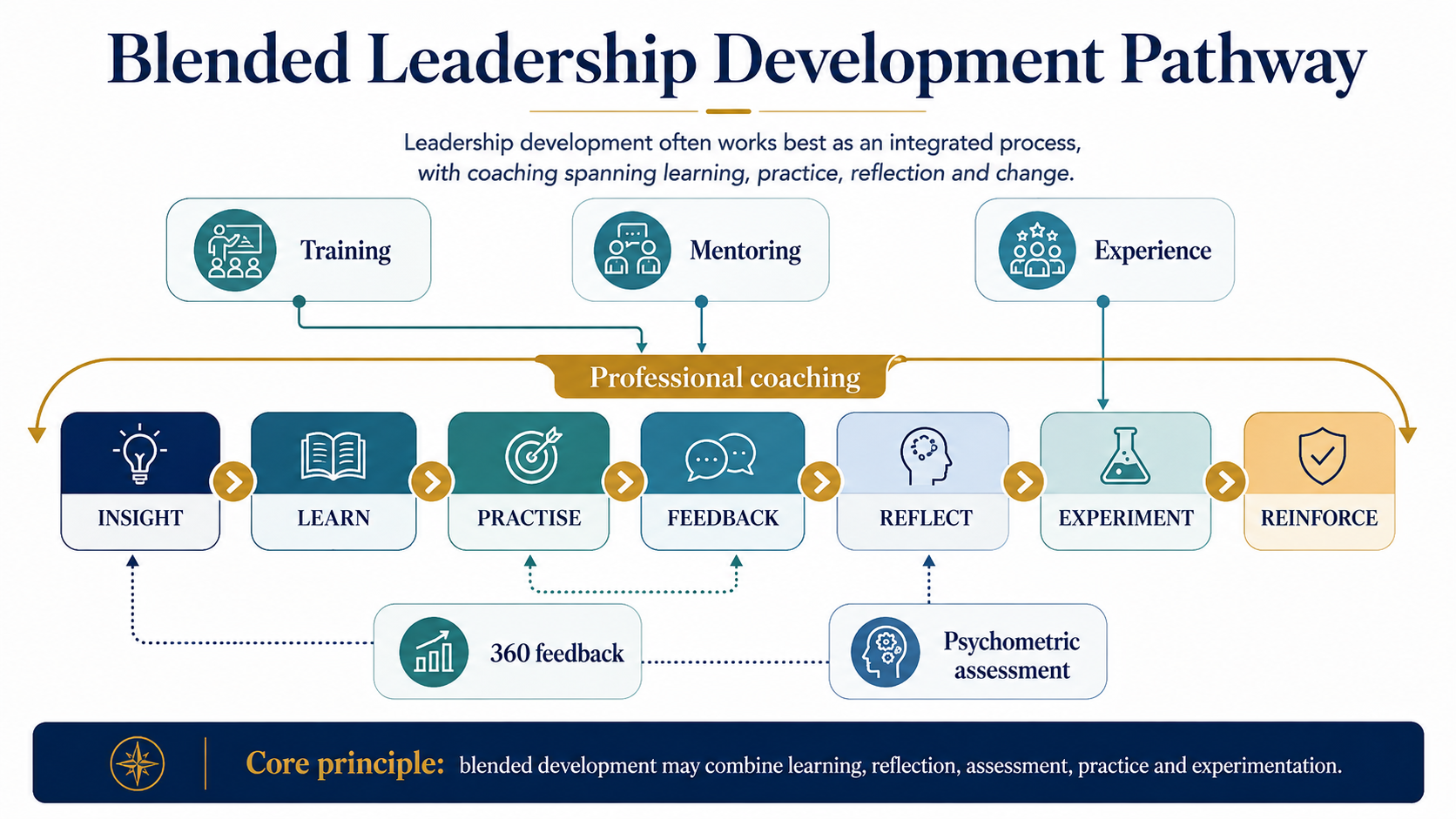
Lasting development rarely comes from a single event. Insight, learning, practice, feedback and reinforcement work together over time.
When coaching is not the right intervention
A credible case for coaching should include the circumstances in which it is not the best answer.
When there is primarily a knowledge or skills gap
If somebody needs to learn something, teach them.
Coaching may support later application, but there is little virtue in making straightforward learning unnecessarily complicated.
When specialist experience or advice is what is missing
If the core problem is:
“I have never navigated this and need somebody who has”
a mentor, adviser or subject-matter expert may be more useful.
When there is an unresolved performance-management issue
Coaching should not become an elegant way of avoiding a difficult organisational conversation.
If expectations are unclear, clarify them.
If performance is unacceptable, address it.
If conduct is inappropriate, manage it.
Coaching can sometimes support development alongside that process, but it should not obscure accountability.
When the leader is unwilling to examine anything
Initial reluctance should not automatically disqualify somebody.
A leader who has been told that HR wants them “fixed” may understandably arrive sceptical.
Good contracting, greater clarity and a stronger connection to the leader's own aspirations can materially change engagement.
But persistent unwillingness to reflect, test assumptions or experiment with different behaviour places an obvious limit on what coaching can achieve.
When the issue primarily sits somewhere else
Individual coaching cannot, by itself:
redesign governance
resolve contradictory incentives
change six people's collective behaviour
repair every dysfunctional relationship
replace management
transform organisational culture
Match the intervention to the level of the issue.
When the client's needs move beyond the coach's competence or the agreed scope
The boundary between coaching and other helping professions should not be reduced to a simplistic checklist.
The relevant questions concern the client's needs, risk, professional scope and the practitioner's competence.
Where appropriate, good practice may involve referral to, or collaboration with, other suitably qualified professionals.
A practical framework for choosing the right leadership development approach
Before commissioning development, work through six questions.
Step 1: What specifically needs to change?
Describe the desired difference behaviourally wherever possible.
Step 2: What kind of need is it?
Is the primary gap:
knowledge, skill, experience, judgement, awareness, behaviour or relationship?
Step 3: Where does the issue sit?
Is it principally:
individual, relational, team or organisational?
Step 4: What will support or inhibit the change?
What happens when the leader returns to the real system?
Which incentives, relationships, norms and consequences reinforce either the desired behaviour or the existing one?
Step 5: Which intervention, or combination, best fits that diagnosis?
Only now decide whether the answer is:
training, mentoring, executive coaching, assessment, team development, organisation development or a deliberate combination.
Step 6: How will you know whether it worked?
Look for meaningful evidence of change rather than completion of an activity.
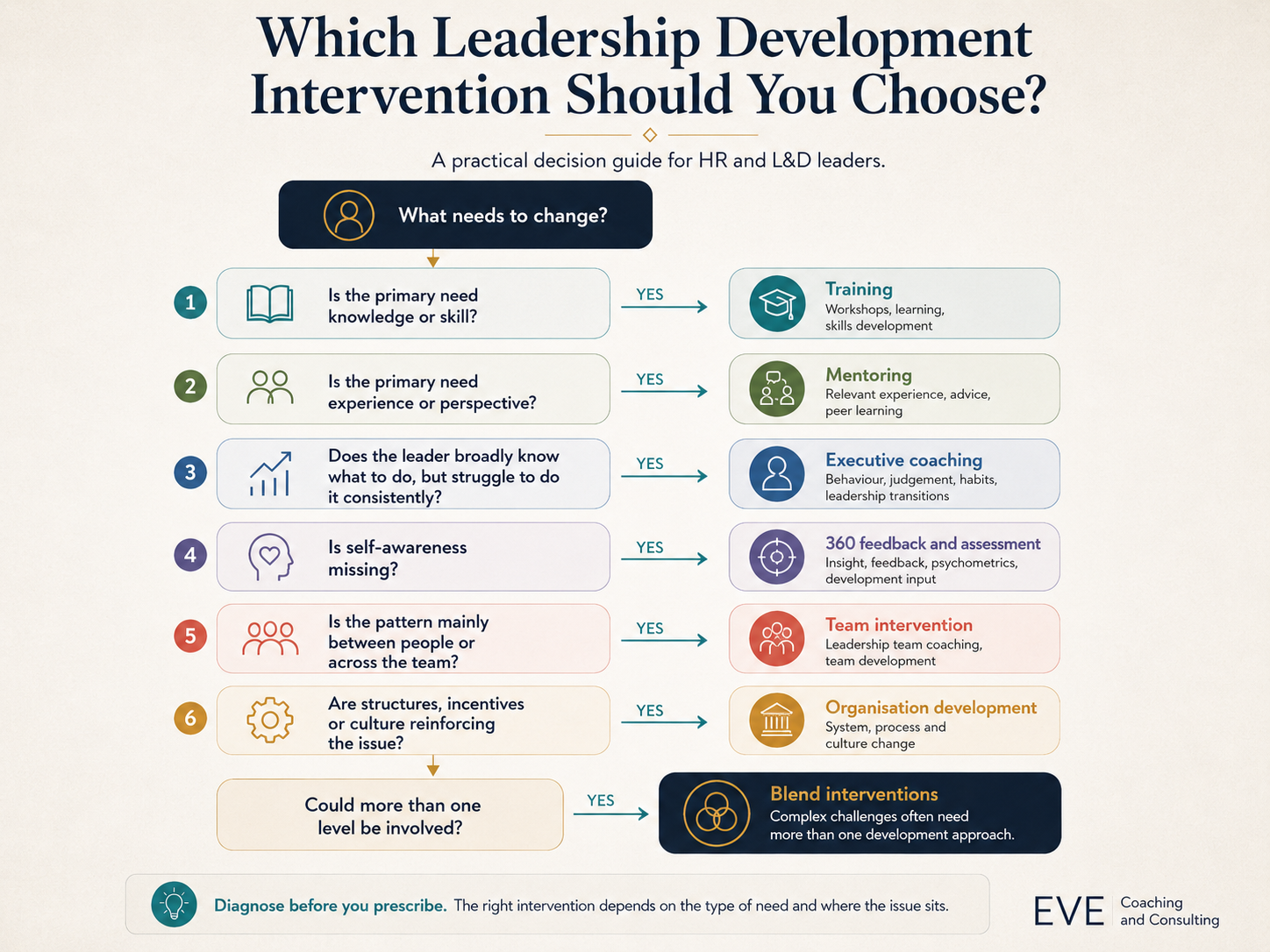
The right intervention depends on what needs to change, from knowledge and experience to behaviour, team dynamics and the wider organisational system.
Choosing the right leadership development intervention
Coaching, mentoring and training can all work.
So can assessment, team development and organisation development.
The difficult question is not:
“Which development method is best?”
It is:
“What are we actually trying to change, what is maintaining the current situation, and at what level does change need to happen?”
For defined knowledge or readily teachable techniques, training or instruction may be the most efficient starting point. Where a skill needs to be developed in a highly individual or complex context, professional coaching or a blended approach may be more useful.
Where access to another person's relevant experience and perspective is central, mentoring may add particular value.
Where the need involves sensemaking, behavioural flexibility, self-awareness, judgement, transition, complex relationships or patterns under pressure, professional executive coaching can provide a bespoke space for thinking, learning, experimentation and change.
These are centres of gravity, not rigid boundaries.
For recurring collective patterns, the team may need to be involved.
And where structures, incentives or organisational practices materially reinforce the problem, leadership development may need to sit alongside wider organisational change.
For the high-performing leader approaching their next step, this distinction becomes particularly important.
The aim is rarely to turn them into somebody else.
It is to understand which elements of an already successful leadership repertoire need to evolve as the scale, complexity and expectations of the role change.
Diagnose before you prescribe.
Then choose the intervention that gives the leader, team and organisation the best chance of creating the change that actually matters.
Not sure where the issue really sits?
The visible leadership problem is not always the real development need.
What looks like an individual capability gap may instead involve behaviour, relationships, team dynamics or the wider organisational system. A short confidential conversation can help clarify what is really getting in the way before you commit to a particular intervention.
Frequently asked questions
What is a leadership development intervention?
A leadership development intervention is a deliberate activity intended to improve leadership capability, behaviour or effectiveness. It might include training, coaching, mentoring, assessment, experiential development, team development or a wider organisation-development intervention.
What is the difference between coaching, mentoring and training?
Training primarily develops knowledge and skills through structured learning. Mentoring primarily draws on another person's relevant experience and perspective. Professional coaching is a bespoke developmental partnership that strengthens how the client thinks, chooses, relates and acts within their particular context.
These are centres of gravity rather than rigid boundaries. Training can involve reflection, mentors can use powerful questioning, and professional coaching can include relevant knowledge, frameworks, psychological techniques, rehearsal, feedback and assessment data where these support the client's goals.
Is coaching or mentoring better for leadership development?
Neither is inherently better.
Mentoring may be particularly useful when somebody needs access to relevant experience or advice.
Coaching may be more useful where the development need concerns behaviour, self-awareness, judgement, relationships, transition or navigating complexity.
What is the difference between coaching and training?
Training usually begins with defined learning objectives and content that can be taught and practised systematically. Professional coaching begins with the individual, their goals and context.
Coaching can develop skills too, particularly where they need to be tailored to the person, practised in live situations or integrated with psychological, behavioural or relational factors. Training and coaching are therefore often complementary rather than competing approaches.
They can also be highly complementary.
When should an organisation use executive coaching?
Executive coaching can be particularly valuable for capable leaders facing increased complexity, transition, behavioural challenges, stakeholder difficulties, self-awareness gaps or the need to broaden how they lead.
Can executive coaching change leadership behaviour?
Research generally indicates positive effects from workplace and executive coaching, with some contemporary evidence suggesting particularly useful effects on behavioural outcomes.
Outcomes still depend on the individual, goals, context, relationship and quality of the intervention.
What if a senior leader is successful but behaviourally difficult?
First distinguish a developmental constraint from a performance or conduct issue.
Where the leader is capable and valued but elements of their current leadership style are beginning to limit effectiveness at greater scale, coaching can be particularly useful if there is sufficient awareness or willingness to examine the issue.
The aim should normally be to broaden the leader's repertoire, not remove the strengths that contributed to their success.
What if the leader does not think they need coaching?
Initial disagreement or scepticism does not necessarily mean coaching will fail.
Specific feedback, clear organisational expectations, good contracting and connecting development to something the leader genuinely wants can create greater engagement.
Persistent unwillingness to reflect or experiment, however, will limit what coaching can achieve.
Can coaching solve a leadership team problem?
Individual coaching can help a leader understand their contribution to team dynamics.
If the problem is primarily collective, a team-level intervention may also be required.
Can coaching solve an organisational culture problem?
Not by itself.
Coaching may help leaders change their own behaviour and influence the system around them. Where structures, incentives, processes or wider leadership behaviour reinforce the problem, organisational interventions may also be necessary.
Can leadership development combine coaching, mentoring and training?
Yes.
Different methods operate through different mechanisms, so deliberately combining them may be more effective for complex senior-leadership development than expecting a single intervention to solve every element of the problem.
📚References
Athanasopoulou, A. and Dopson, S. (2018) ‘A systematic review of executive coaching outcomes: Is it the journey or the destination that matters the most?’, The Leadership Quarterly, 29(1), pp. 70–88.
Blume, B.D., Ford, J.K., Baldwin, T.T. & Huang, J.L. (2010). Transfer of Training: A Meta-Analytic Review. Journal of Management, 36(4), 1065–1105.
Chartered Institute of Personnel and Development (CIPD) (2025)Coaching and mentoring. Factsheet, 11 August. Available at: https://www.cipd.org/en/knowledge/factsheets/coaching-mentoring-factsheet/ (Accessed: 23 August 2026).
Chartered Institute of Personnel and Development (CIPD) (2025)Learning needs analysis. Factsheet, 20 August. Available at: https://www.cipd.org/en/knowledge/factsheets/learning-needs-factsheet/ (Accessed: 23 August 2026).
Chartered Institute of Personnel and Development (CIPD) (2025)Methods of delivering learning interventions. Factsheet, 22 August. Available at: https://www.cipd.org/en/knowledge/factsheets/learning-methods-factsheet/(Accessed: 23 August 2026).
Chartered Institute of Personnel and Development (CIPD) (2025)Learning evaluation, impact and transfer. Factsheet, 18 August. Available at: https://www.cipd.org/en/knowledge/factsheets/evaluating-learning-factsheet/(Accessed: 23 August 2026).
Chartered Institute of Personnel and Development (CIPD) (2025)Organisation development. Factsheet, 19 May. Available at: https://www.cipd.org/uk/knowledge/factsheets/organisational-development-factsheet/(Accessed: 23 August 2026).
Gifford, J. and Wietrak, E. (2022)Organisational culture and climate: An evidence review. Practice summary and recommendations. London: Chartered Institute of Personnel and Development.Available at: https://www.cipd.org/uk/knowledge/evidence-reviews/evidence-culture-climate/ (Accessed: 23 August 2026).
Day, D.V. (2000) ‘Leadership development: A review in context’, The Leadership Quarterly, 11(4), pp. 581–613.
Day, D.V., Fleenor, J.W., Atwater, L.E., Sturm, R.E. and McKee, R.A. (2014) ‘Advances in leader and leadership development: A review of 25 years of research and theory’, The Leadership Quarterly, 25(1), pp. 63–82.
DeRue, D.S. and Wellman, N. (2009) ‘Developing leaders via experience: The role of developmental challenge, learning orientation, and feedback availability’, Journal of Applied Psychology, 94(4), pp. 859–875.
de Haan, E. & Nilsson, V.O. (2023). What Can We Know about the Effectiveness of Coaching? A Meta-Analysis Based Only on Randomized Controlled Trials. Academy of Management Learning & Education.
Eby, L.T., Allen, T.D., Evans, S.C., Ng, T. & DuBois, D.L. (2008). Does Mentoring Matter? A Multidisciplinary Meta-Analysis Comparing Mentored and Non-Mentored Individuals. Journal of Vocational Behavior, 72(2), 254–267.
Gifford, J. and Wietrak, E. (2022)Organisational culture and climate: An evidence review. Practice summary and recommendations. London: Chartered Institute of Personnel and Development. Available at: https://www.cipd.org/uk/knowledge/evidence-reviews/evidence-culture-climate/ (Accessed: 23 August 2026).
Hartnell, C.A., Ou, A.Y. & Kinicki, A. (2011). Organizational Culture and Organizational Effectiveness: A Meta-Analytic Investigation of the Competing Values Framework's Theoretical Suppositions. Journal of Applied Psychology, 96(4), 677–694.
Jones, R.J., Woods, S.A. & Guillaume, Y.R.F. (2016). The Effectiveness of Workplace Coaching: A Meta-Analysis of Learning and Performance Outcomes from Coaching. Journal of Occupational and Organizational Psychology, 89(2), 249–277.
Lacerenza, C.N., Reyes, D.L., Marlow, S.L., Joseph, D.L. & Salas, E. (2017). Leadership Training Design, Delivery, and Implementation: A Meta-Analysis. Journal of Applied Psychology, 102(12), 1686–1718.
Lacerenza, C.N., Marlow, S.L., Tannenbaum, S.I. & Salas, E. (2018). Team Development Interventions: Evidence-Based Approaches for Improving Teamwork. American Psychologist, 73(4), 517–531.
Nicolau, A., Candel, O.S., Constantin, T. & Kleingeld, A. (2023). The Effects of Executive Coaching on Behaviors, Attitudes, and Personal Characteristics: A Meta-Analysis of Randomized Control Trial Studies. Frontiers in Psychology, 14.
Passmore, J. & Lai, Y-L. (2019). Coaching Psychology: Exploring Definitions and Research Contribution to Practice. International Coaching Psychology Review, 14(2), 69–83.
Passmore, J. and Michalik, N.M. (2026) ‘The need for evidence-based psychologically informed practice’, in Passmore, J. and Giraldez-Hayes, A. (eds.) The Coaching Psychology Handbook: Integrating Psychological Theory, Practice and Research. Wiley.
Smither, J.W., London, M. & Reilly, R.R. (2005). Does Performance Improve Following Multisource Feedback? Personnel Psychology, 58(1), 33–66.
Theeboom, T., Beersma, B. & van Vianen, A.E.M. (2014). Does Coaching Work? A Meta-Analysis on the Effects of Coaching on Individual Level Outcomes in an Organizational Context. The Journal of Positive Psychology, 9(1), 1–18.

Under the Surface
A monthly briefing on the hidden dynamics shaping senior leadership, teams and change…
Read next…