Six challenges transformation leaders face, and what helps them stay effective when the pressure builds.
The steering committee is on Thursday. The plan still shows a green milestone, although two functions have yet to release the people needed to deliver it. Your sponsor wants a confident update. Your programme team would prefer an honest one.
You can see the case for the transformation. You can also see the assumptions that are beginning to unravel.
Transformation manuals cover governance, communication, stakeholders, milestones and benefits. They say much less about what happens to the person carrying the responsibility.
I spent many years working in corporate transformation, innovation and leadership development before becoming an executive coach. One thing that experience has reinforced is how easily organisational problems become personal burdens for capable leaders.
Getting the programme over the line matters. So does retaining the judgement, relationships and energy to lead well when much is outside your control.
Why leading organisational change can feel so demanding
Saying change is faster than ever misses something. Organisations have always adapted to technology, markets, regulation and competition.
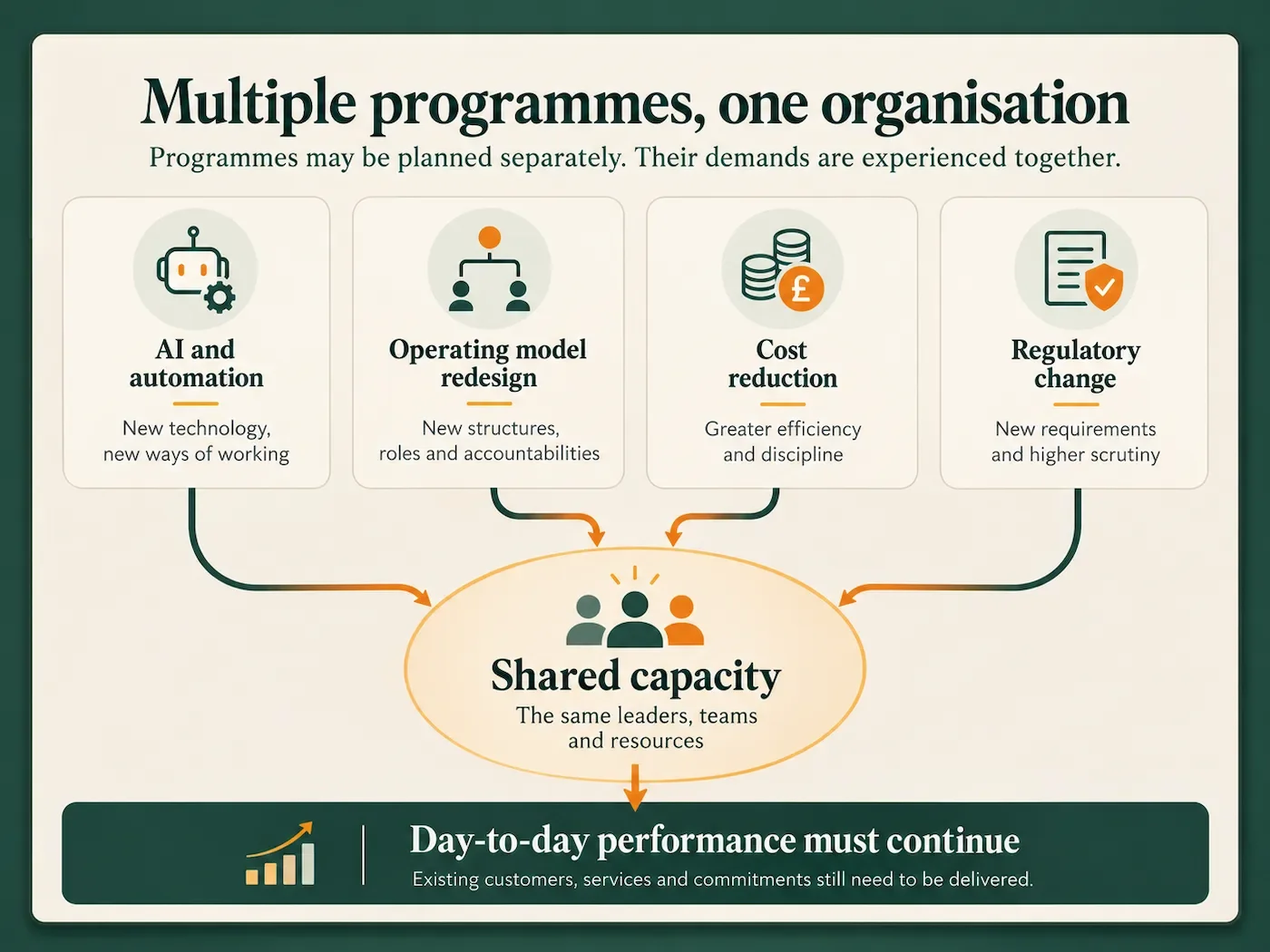
What's difficult is how changes arrive together. A business might be introducing AI, restructuring its operating model, reducing costs and responding to new regulation, while expecting everyone to maintain current performance. Each programme has its own plan. Employees and managers experience the combined effect.
That cumulative pressure can lead to change fatigue at work, with consequences for people's wellbeing, engagement and capacity to deliver further change.
Recent Gartner research, discussed in Harvard Business Review, examines the burden of overlapping, continuous and interdependent change. It is a useful corrective to the notion that the answer is simply greater adaptability.
For the transformation leader there is another complication. You are not watching the change from a safe distance. Your own role, reputation, relationships and future may be affected by the decisions you are helping to implement.
Here is where it gets personal.
1. Leading a transformation you didn't choose
The board approved the direction. The integration timetable was agreed elsewhere. The savings target came from above. Now you're expected to make the change work.
That can leave you in an uncomfortable position: advocating for decisions you did not make, some of which you may privately question.
Balogun, Bartunek and Do (2015) studied senior managers who were both agents and recipients of strategic change. Their understanding shifted as its consequences became real. Commitment was not settled at the launch meeting.
This matters because corporate life sometimes rewards a rather theatrical version of alignment. Once a decision is announced, everyone is expected to sound convinced.
You may support a new operating model but doubt the timetable, or favour automation while worrying about its effect on jobs. Neither concern makes you disloyal.
The task is to work out which disagreements have to be resolved, which risks need to be recorded, and which decisions you can responsibly support even if they are not the ones you would have made.
Distinguish three positions: I disagree; I can implement this responsibly; I cannot in good conscience support this. Each calls for a different conversation.
There is a difference between challenging before and during a decision, and quietly undermining it afterwards. Equally, loyalty does not require silence about material risks. If the evidence changes, your responsibility to raise concerns remains.
The harder question is often: What exactly am I being asked to stand behind, and have I made my reservations clear to the people who need to hear them?
2. Expected to be certain when you're not
Employees want to know whether their team will survive. Your sponsor wants to know whether the benefits will arrive on time. The finance director wants a number. You may not yet have an honest answer to any of them.
Research by Neumann, Turnbull James and Vince describes the pressure middle managers experience when expected to demonstrate certainty while feeling uncertain themselves. Ambiguous authority and organisational politics make that tension harder to manage.
The temptation is familiar: offer reassurance now and hope the detail catches up later.
'Everything will be fine' may settle the room for a moment. It also creates a promise you might not be able to keep. When people discover that decisions were still open, they may question the next assurance you give them.
A more credible response separates three things: what has been decided, what is still being worked through, and when people can reasonably expect an update.
For example:
We know the direction and the outcomes we're aiming for. We haven't decided what the final structure will mean for every team. I understand why that's unsettling. Here's how those decisions will be made, and what I can tell you now.
False comfort can deprive people of time to prepare. Silence invites speculation. Both damage trust.
Senior leaders also need honest uncertainty from the programme team. A forecast that depends on unresolved decisions should say so. An amber risk should not turn green because the review meeting is approaching.
Confidence can come from the quality of your judgement and your willingness to act on new information. It need not depend on pretending that the future is settled.
💬 Coaching Cue: Where might your attempts to reassure people be creating expectations you cannot meet?
3. Accountable for outcomes you cannot control
A capable transformation leader can keep a struggling programme moving for a surprisingly long time.
You chase decisions that belong to functional heads. You negotiate for people who were committed months ago. You personally resolve disputes the executive team has avoided. The programme advances, so everyone assumes the arrangement is working.
It isn't necessarily working. Your competence may be allowing the organisation to avoid fixing what is wrong.
In a matrix organisation, responsibility for delivery rarely comes with command over every budget, team or priority. You might own the milestone while another executive controls the people needed to meet it. When operational performance comes under pressure, those people get pulled back into their day jobs.
You can spend the next month being persuasive, persistent and increasingly exhausted. Or you can make the choice explicit.
We can keep the date if the agreed resource is released. If operational capacity takes priority, we need to re-plan. Which outcome are we choosing?
Now it is a decision about priorities, not another round of personal negotiation.
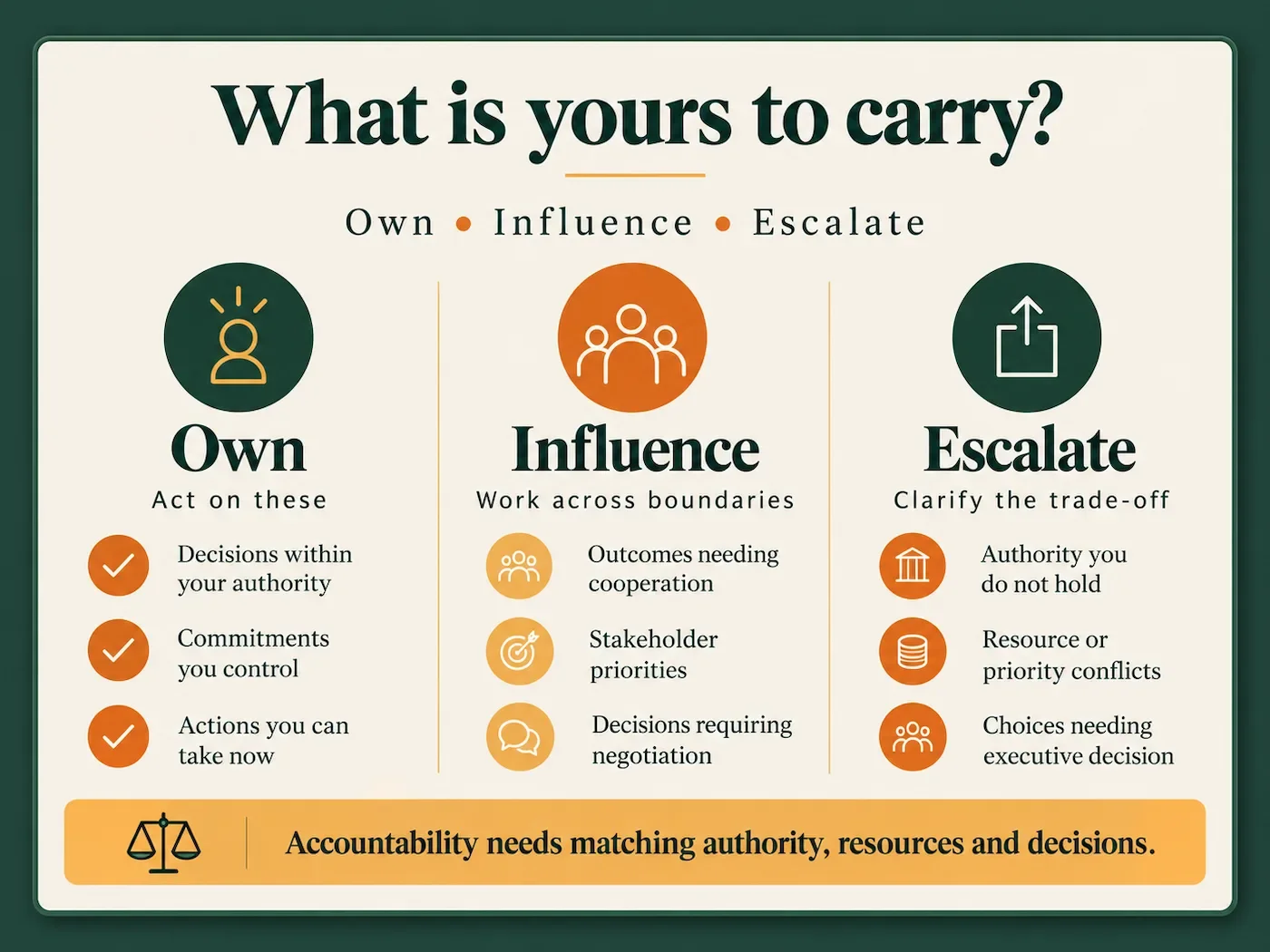
A simple responsibility check helps distinguish three situations:
Own: Decisions that sit within your mandate. Make them.
Influence: Outcomes requiring colleagues' cooperation. Negotiate, challenge and build the relationship.
Escalate: Trade-offs that need authority you do not hold. Bring options and consequences, not merely another status report.
Escalation is no excuse for passing the problem upwards. Bring a recommendation. But stop absorbing the cost of decisions nobody else will make.
For a deeper examination of these dynamics, see The Psychology of Organisational Transformation in Matrix Organisations.
When the system is the problem
What if your competence is keeping an organisational problem alive?
When delivery depends on repeatedly compensating for unclear authority, competing priorities or unresolved conflict, the answer may lie beyond the programme plan. Sometimes the leadership system around the change needs attention.
4. When organisational change hurts people you care about
A cost-reduction programme can be commercially justified and personally painful. So can closing a site, consolidating teams or removing a layer of management. People may lose work they enjoyed, trusted colleagues or a professional identity built over many years.
The leader delivering the decision is not immune to that impact.
Huy's (2002) three-year study of radical change explored the importance of balancing commitment to change with attentiveness to people's emotions. In a different setting, Grunberg, Moore and Greenberg (2006) found associations between implementing redundancies and poorer reported health and work outcomes among managers. Neither study supports pretending the human consequences affect only employees.
One trap is to confuse kindness with delaying the conversation. You know someone will be upset, so you wait until every detail is final. Meanwhile, they hear rumours, watch colleagues being pulled into meetings and draw their own conclusions.
Confidentiality and consultation rules may limit what you can disclose. Explain the process, what remains undecided and when people can expect more.
Another trap is trying to make everyone feel better. Some people will be angry. Others will be frightened, relieved or ambivalent. The leader's responsibility is to treat them fairly and respectfully, not to eliminate their reactions.
There is also a harder possibility: your sympathy may be real, but your reluctance to deliver difficult news might partly protect you from an uncomfortable exchange.
It's worth asking which is happening.
Practical compassion is often unglamorous. Prepare properly. Give people time to ask questions. Don't disguise a final decision as an invitation to influence it. Make sure the support you mention is actually available. And when somebody is distressed, listen before reaching for reassurance.
5. When leading change becomes personally unsustainable
Transformation work can be exciting. Important problems need solving; capable people are working across boundaries; results may matter to the future of the business. That sense of purpose is real.
It can also make it harder to notice when the work is taking too much.
You join another evening call because the decision cannot wait. You rewrite the paper yourself because it will be quicker. You step into a disagreement rather than ask the two leaders concerned to resolve it. None of these choices looks unreasonable in isolation. Six months later, the team depends on you for decisions you never intended to own.
The Job Demands–Resources literature helps explain why sustained demands without sufficient support, autonomy or recovery can erode wellbeing. It also reminds us that strain is not automatically a personal resilience problem. Work design and resources matter.
Strengths that served you well earlier can become costly under pressure:
Taking ownership becomes taking responsibility for everything.
High standards turn into repeated checking and reworking.
Being dependable becomes an inability to disappoint anyone.
Protecting the team means stepping in before others can take responsibility.
These patterns are easy to rationalise. After all, things are getting done. But what is the organisation learning? Perhaps that the programme needs no more support because you will somehow make it happen.
A practical test is to imagine taking two weeks' leave. What would stop? Which decisions could nobody else make? If the list is long, you've found a weakness in the system, whether or not you helped create it.
Remove low-value work. Delegate authority, not just tasks. Revisit commitments to your sponsor. Protect time to think.
And notice your own motives. Does being indispensable feel reassuring? Is it difficult to let a colleague handle something differently from you? There is no shame in asking. These are useful clues about where a successful leadership habit may have become a liability.
A space to think
When you're the one everyone relies on, who challenges your thinking?
It's difficult to see your own patterns when you're immersed in delivery. Executive coaching offers a confidential space to examine the pressures you're carrying, the habits that may no longer serve you and the conversations that could make a difference.
6. When the transformation plan no longer makes sense
Few programmes fail because everybody agrees there is a problem and nobody cares. More awkward is the programme that keeps producing reassuring reports while the original business case is quietly becoming less convincing.
The market has moved. The promised benefits depend on assumptions that no longer hold. Implementation has revealed consequences that were barely considered in the design. Yet budgets, public commitments and reputations are already attached to the plan.
Knowing when persistence has become stubbornness takes judgement, particularly in front of the sponsor.
A useful discipline is to distinguish the outcome from the route. We may still need a simpler operating model, lower costs or better customer service. That doesn't automatically justify continuing with every element of the original programme.
Ask the team what evidence would change its recommendation. If the answer is 'nothing', you've learnt something important about how decisions are being made.
Then ask whether the steering committee is seeing what matters. Milestones and activity can be green while benefits, morale or operational performance are moving in the wrong direction. A programme can be delivered to plan and still disappoint the business.
When the difficulties extend beyond programme delivery into sponsor alignment, leadership relationships and organisational decision-making, transformation consultancy can help address the wider system.
Research reviewed by Oreg and Sverdlik (2026) reinforces the complexity of people's responses to change. Disagreement may contain relevant information about design and implementation. It should be investigated, not automatically labelled resistance.
Challenge with evidence, options and a recommendation. If a concern is rejected, establish what would prompt a further review.
💬 Coaching Cue: What evidence would make you change your mind about the transformation you're leading?
Sometimes the unresolved issue is ethical rather than operational. A leader may need formal advice, a different mandate or, in exceptional circumstances, to reconsider their involvement. There are limits to what professional loyalty can reasonably require.
A useful test: if this transformation were proposed today, with what we now know, would we approve it in its current form?
How to protect your effectiveness while leading change
The dilemmas reinforce one another. Unclear authority creates workarounds; workarounds create overload; overload narrows attention. Organisational decisions become personal pressure.
Gunnarsdóttir's research (2016) describes conflicting loyalties and emotional dissonance among managers implementing radical change, sometimes with little room to express their own concerns. That is a useful reminder of why reflection cannot be left until the programme is over.
Three conversations can help:
With your sponsor: What decisions or resources are needed, what has changed since we agreed the plan, and which trade-offs belong at your level?
With your team: Where have responsibilities become blurred? What bad news are we reluctant to raise? What are we doing because it's useful, and what are we doing because it looks reassuring on a slide?
With someone outside the immediate delivery pressure: How am I behaving differently under strain? What am I avoiding? What might I need to stop carrying?
That last conversation could be with a trusted colleague, mentor or executive coach. A confidential space for reflection can help, but it cannot compensate for poor sponsorship, inadequate staffing or unfair decisions. Those require organisational action.
Five questions for your next programme review
Before another meeting about milestones and risk registers, ask yourself:
Are we still pursuing the right outcomes, or defending the original plan?
Which responsibilities have I taken on without the authority to discharge them?
What have I stopped noticing because I'm too close to the programme?
Which difficult conversation would make the greatest difference if I had it this week?
What would need to change for this pace of work to remain sustainable for six more months?
You don't need to turn every answer into an action plan. One honest discussion or one renegotiated commitment might be the best next step.
Surviving transformation is not simply enduring it
There is satisfaction in helping an organisation make a difficult change. There may be growth, stronger relationships and work you are proud of. I wouldn't want to lose sight of that.
But transformation leaders should be wary of turning endurance into a measure of commitment. The leader who never says no, absorbs every shortfall and keeps the programme green at personal cost may be making it harder for the organisation to face its own decisions.
Good judgement includes knowing when to push, when to listen, when to ask for help and when to challenge the assumptions behind the work.
You can care deeply about a transformation without agreeing to carry all of its weight.
Executive coaching for transformation leaders
If you're leading significant organisational change and recognise some of these pressures, it can help to have a confidential space to work through the decisions and relationships involved.
At Eve Coaching and Consulting, I draw on corporate transformation and innovation experience, alongside coaching psychology and systemic thinking, to work with senior leaders facing complex organisational challenges.
Explore executive coaching for transformation leaders.
📚 Selected research and further reading
Bakker, A. B., Demerouti, E. & Sanz-Vergel, A. (2023). Job Demands–Resources Theory: Ten Years Later. Annual Review of Organizational Psychology and Organizational Behavior.
Balogun, J., Bartunek, J. M. & Do, B. (2015). Senior Managers' Sensemaking and Responses to Strategic Change. Organization Science.
Grunberg, L., Moore, S. & Greenberg, E. S. (2006). Managers' Reactions to Implementing Layoffs. Human Resource Management.
Gunnarsdóttir, H. M. (2016). Autonomy and Emotion Management: Middle Managers During Radical Organisational Change. Nordic Journal of Working Life Studies.
Huy, Q. N. (2002). Emotional Balancing of Organizational Continuity and Radical Change. Administrative Science Quarterly.
Neumann, J. E., Turnbull James, K. & Vince, R. Leading Change from the Middle: Challenges for Middle Managers as Internal Change Agents.
Oreg, S. & Sverdlik, N. (2026). Responses to Organizational Change. Annual Review of Organizational Psychology and Organizational Behavior.
Velnoskey, K., Laman, I. & Valencia, C. (2026). Why Keeping Up with Change Feels Harder Than Ever. Harvard Business Review.

Read next…