Leading Across Cultures: A Practical Guide to Cross-Cultural Leadership
A leader can be highly effective in one country, organisation or team and then find that the same approach lands rather differently somewhere else.
Directness that used to signal clarity may suddenly feel abrupt. A collaborative style can be interpreted as uncertainty. Everyone seems to agree in the meeting, only for the decision to resurface a few days later. A leader makes it clear that challenge is welcome, yet very little challenge comes.
Sometimes the leader has changed very little. The context around them has changed considerably.
People may be working with different expectations about what credible leadership looks like, how trust develops, what someone senior should do, when disagreement is appropriate and how decisions are really made.
This is at the heart of cross-cultural leadership.
For senior leaders working across countries, regions and international organisations, simply knowing that cultures differ is not particularly helpful. The harder task is recognising where different expectations are affecting the work in front of you.
There is an obvious risk here. Conversations about culture can quickly slide into statements about what British, German, American, Indian or Japanese people are supposedly like. Cultural patterns can provide useful clues, but they become misleading when they are treated as instructions for understanding individuals.
A better place to start is with a different question:
What am I assuming about good leadership that the people around me may not share?
What is cross-cultural leadership?
Cross-cultural leadership is the ability to lead effectively when people may hold different expectations about how leadership should be exercised and experienced.
Those differences can affect trust, communication, authority, challenge, influence and decision-making. They can shape how confidence, humility, directness, silence, autonomy and seniority are interpreted.
Culture is part of the picture, but it is rarely the whole picture.
People are also shaped by the organisations in which they have worked, their profession, role, status, personality, education and previous experience of leadership. Two people from the same country can have quite different expectations. Conversely, two people from different countries who have spent years in the same multinational organisation may share a great deal.
This is one reason cultural frameworks need to be handled carefully.
Research does show that expectations of leadership vary across societies. The GLOBE research programme examined leadership and culture across 62 societies and found both areas of commonality and meaningful differences in what people associate with effective leadership (House et al., 2004). Research on cultural intelligence also suggests that effectiveness across cultures depends on more than knowledge. Awareness, motivation and the ability to adjust behaviour matter too (Ang et al., 2007).
These frameworks can help us see things we might otherwise miss.
They cannot tell us who the person sitting opposite us is.
💬 Coaching Cue: Which part of your leadership style are you assuming is universally understood?
When does cross-cultural leadership become relevant?
It is easy to think of cross-cultural leadership as something that matters when somebody relocates overseas. In practice, it often starts much closer to home.
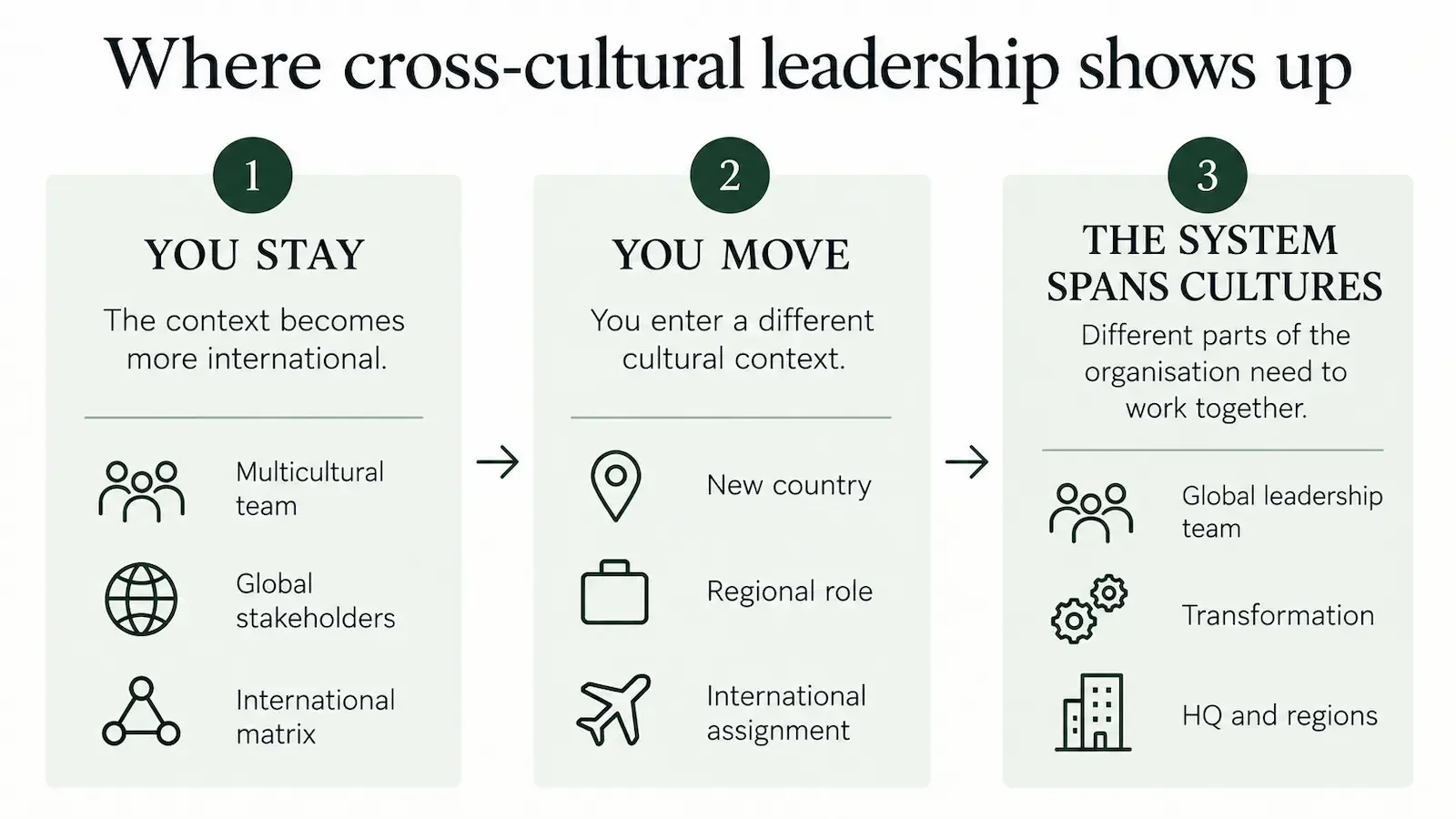
When cultural difference comes into your existing role
A leader can remain in exactly the same office while their role becomes much more international.
A London-based executive, for example, may lead colleagues from several countries, report into an overseas headquarters, work with international customers or spend much of their time influencing people across a global matrix. In a city such as London, leading across cultures is often part of everyday organisational life.
The signs are not always dramatic.
A stakeholder relationship takes much longer to establish than expected. One regional team appears to want more autonomy while another wants clearer direction. People seem reluctant to challenge openly. A message that works perfectly well with one group falls flat with another.
The leader may experience this as a problem with communication, influence or stakeholder management long before they think of culture.
When you move into a different cultural context
The more obvious version is when the leader moves.
They may relocate, take responsibility for a new region, join an organisation headquartered elsewhere or move from a largely domestic role into one with international scope.
This can be disorienting for experienced leaders because the behaviours that helped establish their reputation in one setting may no longer have quite the same effect.
Someone known for getting quickly to the point may discover that relationships need more time before trust develops. A leader accustomed to lively debate may mistake silence for agreement. Someone who normally gives people considerable autonomy may find that a new team expects more visible direction from the person at the top.
There can also be a temptation to over-correct. Leaders sometimes become so conscious of adapting that they lose some of their natural clarity and confidence.
New role, new context
What worked before may not stop working. It may simply need translating.
Moving into a new country, region or international role often means rebuilding credibility in a context where familiar leadership signals carry different meanings. Executive transition coaching can help you work out what to keep, what to adapt and where to resist changing simply for the sake of fitting in.
When the organisation itself operates across cultures
Sometimes the issue sits less with one individual and more with the system around them.
A global transformation progresses quickly in one country and stalls in another. A cross-border acquisition brings together different assumptions about status, pace and decision-making. Headquarters believes a policy is perfectly clear while regional teams interpret it rather differently. An international leadership team appears aligned in formal meetings, while the real disagreement is happening elsewhere.
At that point, culture is not simply something for one leader to understand. It is part of how the organisation is working.
Worth noticing
Your role can become cross-cultural without you moving anywhere.
A broader remit, an international team, a new regional stakeholder or a global matrix can change how your leadership is interpreted. If familiar approaches are no longer landing as expected, the issue may be less about capability and more about the context around you.
Cross-cultural problems seldom look like cultural problems
This is one reason they can be difficult to diagnose.
A senior leader is unlikely to arrive in coaching saying, “I have a cross-cultural leadership problem.”
They are much more likely to say something such as:
Why am I finding this group so difficult to influence?
We agreed this last week, so why are we discussing it again?
Why do I only hear about problems when they have become serious?
Why does this team seem to want more direction from me?
Am I being too direct, or are they simply not being clear?
How much should I adapt before I stop sounding like myself?
The presenting issue may be stakeholder management, communication, executive presence, team dynamics, trust or a difficult transition.
Culture may be one part of what is going on.
That qualification matters. Explaining everything through culture can be just as unhelpful as ignoring culture altogether. A difficult relationship may also be shaped by personality, organisational politics, professional identity, role ambiguity, status or a history between functions.
The useful task is not to reach quickly for a national explanation. It is to develop better hypotheses about what is happening and then test them.
Intention is only part of the story
Most experienced leaders have a fairly clear idea of what they are trying to communicate.
Other people cannot see the intention. They experience the behaviour.
Confidence can be read as arrogance. Careful listening can look like hesitation. Informality can create warmth for one person and discomfort for another. A leader may genuinely believe they have created room for disagreement while everyone else remains very aware of status and hierarchy.
This is why one question becomes particularly useful:
How was my leadership experienced in that situation?
It shifts the focus from what the leader meant to what happened between people.
And that brings us to the areas where cultural assumptions often become most visible.
Where cultural differences tend to show up
Cross-cultural leadership can become complicated in many ways, but a relatively small number of themes appear again and again.
The useful question is not, “What is this culture like?”
It is, “Where might our expectations differ enough to affect how we work together?”
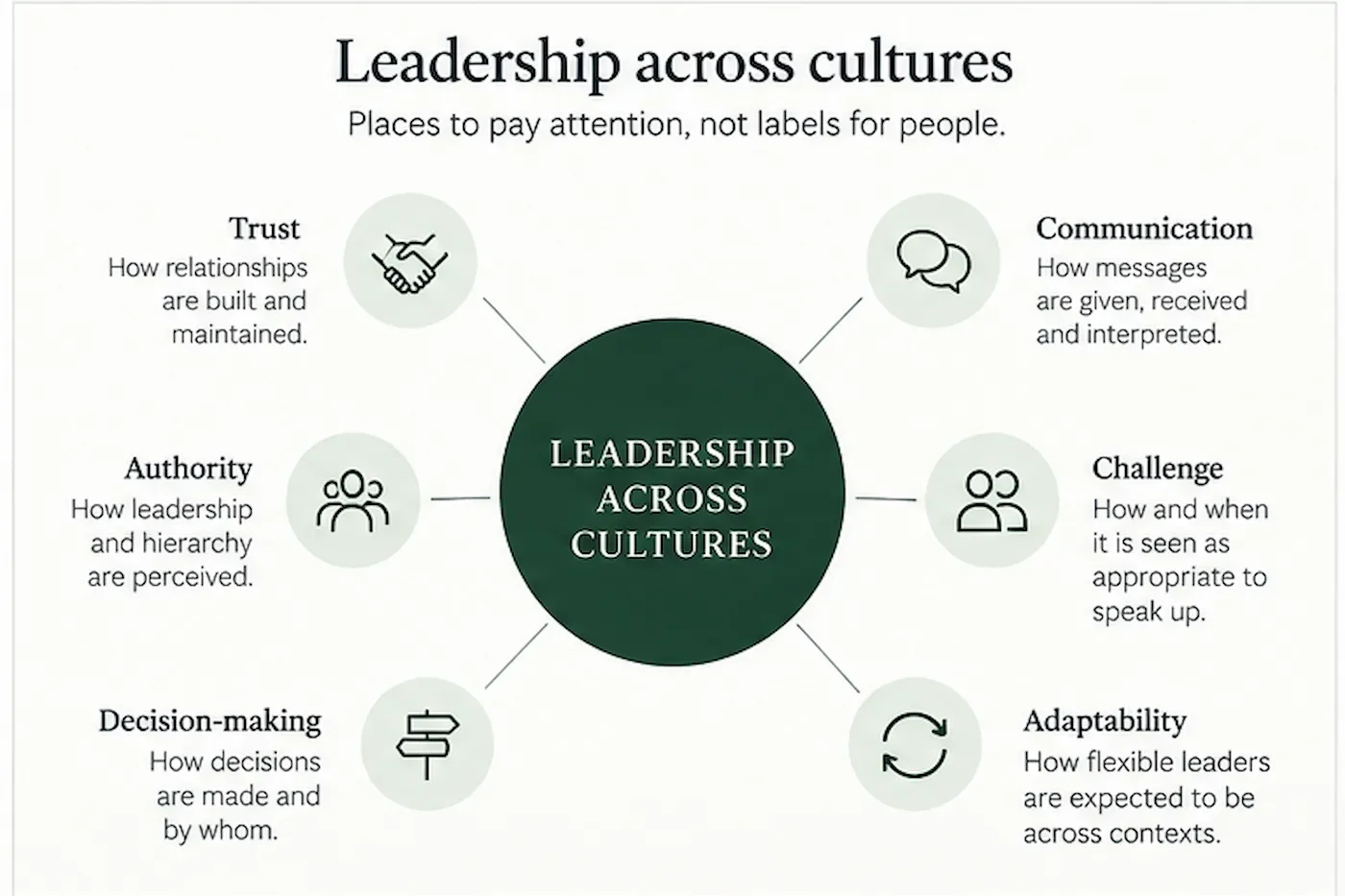
Trust
Trust sounds straightforward until two people are using the same word to mean slightly different things.
For some, trust develops largely through competence, reliability and delivery. Do what you said you would do, do it well and keep doing it.
For others, the relationship itself matters more. They want to know the person, understand their intentions and develop a degree of personal connection before relying on them.
Neither approach is inherently superior. Problems arise when we assume that everyone builds trust in roughly the same way we do.
A task-focused leader may believe they have done everything required. They have turned up prepared, delivered on their commitments and behaved consistently, yet a stakeholder still keeps them at arm's length.
Another leader may invest heavily in relationships and informal connection while their stakeholders are waiting for a clear recommendation and some evidence of delivery.
Erin Meyer describes this in terms of task-based and relationship-based trust. It is a useful distinction, provided it remains a lens rather than a label (Meyer, 2014).
For a leader, the practical issue is simpler: what is creating trust in this particular relationship, and what may be getting in the way?
Communication and context
Many cross-cultural difficulties first appear as communication problems.
One leader thinks they are being clear. Other people find them abrupt.
Another believes they are being diplomatic, but the message is softened to the point where nobody is entirely sure what is being asked of them.
Someone gives a short answer because they assume the surrounding context is understood. The recipient expects the important points to be made explicitly.
Both sides can walk away convinced that the other person is a poor communicator.
There is rarely much value in deciding which style is objectively better. Senior leaders need enough range to recognise when their usual style is no longer doing the job.
Sometimes that means being more direct because ambiguity is causing problems. At other times the message needs more context, a stronger relationship around it or a different route into the conversation.
Feedback is a good example. A comment intended as honest and efficient may feel unnecessarily exposing. But feedback delivered so indirectly that the recipient cannot work out what needs to change is not especially useful either.
Knowing what you meant is not the same as knowing what the other person heard.
Authority and hierarchy
Expectations of seniority can be particularly easy to miss.
In some settings, good leaders are expected to consult widely, minimise visible status differences and encourage open challenge.
Elsewhere, people may expect someone senior to provide clearer direction, make decisions and carry authority more visibly.
This can create uncomfortable misreadings.
A leader trying to involve everyone may be seen as uncertain. Another trying to give clarity may be experienced as overly controlling. A senior executive may genuinely want more junior colleagues to contribute freely without appreciating how much weight their position carries in the room.
Research from GLOBE and other cross-cultural leadership studies has shown that expectations around leadership and power differ across societies, even where some leadership attributes appear to have broader appeal (House et al., 2004; Den Hartog et al., 1999).
That does not mean leaders should consult a national score before deciding how hierarchical to be.
It means watching the room.
Who speaks early? Who waits? Who is comfortable disagreeing? What happens after the most senior person has given their view?
Those observations often tell us more than a cultural label.
Challenge and disagreement
Disagreement is another area where people can easily misread one another.
Some leaders are used to environments in which challenge is overt. People interrupt, disagree, question assumptions and expect the relationship to survive intact.
In other settings, disagreement may be expressed more cautiously.
A concern appears as a question. A decision is accepted in the room but receives lukewarm support afterwards. Someone raises the issue privately with a trusted colleague rather than challenging the group openly. Occasionally, the disagreement only becomes obvious when implementation starts to drift.
A leader accustomed to open debate may interpret this as avoidance or lack of courage. Someone from a less confrontational environment may experience the leader's preferred style as needlessly aggressive.
The important question is whether the system allows meaningful disagreement to be heard.
False agreement carries a cost. Information gets lost, risks remain unspoken and decisions are made using an incomplete picture. Leaders can leave a meeting believing there is alignment when there is not.
Decision-making and influence
The word “agreed” can hide a surprising amount of ambiguity.
Was the discussion intended to gather views before the leader made the decision?
Was the group supposed to reach consensus?
Did some people assume the decision had already been made?
Does formal authority decide what happens, or does real influence sit with people who are less visible on the organisation chart?
These differences become particularly noticeable in global matrix organisations.
A leader may have the formal authority to make a decision but still need the support of regional leaders, technical specialists or long-standing informal networks to make anything happen.
Another may spend too long seeking consensus because that worked in a previous organisation, only to find that their new stakeholders expect a clearer recommendation and a quicker decision.
Influence across cultures is therefore not simply a matter of becoming more persuasive. It also requires an understanding of how decisions are made and who needs to be involved for them to stick.
Adapting without becoming someone else
Most leaders working across cultures eventually reach the same uncomfortable question: how much should I adapt?
There is no sensible rule saying that more adaptation is always better.
Leaders who continually adjust themselves to fit what they think other people expect can become tentative and inconsistent. At some point the behaviour starts to feel performative.
But “this is just my style” is not a particularly convincing alternative either.
All leadership involves responding to context. The harder judgement is deciding what to flex, what to explain more clearly and what needs to remain consistent because it reflects your role, values or responsibilities.
A leader may change how they deliver challenge without abandoning challenge.
They may invest more time in relationships without pretending that relationships matter more than the work.
They may make their authority more visible in one setting and deliberately step back in another.
The goal is not to become culturally perfect. It is to have more than one way of leading.
Psychological safety is not culturally neutral
The issue becomes more important when we move beyond communication style and ask whether people feel able to say what needs to be said.
Psychological safety is commonly described as a shared belief that a team is safe for interpersonal risk-taking (Edmondson, 1999).
In practice, that includes admitting a mistake, asking for help, questioning an assumption, raising a concern and disagreeing with somebody more senior.
Those behaviours matter across cultures. The experience of risk surrounding them may differ.
A leader can sincerely tell people that challenge is welcome. That does not mean everybody will experience challenging them as safe.
What if disagreement with somebody senior has previously been associated with disrespect? What if preserving relationships or avoiding loss of face is particularly important in the group? What if earlier leaders asked for candour and then reacted badly when they received it?
There may also be different expectations about who carries responsibility for starting the conversation. A junior colleague may believe that someone senior needs to invite their view explicitly rather than expecting them to volunteer it.
None of this is an argument for lowering expectations around openness. It is an argument for taking the conditions around openness seriously.
💬 Coaching Cue: Who is least likely to challenge you openly, and what might make that easier?
As part of my MSc in Coaching and Behavioural Change, I researched psychological safety across an intercultural population spanning more than 55 countries (Eve, 2023). One of the questions behind that work was whether ideas about speaking up and interpersonal risk, developed largely within Western organisational research, could simply be assumed to operate in the same way across cultural contexts. I explore this in more depth in Building Psychological Safety with International Teams.
The picture was more complex.
Psychological safety mattered, but the experience of speaking up also sat alongside expectations about hierarchy, relationships, appropriate behaviour and the perceived consequences of challenge.
For senior leaders, there is a practical implication.
It is not enough to tell people they are free to speak.
Pay attention to what happens when they do.
Does the leader become defensive? Does the conversation narrow? Is the person who raised the concern taken seriously? Is disagreement genuinely explored or politely acknowledged and moved past?
Nembhard and Edmondson's research is useful here. Their study of healthcare teams found that professional status and leader inclusiveness were associated with psychological safety (Nembhard and Edmondson, 2006).
The setting is specific, but the leadership question is much broader:
What does the most powerful person in the room do that makes speaking up easier or harder?
Sometimes silence means agreement.
Sometimes it simply means that disagreement still feels too costly.
A question for leaders
What might you not be hearing?
When people hesitate to challenge, raise concerns or bring bad news, the cost is not only silence. Leaders may be making decisions without information that exists elsewhere in the system. The useful question is not simply whether people are allowed to speak, but what makes speaking up feel possible in practice.
Cultural frameworks can help, but they have limits
There is no shortage of frameworks for understanding cultural difference.
Hofstede's work has been highly influential, particularly around concepts such as power distance and individualism (Hofstede, 2001). The GLOBE programme extended the study of culture and leadership across a large number of societies (House et al., 2004). Erin Meyer's The Culture Map translates cultural differences into recognisable business situations involving communication, trust, disagreement and decision-making (Meyer, 2014).
Philippe Rosinski's Coaching Across Cultures is particularly relevant to coaching because he looks beyond national culture and includes corporate and professional cultures within the picture (Rosinski, 2003).
Cultural Intelligence, usually shortened to CQ, takes a somewhat different approach. Rather than mainly describing differences between cultural groups, it focuses on an individual's capability to function effectively in culturally diverse situations. Research identifies metacognitive, cognitive, motivational and behavioural aspects of cultural intelligence (Ang et al., 2007; Van Dyne et al., 2012).
Each can be useful.
The trouble starts when a framework moves from helping us ask questions to giving us answers about individuals.
A national pattern tells us something about populations. It tells us far less about what a particular person is going to do in tomorrow morning's leadership meeting.
Country of origin is one influence among many.
Organisational experience, profession, social background, personality, seniority, generation and personal history all matter too.
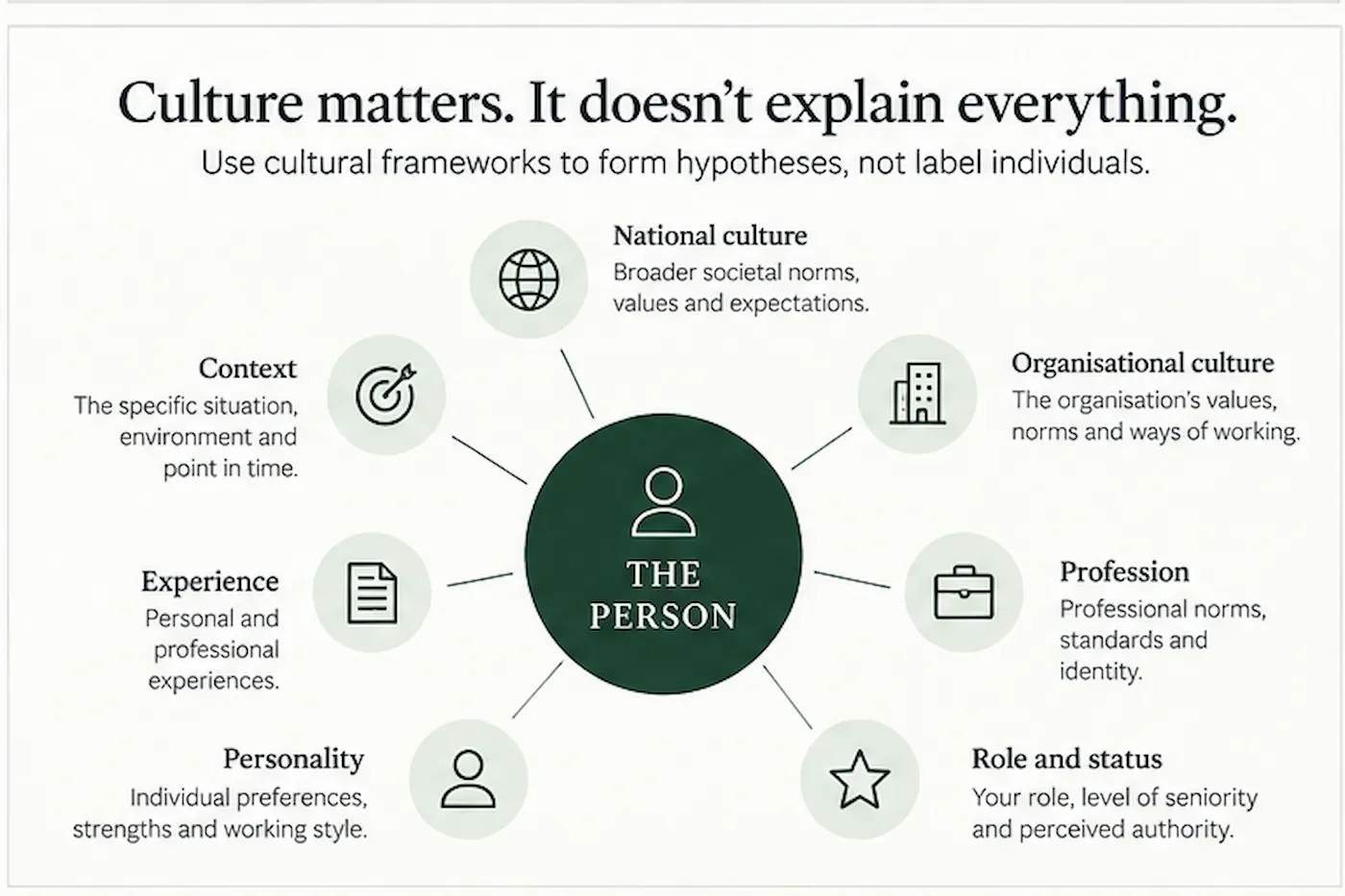
The more useful way to work with cultural frameworks is as a source of hypotheses.
Perhaps hierarchy is contributing to the lack of challenge.
Perhaps this stakeholder builds trust more relationally than I expected.
Perhaps I am reading silence as consent when it means something else.
Those are possibilities to explore, not conclusions to impose.
What cross-cultural leadership problems look like in practice
The ideas become more useful when they are brought back to ordinary leadership situations.
“Everyone agreed in the meeting”
Yet the issue is back on the agenda two days later.
It may be tempting to conclude that people are avoiding accountability. Sometimes they are.
It is also worth asking whether everyone saw the meeting as the place where disagreement should happen. Perhaps some people needed to consult their own stakeholders first. Perhaps important conversations normally take place before formal meetings. Perhaps openly challenging the most senior person felt inappropriate.
Understanding that changes how the leader responds.
“My door is always open”
The leader believes, quite genuinely, that they are approachable.
Yet difficult news still arrives late and problems have often been softened several times before they reach them.
The issue may not be physical or formal access.
It may be status.
A leader's intention to be approachable does not remove the authority attached to the role. People need evidence that bringing difficult information is safe and worthwhile.
“I'm trying to empower them”
The leader is deliberately avoiding becoming too directive.
The team experiences a lack of leadership.
Assumptions about autonomy are not always shared. What one person experiences as empowerment can feel to somebody else like being left without sufficient context, authority or support.
That does not automatically mean becoming more controlling. It may mean having a much more explicit conversation about what autonomy actually involves.
“I'm just being clear”
The leader values straightforward communication.
Stakeholders experience the same behaviour as blunt or dismissive.
Arguing about whether directness is inherently good or bad does not get us very far.
The useful question is whether the communication is achieving its purpose.
If the relationship deteriorates to the point that people stop sharing useful information, clarity has become expensive.
“I need to adapt”
This problem can move in the opposite direction.
A leader becomes so conscious of cultural difference that every interaction requires calculation.
Should I be more direct? Less direct? More authoritative? More relational?
Eventually the leader becomes hesitant.
Effective cross-cultural leadership should expand a leader's range, not leave them frightened of getting everything wrong.
How to lead more effectively across cultures
There is no technique that removes uncertainty from cross-cultural leadership. What helps is a disciplined way of making sense of what is happening.
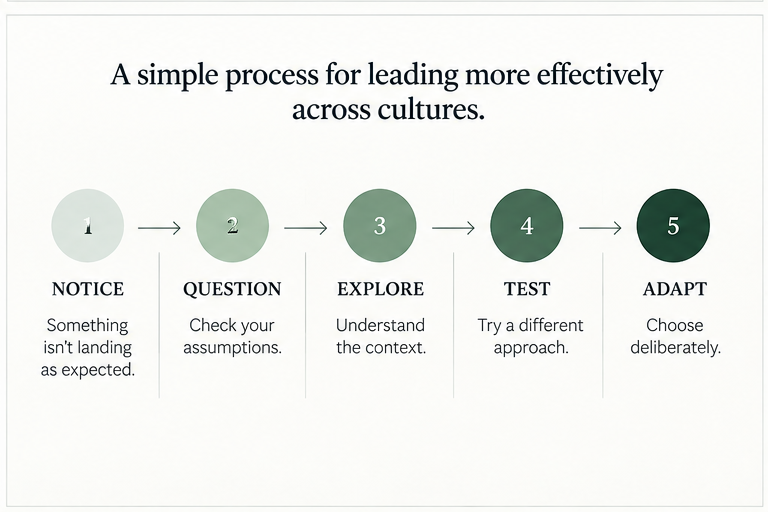
Notice when the response is different from what you expected. Repeated surprise is useful information. Slow trust, unusual silence, decisions reopening or unusually cautious communication are all worth paying attention to.
Question your own interpretation. What are you assuming good leadership should look like? Which parts of that assumption have become so familiar that you no longer notice them?
Explore the context rather than reaching immediately for a cultural explanation. How are decisions normally made here? What builds credibility? How does disagreement tend to show up? What do people expect from someone in your role?
Test your assumptions. Try something small and watch what happens. Invite challenge differently. Spend more time on the relationship. Be more explicit about your recommendation. Ask somebody you trust how your communication is landing.
Adapt deliberately. Sometimes changing your behaviour is appropriate. Sometimes the better response is to explain your intention more clearly. Occasionally the right decision is not to adapt at all.
This is where ideas such as cultural intelligence become practical.
The objective is not to know everything about somebody else's culture. It is to notice when your own default way of making sense of the situation is no longer enough.
Next step
If the room is reading you differently from how you intend:
Cross-cultural leadership problems often show up as communication, influence or stakeholder issues. Coaching gives you space to slow the pattern down, test what may be happening and decide what to change, without reducing the situation to cultural stereotypes.
Questions for senior leaders working across cultures
When something is not landing as expected, these questions can help:
What might I be interpreting through my own cultural assumptions?
How is trust actually built in this relationship or organisation?
Who finds it easy to challenge me, and who does not?
How does disagreement show up when it is not expressed directly?
What does credible leadership appear to look like in this context?
Where might hierarchy or status be preventing me from hearing something important?
What am I adapting because it genuinely helps, and what am I adapting because I am uncertain?
How is my leadership being experienced, rather than simply how do I intend it to be experienced?
The point is not to find a perfect answer to each one.
It is to make some of the assumptions around the situation easier to see.
When cross-cultural coaching can help
Cross-cultural coaching becomes particularly useful when these questions are attached to live leadership situations.
A leader may be stepping into a broader international role, preparing to relocate or adjusting after a move. They may be struggling to influence a stakeholder in another region, leading a culturally diverse team or finding that their executive presence is being interpreted differently in a new environment.
Sometimes the problem is broader. A leadership team may be working across countries and functions. A transformation programme may require people with very different expectations to make difficult decisions together. Headquarters and regional leaders may find themselves repeatedly misunderstanding one another.
Coaching creates space to examine what is happening without jumping too quickly to a cultural explanation.
That might involve preparing for an important conversation, looking closely at why a meeting went badly, mapping stakeholder expectations or testing a different way of communicating.
The purpose is not to turn a leader into an expert on other people's cultures.
It is to improve their judgement in situations where their usual assumptions may not be enough.
Leading across cultures without becoming someone else
There is a tension at the heart of cross-cultural leadership.
Leaders need enough flexibility to work effectively in different settings, but they also need to remain recognisably themselves.
Too little adaptation and familiar strengths can harden into habits. Too much and leadership begins to feel artificial.
There is no perfect point between the two.
What matters is becoming more deliberate.
Leaders who work well across cultures tend to notice more. They become less attached to their first interpretation. They ask questions before deciding why somebody behaved as they did. They pay attention to power, trust and context. And they develop more than one way of communicating, challenging and influencing.
They still need judgement.
Leading across cultures does not require becoming fluent in every local norm you encounter.
It does require recognising that your own assumptions about leadership come from somewhere too.
Once those assumptions are easier to see, you have more choice about what to do with them.
FAQ: Cross-cultural leadership
-
Cross-cultural leadership is the ability to lead effectively when people may hold different expectations about trust, communication, authority, challenge and decision-making. It involves paying attention to context, questioning assumptions and adapting where doing so improves the quality of leadership.
-
Senior leaders increasingly work across countries, functions and culturally diverse teams. Different expectations can affect trust, communication, decision quality, stakeholder influence and whether people feel able to speak openly. Cross-cultural leadership helps leaders recognise these differences rather than assuming their usual approach will always be interpreted as intended.
-
Common challenges include building trust, adapting communication, understanding different expectations of authority, making space for disagreement, navigating decision-making and deciding how far to adapt without losing authenticity. These issues often appear as ordinary leadership or relationship problems rather than obviously cultural ones.
-
Useful capabilities include curiosity, perspective-taking, cultural intelligence, communication range, self-awareness, tolerance of ambiguity and behavioural flexibility. Just as important is a willingness to question one's own assumptions rather than concentrating solely on understanding other people's cultures.
-
Cultural intelligence describes a person's capability to function effectively in culturally diverse situations. Research commonly distinguishes cognitive, metacognitive, motivational and behavioural elements. It is a useful part of cross-cultural leadership, although leadership also involves power, relationships, organisational context and the responsibilities attached to a senior role.
-
Yes. Leaders can become more aware of their own assumptions, learn to notice different expectations, widen their behavioural repertoire and become more deliberate about how they communicate, build trust, exercise authority and invite challenge. Development is less about memorising rules for different cultures and more about becoming observant and adaptable in unfamiliar situations.
📚 References
Ang, S., Van Dyne, L., Koh, C., Ng, K.Y., Templer, K.J., Tay, C. and Chandrasekar, N.A. (2007) ‘Cultural intelligence: its measurement and effects on cultural judgment and decision making, cultural adaptation and task performance’, Management and Organization Review, 3(3), pp. 335–371.
Den Hartog, D.N., House, R.J., Hanges, P.J., Ruiz-Quintanilla, S.A. and Dorfman, P.W. (1999) ‘Culture specific and cross-culturally generalizable implicit leadership theories: are attributes of charismatic/transformational leadership universally endorsed?’, The Leadership Quarterly, 10(2), pp. 219–256.
Edmondson, A.C. (1999) ‘Psychological safety and learning behavior in work teams’, Administrative Science Quarterly, 44(2), pp. 350–383.
Eve, E. (2023) Psychological Safety in a Fortune 100 Global Corporation: The Moderating Role of Culture. Unpublished MSc dissertation. Henley Business School, University of Reading.
House, R.J., Hanges, P.J., Javidan, M., Dorfman, P.W. and Gupta, V. (eds.) (2004) Culture, Leadership, and Organizations: The GLOBE Study of 62 Societies. Thousand Oaks, CA: Sage.
Meyer, E. (2014) The Culture Map: Breaking Through the Invisible Boundaries of Global Business. New York: PublicAffairs.
Nembhard, I.M. and Edmondson, A.C. (2006) ‘Making it safe: the effects of leader inclusiveness and professional status on psychological safety and improvement efforts in health care teams’, Journal of Organizational Behavior, 27(7), pp. 941–966.
Rosinski, P. (2003) Coaching Across Cultures: New Tools for Leveraging National, Corporate and Professional Differences. London: Nicholas Brealey.
Van Dyne, L., Ang, S., Ng, K.Y., Rockstuhl, T., Tan, M.L. and Koh, C. (2012) ‘Sub-dimensions of the four factor model of cultural intelligence: expanding the conceptualization and measurement of cultural intelligence’, Social and Personality Psychology Compass, 6(4), pp. 295–313.

Read next…