How to build a compelling business case, find the right budget and secure your organisation's support for your leadership development.
Congratulations, lets suppose you've found an executive coach you want to work with. You can see how coaching might help you navigate the challenges ahead.
Now comes a potentially harder conversation: asking your employer to pay for it (or part-fund).
Perhaps you've stepped into a more senior role, are navigating difficult relationships or want to strengthen your leadership presence and influence. You recognise that developing these capabilities could make a meaningful difference, both personally and professionally.
But how do you persuade your manager or HR that coaching is worth funding?
Even if your employer cannot cover the full cost of executive coaching, you may still be able to secure a meaningful financial contribution through an existing learning and development budget or a shared-cost arrangement.
And employer sponsorship is not unusual. According to the International Coaching Federation (ICF), nearly six in ten coaching clients are sponsored by their employers, based on its 2025 Global Coaching Study.
The key is connecting your development needs with something your organisation already cares about.
This guide explains how to build your case, identify potential funding, approach your employer and agree on a coaching arrangement that benefits both you and your organisation.
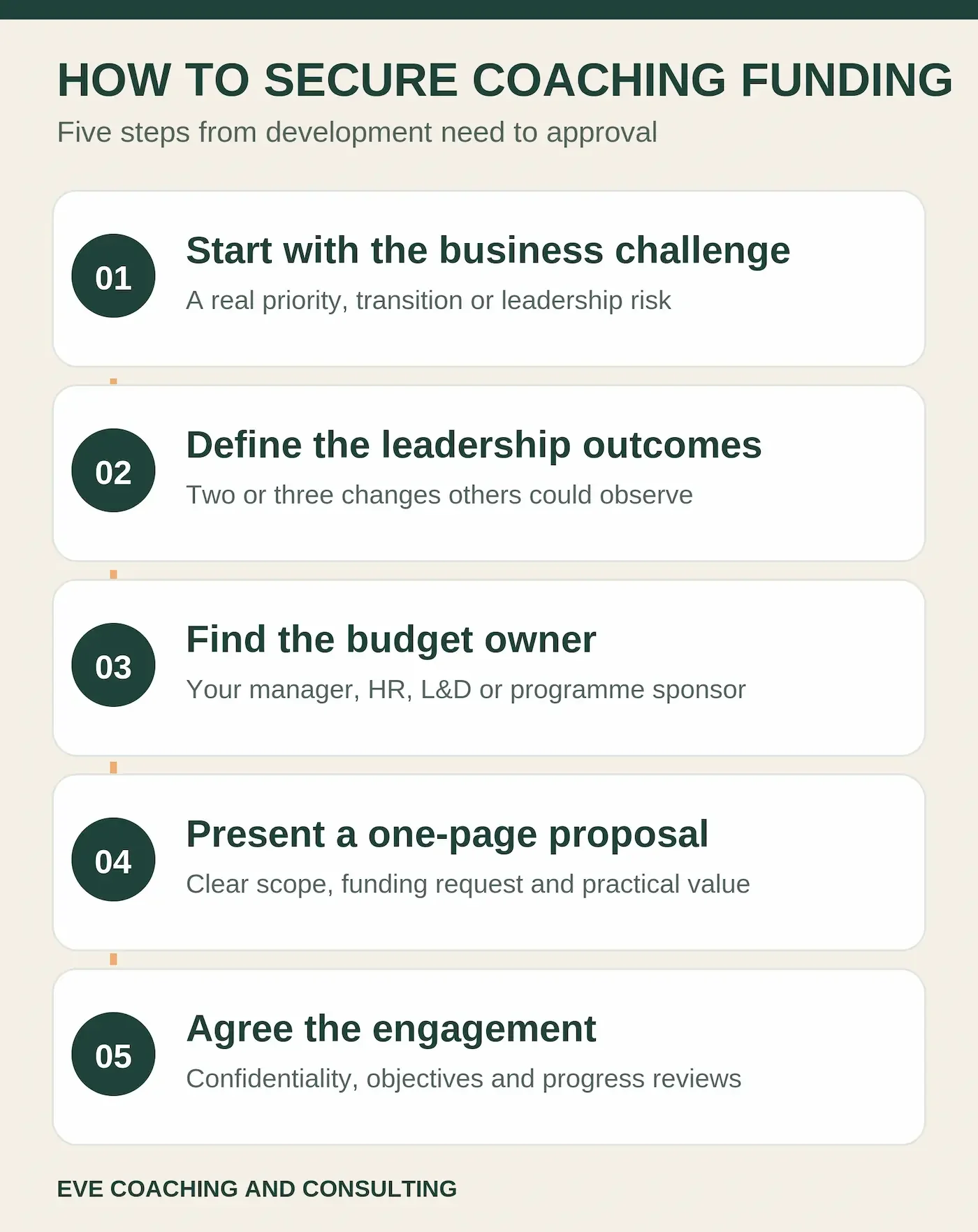
Why do organisations invest in executive coaching?
Executive coaching is not reserved for leaders who are struggling, nor is it simply a reward for high performance.
Organisations invest in coaching for many reasons: preparing leaders for greater responsibility, strengthening leadership effectiveness, supporting critical transitions, navigating complex relationships and helping executives respond to challenges that cannot be resolved through technical expertise alone.
Sometimes the catalyst is a significant organisational change. At other times, it is difficult feedback, a stalled relationship, succession planning or a recognition that a successful leadership approach may no longer be sufficient.
The common thread is a meaningful gap between the demands of a leadership role and the capabilities, behaviours or perspectives needed to succeed.
Here are some examples of situations where executive coaching can add value.
A significant leadership transition
You've been promoted, taken responsibility for a larger team or moved into a broader enterprise role.
Your previous experience got you here. But the new position requires different relationships, greater visibility and perhaps a different leadership style.
Coaching can help you accelerate the transition, establish credibility and adapt to the expectations of your new role.
Explore Executive Transition Coaching.
Navigating a complex matrix organisation
You are accountable for results, but achieving them depends on colleagues and stakeholders who do not report to you.
Competing priorities, organisational politics and conflicting expectations are making progress harder than it needs to be.
Coaching can help you develop the relationships, influence and judgement needed to work more effectively across organisational boundaries.
Leading organisational change
You are responsible for implementing change, but progress is being affected by uncertainty, resistance or competing agendas.
The technical plan may be sound. The human dynamics are proving more difficult.
Coaching can help you examine how you lead through uncertainty, build commitment and respond more effectively to resistance.
Strengthening executive presence
Your capability is recognised, but you need greater impact in senior forums, with executive stakeholders or in high-stakes conversations.
Coaching can help you develop greater clarity, composure, strategic voice and influence.
Explore Executive Presence Coaching.
Moving from technical expertise to broader leadership
You are an accomplished engineer, scientist, technologist or specialist. Your role now requires you to lead through others, think more strategically and influence people beyond your professional discipline.
Coaching can support that transition without requiring you to abandon the expertise that made you successful.
Explore Coaching for Technical Leaders.
The principle is simple: begin with the organisational challenge, then explain how developing your leadership capabilities could help address it.
Other reasons organisations commission executive coaching
The reasons for coaching extend well beyond transitions and organisational change. Other common situations include:
Succession planning and high-potential development: Preparing promising leaders for enterprise-wide responsibilities, executive appointments or future succession opportunities.
Responding to challenging leadership feedback: Helping a capable leader understand how their behaviour affects others, recognise potential derailers and make intentional changes.
Managing difficult relationships and conflict: Working through challenging relationships with peers, senior stakeholders or team members where trust, communication or collaboration has deteriorated.
Building and leading high-performing teams: Developing a leader's ability to create accountability, psychological safety, constructive challenge and more effective team dynamics.
Strengthening emotional intelligence and self-awareness: Understanding personal triggers, regulating responses under pressure and developing greater awareness of how others experience one's leadership.
Navigating cross-cultural leadership challenges: Leading across national, professional and organisational cultures, particularly where expectations about authority, communication and decision-making differ.
Improving strategic judgement and decision-making: Creating space to challenge assumptions, examine competing priorities and make sound decisions in ambiguous or politically complex environments.
Leading through sustained pressure: Helping executives recognise unhelpful patterns, maintain perspective and lead effectively when expectations, uncertainty and emotional demands are high.
These examples are not exhaustive. Coaching may also support career decisions, leadership identity, organisational integration or a specific challenge where confidential reflection and independent challenge would be valuable.
For an employer, the important question is not simply whether coaching would benefit an individual, but why this particular development matters to the organisation now.
Think about the request from your employer's perspective
Having spent 22 years at 3M, working across engineering, innovation, operational excellence, international business leadership and organisational transformation, I understand something about the realities of large organisations.
Investment decisions do not happen in a vacuum.
There are budgets, business priorities, competing demands, approval processes and people who are accountable for how resources are used.
I've also spent many years coaching leaders who work within those realities.
When considering your funding request, I would encourage you to look at the situation through three different lenses.
Your manager's perspective
How might this development help you become more effective in your current responsibilities? What would improve for your team, your stakeholders or the wider business?
HR or Talent Development's perspective
How does the proposed coaching relate to leadership capability, succession readiness, organisational priorities or an identified development need?
The budget holder's perspective
Is the proposed investment proportionate to the challenge? Is there a clear reason to act now? Are the intended outcomes sufficiently specific to justify the expenditure?
These perspectives overlap, but they are not identical.
For example, your manager might welcome support with a difficult leadership transition, while HR wants reassurance about the coach's qualifications and the budget holder needs to understand the likely organisational benefits.
A well-prepared request addresses all three without turning a straightforward development proposal into an elaborate financial exercise.
What makes a compelling business case?
From my corporate experience, I would concentrate on four questions:
Relevance: Is the development connected to a meaningful business priority?
Timing: Why does it make sense to invest now?
Outcomes: What should be different as a result?
Confidence: Is there a credible approach, appropriate investment and sensible way to evaluate progress?
You do not need to promise an extraordinary financial return.
You need to make a credible case for why strengthening your leadership would be valuable.
Build a one-page business case for executive coaching
A short, thoughtful proposal can be more persuasive than several pages of generic leadership development language.
I recommend covering five areas.
ElementQuestion to answerBusiness challengeWhat is happening that makes development important?Why now?What is the consequence or opportunity?Development objectivesWhat would you like to change in how you lead?Evidence of progressWhat differences might you and others observe?Funding requestWhat coaching engagement are you proposing?
Worked example: A senior technical leader
Imagine you are responsible for a major cross-functional engineering programme.
The technical challenges are manageable, but decisions are taking too long. Engineering, commercial and operational stakeholders have different priorities, and you are struggling to build alignment.
Your proposal might look like this:
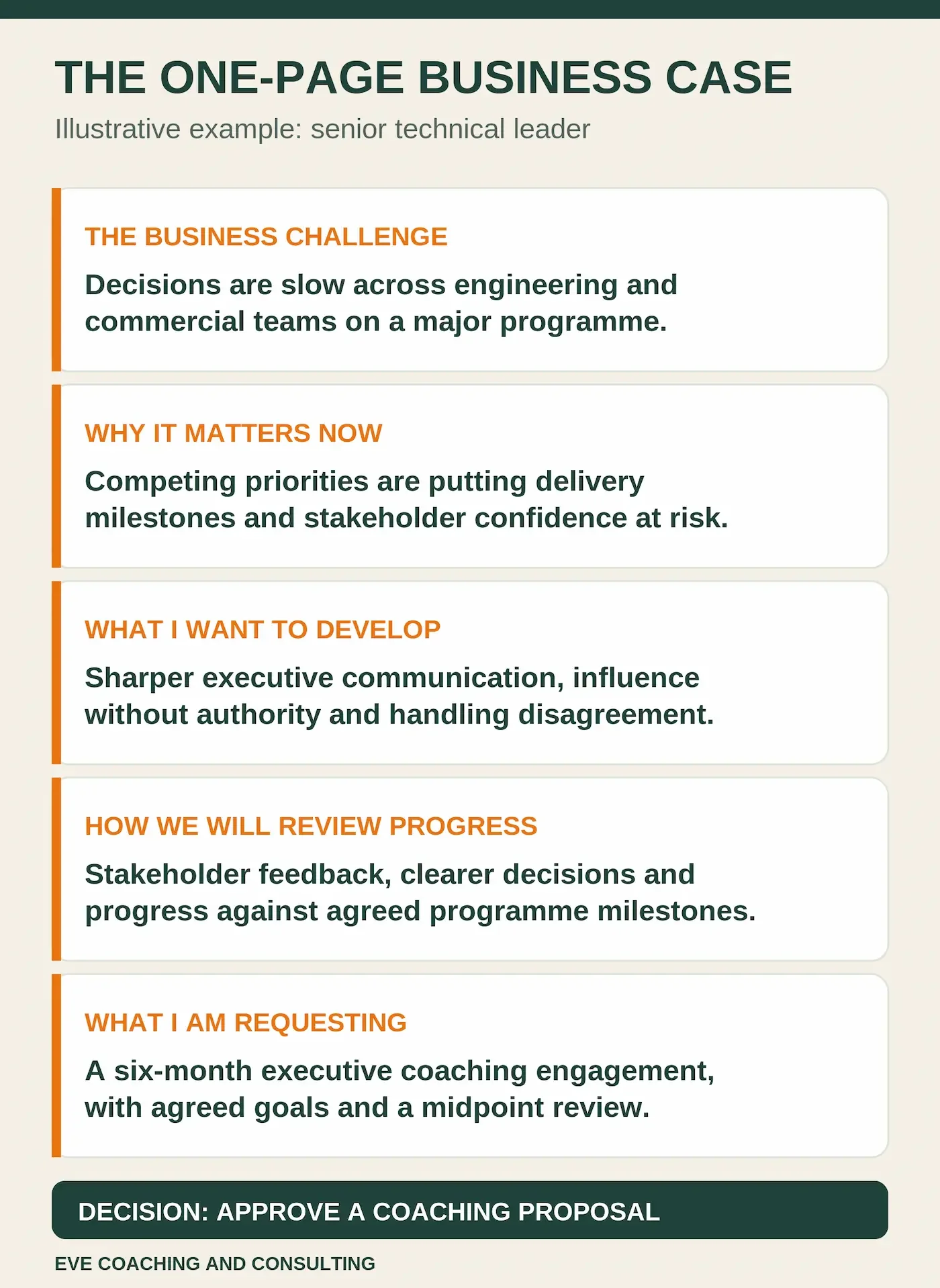
Business challenge
Cross-functional decision-making is slowing progress on a strategically important programme.
Why it matters now
The programme has demanding delivery milestones. Greater alignment and earlier resolution of disagreements would support delivery confidence.
Leadership development objectives
Strengthen strategic communication, stakeholder influence and the ability to handle competing priorities constructively.
Evidence of progress
Clearer stakeholder feedback, more effective decision-making discussions and improved alignment around programme priorities.
Proposed investment
A six-month executive coaching programme, with agreed objectives, opportunities to apply learning in the workplace and a midpoint review.
Notice what is different about this approach.
The proposal is not built around becoming a more confident or accomplished individual in the abstract. It connects leadership development with an existing organisational priority.
Nor does it promise that coaching alone will solve every problem.
It describes how the leader could become more effective in situations that already matter.
Before you make the request
Are you asking your employer to invest in the right development?
A convincing business case starts with clarity about what needs to change. We can explore your leadership challenge, whether coaching is the right approach, and what a suitable engagement could look like, so you have something meaningful to take to your manager or HR.
The growing case for investing in executive coaching
Executive coaching has become an increasingly established part of leadership development, reflecting growing recognition of the importance of leadership behaviour, relationships and effectiveness.
The scale of that growth is significant. According to the 2025 ICF Global Coaching Study, the worldwide coaching profession has expanded to nearly 123,000 practitioners, with estimated annual revenues reaching US$5.34 billion, an increase of 17% compared with the 2023 study.
While these figures cover the wider coaching profession, they illustrate its growing scale and commercial significance.
Importantly, this growth is accompanied by a developing body of research into coaching effectiveness.
A meta-analysis by de Haan and Nilsson (2023), examining 37 randomised controlled studies, found a statistically significant, moderate positive overall effect of coaching across leadership and personal outcomes.
For a more detailed examination of the financial and organisational value of coaching, including the limitations of commonly quoted ROI figures, see my article on the ROI of executive coaching.
Together, these findings provide a credible foundation for organisations considering coaching as an investment in leadership development. Market growth demonstrates increasing adoption, while the research provides evidence that coaching can make a meaningful difference.
How can you demonstrate the value of coaching?
Rather than promising a precise financial Return on Investment, a more credible approach is to identify the leadership capabilities you want to strengthen and the organisational benefits those improvements could support.
| Leadership development | Potential organisational benefit |
|---|---|
| Stronger stakeholder influence | Better cross-functional alignment |
| More effective delegation | Greater team ownership and capacity |
| Improved communication under pressure | Clearer senior-level decision discussions |
| Better handling of conflict | More constructive working relationships |
| Greater strategic perspective | More effective prioritisation |
These relationships are plausible rather than guaranteed. Progress can be assessed through changes in leadership behaviour, stakeholder feedback, the achievement of development objectives and relevant organisational outcomes.
Agreeing these measures at the beginning of an engagement creates a shared understanding of what success could look like.
The strongest business case is not built on exaggerated financial promises. It is built on a clear connection between leadership development and the outcomes that matter to the organisation.
Find out where the coaching budget sits
There may be more than one potential source of funding within your organisation.
The most obvious route is often Learning and Development (L&D), but it is not always the most appropriate.
| Potential funding source | When it may be relevant |
|---|---|
| Learning and Development | Individual leadership development |
| Departmental budget | Developing capability linked to team performance |
| Talent or succession budget | Preparing leaders for broader responsibilities |
| Leadership transition support | Promotion, significant role changes or expanded responsibilities |
| Transformation programme | Strengthening leadership during organisational change |
The choice depends on how your employer structures its budgets and approval processes.
A conversation with your manager or HR business partner can help you establish:
Whether executive coaching is already available.
Who has authority to approve an engagement.
Whether a preferred supplier or coaching panel exists.
What budget and procurement requirements apply.
When should you ask?
Timing can make a substantial difference.
Natural opportunities include promotion discussions, annual development planning, performance and development reviews, succession conversations, and the launch of a significant programme or transformation.
If an important leadership challenge is already affecting your effectiveness, there may be a good reason to raise the request sooner.
Rather than waiting for a formal funding cycle, ask how development investments are considered and when approval would be possible.
How to ask your manager to fund executive coaching
Your initial approach should be concise and professional.
You are not trying to persuade your manager that coaching is universally beneficial. You are proposing a specific investment in your effectiveness.
Here is an email template you can adapt.
Email template: Request for employer-sponsored executive coaching
Subject: Leadership Development Proposal: Executive Coaching
Hi [Manager's name],
As I look ahead to [specific priority, leadership transition or current responsibility], I've been reflecting on how I can strengthen my effectiveness and contribution.
In particular, I would like to develop my ability to [leadership objective 1] and [leadership objective 2], which I believe would help me [relevant business outcome].
To support this, I would like to explore working with an external executive coach.
My intention would be to agree clear development objectives, apply the learning to real leadership challenges and review progress against those objectives.
Could we explore whether the organisation might support this through our leadership development or departmental budget?
I'd welcome the opportunity to discuss this during our next one-to-one.
Best regards,
[Your name]
Should you mention a particular coach?
If you have already identified someone, explain why their experience is relevant to your particular situation.
For example:
"I've identified an executive coach whose background combines professional coaching qualifications with substantial experience of international business leadership, technical organisations and transformation. I believe that combination would be particularly relevant to the challenges of my current role."
That is more persuasive than a long list of credentials without any connection to your needs.
Your employer is interested in the suitability of the investment, not simply how impressive a coach's biography sounds.
If your manager is interested, offer to share the coach's professional background and a proposed scope of work.
What if your employer will only contribute towards the cost?
Full organisational sponsorship is worth exploring first, particularly when the coaching directly supports your current responsibilities.
However, you do not necessarily have to choose between 100% employer funding and paying the entire cost yourself.
A partial contribution may be a practical alternative if budgets are constrained.
Option 1: Use an existing development allowance
Your employer may have an annual professional development allowance that could contribute towards an external coaching programme.
For example, if your available allowance is £2,000, you might propose using it towards an engagement that you partly finance yourself.
The key is to establish what your employer is prepared to fund before making a personal financial commitment.
Option 2: Propose a shorter initial engagement
Rather than asking for a longer programme immediately, consider a focused initial engagement.
This could include agreeing development objectives, undertaking several coaching sessions and reviewing whether continuing would be valuable.
A shorter programme should still be sufficiently substantive to support the intended development.
Option 3: Agree a phased investment
For a longer engagement, the organisation might approve an initial phase and make a further funding decision after a review.
The decision should consider progress, the relevance of continuing and the value being experienced.
Avoid making continuation conditional on a single commercial KPI that coaching cannot reasonably be expected to control.
My advice: Do not volunteer to personally fund half the coaching before you have established whether the organisation would sponsor the full programme.
You may be negotiating against yourself unnecessarily.
Make it straightforward for HR to approve your coach
Once a manager supports the proposal, the next challenge may be organisational approval.
HR, Talent Development or Procurement might require information about the coach and the engagement.
Prepare a short information pack covering:
Professional credentials
Relevant qualifications, recognised coaching accreditation and professional experience.
Suitability
Why this coach's background and approach fit the leader's needs and organisational context.
Programme structure
The proposed scope, duration, number of sessions, objectives and review arrangements.
Financial arrangements
A clear proposal showing costs, payment terms and what is included.
Confidentiality and contracting
An explanation of how the coaching relationship will operate, including information sharing and the respective roles of the organisation, coach and individual.
Why confidentiality matters
When an employer pays for coaching, there are usually three parties involved: the leader, the coach and the organisation sponsoring the engagement.
Each has legitimate expectations, but those expectations need to be agreed.
The employer may reasonably want to know whether the agreed development objectives are being addressed.
That does not mean the employer should receive details of private coaching conversations.
The ICF Code of Ethics requires clarity about roles, responsibilities, confidentiality, financial arrangements and what information will be exchanged.
In my work, I consider clear contracting an essential part of the engagement, particularly when coaching addresses sensitive relationships, behavioural concerns or organisational pressures.
An appropriate agreement protects the integrity of the coaching while allowing the organisation to understand the purpose and intended value of its investment.
What if your employer says no?
A refusal may reflect budget limitations, organisational policy or uncertainty about the proposed value rather than a judgement that your development is unimportant.
Try to understand the reason before deciding what to do next.
If there is no available budget, ask when future development funding decisions will be made.
If the business case is unclear, revisit the specific leadership challenge and how coaching could help you address it.
If the organisation has preferred coaching providers, explore whether they are suitable for your particular needs.
If the proposed investment is too large, consider whether a narrower initial engagement could still offer meaningful value.
If coaching is not considered appropriate, explore what alternative development support the organisation would be prepared to offer.
There is also a question worth considering: is the issue one that coaching can meaningfully address?
Sometimes the greater need is for mentoring, technical training, management action, clearer organisational responsibilities or a change in working processes.
An effective coaching engagement should not be used to compensate indefinitely for problems that require organisational decisions.
Frequently asked questions
Q. Do companies pay for executive coaching?
Yes. Executive coaching is used by organisations for leadership development, transitions, succession planning and support with complex leadership challenges. Funding depends on the employer's policies, priorities and available budgets.
Q. How much does executive coaching cost in the UK?
Costs vary considerably depending on the coach's experience, the seniority and complexity of the engagement, the number of sessions, and any assessments or stakeholder work included.
Rather than relying on a generic hourly rate, ask for a proposal based on your objectives and the intended scope of work. This will also make the funding request easier for your employer to evaluate.
Q. Do I need to be a director to receive employer-funded coaching?
No. Organisations may support coaching for managers, emerging leaders, high-potential employees and technical specialists moving into broader responsibilities.
The relevance of the development need and the employer's leadership development policies may matter more than job title.
Q. Is employer-funded executive coaching tax-free in the UK?
Employer-funded work-related training may qualify for tax exemption where the relevant conditions are satisfied.
HMRC guidance includes development of knowledge, skills and personal qualities useful in employment. Leadership development can fall within the scope of work-related training.
However, the tax treatment of a particular coaching arrangement depends on its circumstances. Your organisation's finance or tax advisers should confirm the position.
Q. Can my employer pay part of the coaching fees?
Yes, where the organisation agrees. A contribution from an existing development budget or a shared-cost arrangement may be possible.
Agree the scope, responsibilities and financial terms before committing to a programme.
Q. Will my employer know what I discuss with my coach?
Private coaching conversations should be protected by clear confidentiality agreements, subject to agreed legal and ethical limits.
The organisation and individual may agree to share progress against development objectives without disclosing the content of individual sessions.
The boundaries should be clear before coaching begins.
Q. Can I choose my own executive coach?
Sometimes. Some employers allow individuals to select their coach, while others use an approved supplier panel or require HR or Procurement approval.
If you prefer an external coach, be prepared to explain why their particular experience and approach are appropriate for your development needs.
Final thoughts: Make the case for the leadership you want to develop
Securing employer funding for executive coaching need not be complicated.
The strongest starting point is understanding what your organisation needs, the leadership challenges you are experiencing and the difference that further development could make.
Be specific about your objectives. Connect them to real business priorities. Make the funding request proportionate and straightforward to evaluate.
Above all, remember that personal development and organisational value are not competing priorities.
The right investment in your leadership can benefit you, the people you lead and the organisation you serve.
Considering employer-sponsored executive coaching?
I'm Edwin Eve, founder of Eve Coaching and Consulting.
I combine over 30 years of experience across engineering, international business leadership, innovation, organisational transformation and leadership development with an MSc in Coaching & Behaviour Change, ICF Professional Certified Coach accreditation and EMCC Global Senior Practitioner accreditation.
My approach is psychologically informed, commercially grounded and designed for leaders navigating the realities of complex organisations.
If you're considering coaching and want to explore the right objectives, programme structure or information your employer may need to make a funding decision, we can begin with a confidential conversation.
Your next step
Ready to make the case for investing in your leadership?
Whether you're seeking full employer sponsorship or a contribution towards coaching, the right support starts with the challenge in front of you. Let's explore your objectives, what coaching could offer, and the information your organisation may need to consider your request.
📚References
de Haan, E. and Nilsson, V.O. (2023) 'What can we know about the effectiveness of coaching? A meta-analysis based only on randomized controlled trials', Academy of Management Learning & Education, 22(4), pp. 641–661. Available at: https://doi.org/10.5465/amle.2022.0107
HM Revenue & Customs (2026) Employment Income Manual: EIM01220, Work-related training: meaning of. Available at: https://www.gov.uk/hmrc-internal-manuals/employment-income-manual/eim01220
International Coaching Federation (2025) ICF Code of Ethics. Available at: https://coachingfederation.org/credentialing/coaching-ethics/icf-code-of-ethics/
International Coaching Federation (2025) 2025 ICF Global Coaching Study: Executive Summary. Available at: https://coachingfederation.org/resource/2025-icf-global-coaching-study-executive-summary/
International Coaching Federation (2025) How to Get Your Employer to Pay for Coaching. Available at: https://coachingfederation.org/blog/your-guide-to-getting-your-employer-to-pay-for-coaching/

Read next…