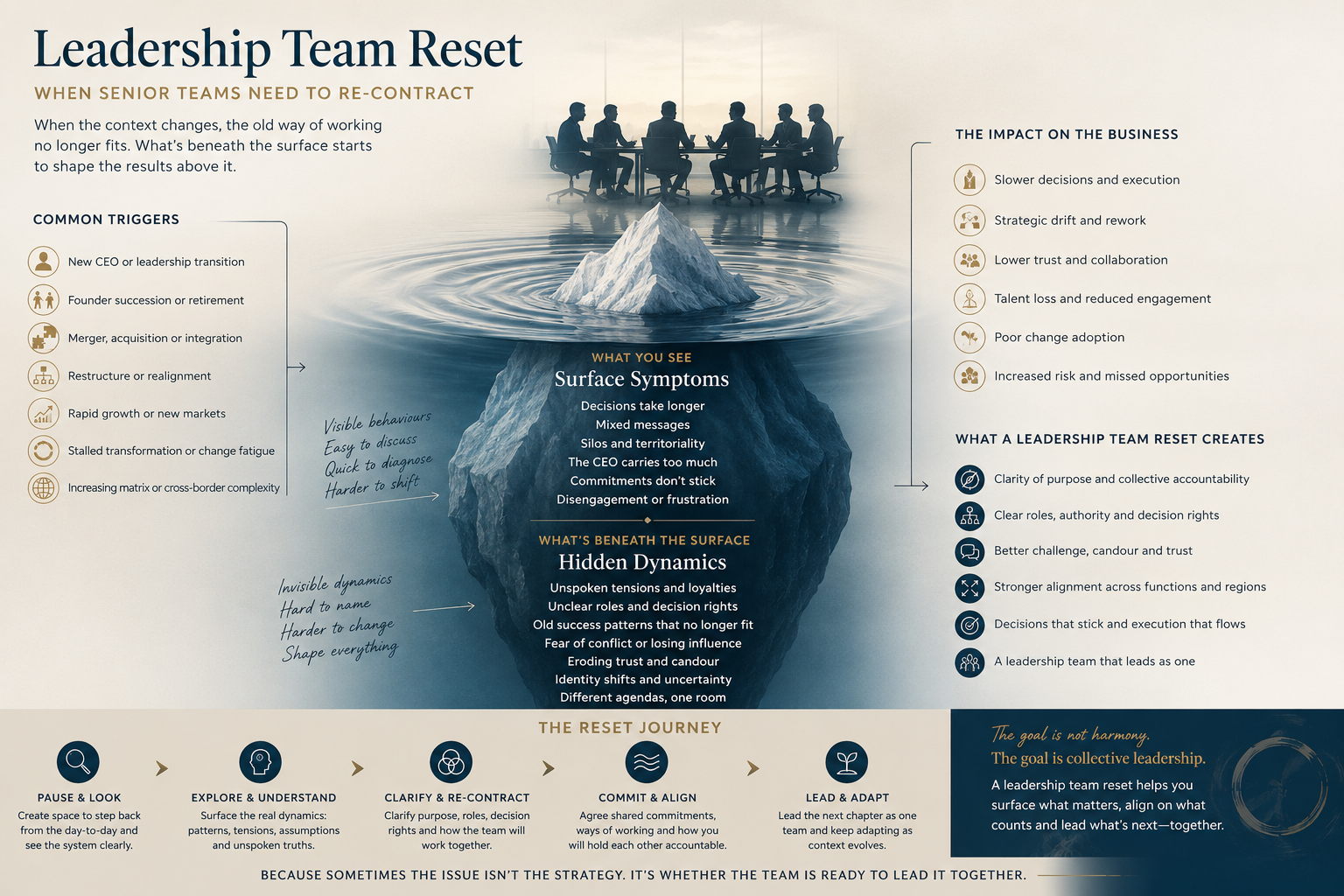
The Neuroscience of Getting Unstuck at Work (for Change and Transformation Leaders Driving Change)
If you are a transformation leader driving change, “stuck” rarely means lazy or unmotivated. It usually means your brain has decided the environment is high-risk: ambiguity, conflict, overload, reputational threat, or a run of setbacks. In that state, the nervous system prioritises protection over progress (Arnsten, 2009; Roberts, 2020).
This article translates practical neuroscience into six levers you can use to regain momentum at work. It is designed for leaders working in complex, matrix organisations where change is constant and politics are real.
If you want help applying this to your specific context, I’m a London-based executive coach and former transformation leader. You can book a confidential call at the end.
The 20-minute Unstuck Protocol (for transformation leaders)
Use this when you feel stuck, avoidant, or constantly “busy but not progressing”.
Name the stuck pattern (2 mins): What are you repeatedly postponing, circling, or overthinking?
Reduce threat (5 mins): What is driving threat right now: ambiguity, conflict, overload, or visibility? Remove one small stressor today.
Choose the smallest “meaningful next step” (5 mins): One action that moves the change forward, even slightly.
Add accountability (3 mins): Who will you tell, and by when? A colleague, sponsor, coach, or peer.
Review the signal (5 mins): What changed in energy, clarity, or confidence after you acted? Repeat tomorrow.
1) Habit loops and why leaders repeat the familiar during change
The brain has a natural inclination to seek comfort and efficiency through the formation of habits (Wood and Neal, 2007; Yin and Knowlton, 2006). When we feel stuck, it often indicates that we have become trapped in unproductive or limiting patterns of behaviour. Neuroscience reveals that these habits are formed through neural pathways in the brain, creating automatic responses to familiar stimuli (Graybiel, 2008). Breaking free from being stuck involves rewiring these neural pathways and forming new connections.
When change pressure rises, the brain defaults to efficiency (Wood and Neal, 2007). That means you will repeat familiar behaviours that previously reduced risk, even when they no longer move the work forward. For transformation leaders, this can show up as over-analysis, seeking more alignment, or staying in planning because it feels safer than visible execution.
In a matrix organisation, this looks like revisiting decisions, delaying stakeholder conversations, or polishing the narrative instead of taking the next step.
If you want to break unhelpful patterns quickly, executive coaching for leading change helps you spot the loop and replace it with a more effective response.
2) Neuroplasticity: how transformation leaders make new behaviours stick
The concept of neuroplasticity is at the core of becoming unstuck. Neuroplasticity refers to the brain's ability to reorganise and form new neural connections throughout life (Pascual-Leone et al., 2005; Fuchs and Flügge, 2014). By understanding that our brains are not fixed entities but constantly evolving, we can harness this neuroplasticity to initiate change. Introducing new experiences, thoughts, and behaviors activates the brain's capacity to adapt and rewire itself, enabling us to break free from being stuck (Pascual-Leone et al., 2005).
As a transformation leader, your job is to design actions that are easy to start, hard to avoid, and tied to the actual moments you tend to derail.
This is the core of making change stick, especially when you are leading a long transformation programme under pressure.
3) Dopamine, novelty and sustaining momentum in transformation programmes
Novelty and learning can engage dopaminergic systems that help the brain learn from feedback and update expectations (Schultz, Dayan and Montague, 1997). Novelty can also modulate how strongly information is retained over time, which is one reason learning moments matter during long change cycles (Duszkiewicz et al., 2019). Dopamine is better understood as a signal that supports learning and motivation through prediction and feedback, rather than a simple ‘pleasure chemical’ (Schultz, Dayan and Montague, 1997).
For change and transformation leaders, the practical application is to design short feedback loops and visible progress markers so momentum is reinforced week to week (Lisman and Grace, 2005; Bunzeck and Düzel, 2006). That might mean shorter delivery cycles, clearer success markers, and a weekly “what moved” review that makes progress undeniable, alongside recognition that reinforces the behaviours you want repeated.
If momentum is stalling, this is a common challenge in leading transformation in complex organisations, where priorities shift and stakeholders pull in different directions.
4) Threat response: why the brain resists change under pressure
Under threat, the nervous system shifts into protection mode. In humans, this can include active defence responses (fight or flight) and freezing, which can look at work like hesitation, avoidance, or suddenly going rigid in a meeting. (Kozlowska et al., 2015; Bracha, 2004).
When pressure is high, people often become less flexible and more defensive or avoidant, not because they do not care, but because the system is trying to reduce risk. (Arnsten, 2009; Roberts, 2020).
In leadership, this is frequently mislabelled as “resistance”, when it is often a predictable response to uncertainty, conflict, overload, or reputational threat. (Arnsten, 2009).
The goal is not to “push through”. It is to reduce perceived threat, increase clarity, and create the conditions where people can speak up, learn, and take sensible risks during change. (Edmondson, 1999).
If you want to understand your default pattern under strain, the Hogan Development Survey (HDS) focuses on “dark side” tendencies that are more likely to show up when stress is higher and self-monitoring drops, which can derail relationships and performance. (Hogan Press, 2014; Hogan Assessments, n.d.).
By practising mindfulness, self-compassion, and cognitive reappraisal, many people can support emotion regulation and reduce stress reactivity over time, which makes change feel less threatening and easier to act on. (Ochsner and Gross, 2005; Buhle et al., 2014).
Done well, this overlaps directly with psychological safety: a shared belief that the team is safe for interpersonal risk-taking, which supports learning behaviour in real work teams. (Edmondson, 1999).
Stuck moment
If you feel stuck, it is often a threat response, not a capability problem.
If you’re leading change in a complex, matrix organisation, I can help you reduce noise, name the real constraint, and leave with 1 to 2 concrete next steps to regain momentum.
5) Visualisation and mental rehearsal for high-stakes leadership decisions
Visualisation is useful when it becomes structured mental rehearsal: imagining the situation, the obstacles, and the exact behaviours you will use under pressure (Van Caenegem et al., 2024). Visualisation is a powerful tool that leverages the brain's neural networks to create a clear vision of the desired outcome. When we visualise our goals and the steps needed to achieve them, we activate the brain's motor and sensory areas, simulating the experience as if it were happening in real life (Van Caenegem et al., 2024). This process strengthens the neural connections associated with the desired behaviors.
For transformation leaders, this is most valuable before difficult conversations, executive steering meetings, or moments where you are likely to revert to old habits. Rehearsal increases readiness because you have already “run the script” and chosen your response as well as potentially helping others to visualise the future (Gippert et al., 2025).
This supports stronger executive decision-making under pressure, particularly when the stakes and visibility are high.
6) Social support and accountability: why executive coaching helps leaders change
Change is social. Your behaviour is shaped by the people around you, the incentives in the system, and the feedback you receive (Muscatell and Eisenberger, 2012; Uchino et al., 2011).
For transformation leaders: In transformation roles, isolation is common: you are expected to have answers while navigating politics, ambiguity, and competing agendas (Coan et al., 2006). A good accountability structure creates follow-through, sharper thinking, and a place to reality-test decisions before you act.
For everyone else: if your organisation is going through a transformation program you should bear in mind that the brain's social wiring emphasizes the importance of connection and support for personal growth. Surrounding yourself with a supportive network of friends, mentors, or coaches can provide encouragement, feedback, and accountability. Sharing your aspirations and progress with others activates the brain's reward system, increasing motivation and resilience. By leveraging social support, you create a nurturing environment that fosters growth and helps you become unstuck.
That is why executive coaching is often the fastest way for transformation leaders to get unstuck and sustain change (Theeboom et al., 2014; Jones et al., 2016), including for clients who want a London-based coach.
Next step
Do not carry complex change alone.
Executive coaching for transformation leaders: decide faster, handle stakeholder conflict cleanly, and sustain follow-through under pressure. London-based, working internationally.
Conclusion
When you feel stuck during change, treat it as a signal, not a flaw. Your brain is responding to pressure, uncertainty, and risk, and it will default to familiar patterns unless you deliberately design a new one (Arnsten, 2009). The practical levers are consistent: reduce threat, choose a small meaningful action, create visible progress, rehearse the moments that trigger you, and build accountability.
Used well, these neuroscience-informed steps help transformation leaders move from intention to execution, and from short-term effort to sustainable change.
If you are leading change in a complex organisation and you want help applying this in your real context, executive coaching gives you a confidential space to think clearly, test choices, and follow through. The goal is simple: regain momentum and make change stick.
Next step
Book a confidential call to get unstuck and regain momentum.
If you’re a transformation leader driving change, we’ll pinpoint what’s keeping you stuck and identify 1 to 2 practical next steps you can implement. London-based, working internationally.
FAQ: The Neuroscience of Getting Unstuck at Work
-
Neuroscience helps explain why smart, capable leaders can become less flexible under sustained pressure. It gives you practical levers to reduce threat, regain clarity, and turn intention into behaviour during change.
-
Because change increases uncertainty, social risk, and cognitive load. When that pressure is high, leaders often default to familiar habits like over-analysis, seeking more alignment, or delaying the hardest conversations.
-
Neuroplasticity is the brain’s ability to adapt through repeated experience. For transformation leaders, the implication is simple: design small repeatable actions, rehearse them in real situations, and build feedback loops so the new behaviour becomes your default.
-
Shrink the work to one visible, meaningful next step and set a short review cycle. Momentum returns when progress is measurable, ownership is clear, and follow-through is monitored weekly.
-
Treat “resistance” as information, not defiance. Reduce ambiguity, clarify decision rights, make success measures visible, and create psychological safety with standards so people can speak honestly and still deliver.
-
Executive coaching gives you a confidential space to think clearly, spot unhelpful patterns, pressure-test decisions, and follow through. It helps you shift behaviour under real pressure, not just talk about change.
-
No. The goal is not to become a neuroscientist. The goal is to apply simple, evidence-informed practices that improve decision-making, momentum, and behaviour change at work.
-
Yes. I’m based in London and work internationally. If you want to apply these ideas to your current change context, you can book a confidential call.
References
Arnsten, A.F.T. (2009) ‘Stress signalling pathways that impair prefrontal cortex structure and function’, Nature Reviews Neuroscience, 10(6), pp. 410–422.
Bracha, H.S. (2004) ‘Freeze, flight, fight, fright, faint: adaptationist perspectives on the acute stress response spectrum’, CNS Spectrums, 9(9), pp. 679–685.
Buhle, J.T. et al. (2014) ‘Cognitive reappraisal of emotion: a meta-analysis of human neuroimaging studies’, Cerebral Cortex, 24(11), pp. 2981–2990.
Bunzeck, N. and Düzel, E. (2006) ‘Absolute coding of stimulus novelty in the human substantia nigra/VTA’, Neuron, 51(3), pp. 369–379.
Coan, J.A., Schaefer, H.S. and Davidson, R.J. (2006) ‘Lending a hand: social regulation of the neural response to threat’, Psychological Science, 17(12), pp. 1032–1039.
Duszkiewicz, A.J. et al. (2019) ‘Novelty and dopaminergic modulation of memory persistence: a tale of two systems’, Trends in Neurosciences, 42(2), pp. 102–114.
Edmondson, A. (1999) ‘Psychological safety and learning behavior in work teams’, Administrative Science Quarterly, 44(2), pp. 350–383.
Fuchs, E. and Flügge, G. (2014) ‘Adult neuroplasticity: more than 40 years of research’, Neural Plasticity, 2014, Article 541870.
Gippert, M. et al. (2025) ‘Motor imagery enhances performance beyond the imagined action’, Proceedings of the National Academy of Sciences of the United States of America, 122(20), e2423642122.
Graybiel, A.M. (2008) ‘Habits, rituals, and the evaluative brain’, Annual Review of Neuroscience, 31, pp. 359–387.
Hogan Assessments (n.d.) ‘Hogan Development Survey (HDS)’. Available at: https://www.hoganassessments.com/assessment/hogan-development-survey/ (Accessed: 6 February 2026).
Hogan Press (2014) Hogan Development Survey: Technical Supplement, Form 5. Tulsa, OK: Hogan Press.
Jones, R.J. et al. (2016) ‘The effectiveness of workplace coaching: a meta-analysis of learning and performance outcomes from coaching’, Journal of Occupational and Organizational Psychology, 89(2), pp. 249–277.
Kozlowska, K., Walker, P., McLean, L. and Carrive, P. (2015) ‘Fear and the defense cascade: clinical implications and management’, Harvard Review of Psychiatry, 23(4), pp. 263–287.
Kübler-Ross, E. (1969) On Death and Dying. New York: Macmillan.
Lally, P. et al. (2010) ‘How are habits formed: modelling habit formation in the real world’, European Journal of Social Psychology, 40(6), pp. 998–1009.
Lisman, J.E. and Grace, A.A. (2005) ‘The hippocampal-VTA loop: controlling the entry of information into long-term memory’, Neuron, 46(5), pp. 703–713.
Muscatell, K.A. and Eisenberger, N.I. (2012) ‘A social neuroscience perspective on stress and health’, Social and Personality Psychology Compass, 6(12), pp. 890–904.
Ochsner, K.N. and Gross, J.J. (2005) ‘The cognitive control of emotion’, Trends in Cognitive Sciences, 9(5), pp. 242–249.
Pascual-Leone, A. et al. (2005) ‘The plastic human brain cortex’, Annual Review of Neuroscience, 28, pp. 377–401.
Roberts, A.C. (2020) ‘Prefrontal regulation of threat-elicited behaviors: a pathway to translation’, Annual Review of Psychology, 71, pp. 357–387.
Schultz, W., Dayan, P. and Montague, P.R. (1997) ‘A neural substrate of prediction and reward’, Science, 275(5306), pp. 1593–1599.
Theeboom, T., Beersma, B. and van Vianen, A.E.M. (2014) ‘Does coaching work? A meta-analysis on the effects of coaching on individual level outcomes in an organizational context’, The Journal of Positive Psychology, 9(1), pp. 1–18.
Uchino, B.N. et al. (2011) ‘Social support and the reactivity hypothesis: conceptual issues in examining the efficacy of received support during acute psychological stress’, Biological Psychology, 86(2), pp. 137–142.
Van Caenegem, E.E. et al. (2024) ‘Multisensory approach in Mental Imagery: ALE meta-analyses comparing Motor, Visual and Auditory Imagery’, Neuroscience & Biobehavioral Reviews, 167, 105902.
Wood, W. and Neal, D.T. (2007) ‘A new look at habits and the habit-goal interface’, Psychological Review, 114(4), pp. 843–863.
Yin, H.H. and Knowlton, B.J. (2006) ‘The role of the basal ganglia in habit formation’, Nature Reviews Neuroscience, 7(6), pp. 464–476.

Under the Surface
A monthly briefing on the hidden dynamics shaping senior leadership, teams and change…
Read next…