Top 5 Behavior Change Models for Personal Transformation

Embarking on a journey of personal transformation and behaviour change can be both exciting and challenging. Whether you're aiming to adopt healthier habits, break free from limiting beliefs, or enhance your overall well-being, having a clear understanding of behaviour change models can greatly support your efforts. In this article, we will delve into several influential behaviour change models, including the Kubler-Ross Change Curve, the Trans-Theoretical Model (TTM), the HAPA Behaviour Change Model, and others. Let's explore how these models can help unlock sustainable change and guide you towards your desired outcomes.
Behaviour change models are useful because they stop us treating change as a simple problem of willpower. In executive coaching, they help identify whether the real constraint is readiness, confidence, planning, emotional regulation, social pressure or the wider system around the behaviour. This is why behaviour change links closely with emotional intelligence coaching, coaching for transformation leaders and the psychology of organisational transformation in matrix organisations.
Dr Elizabeth Kubler-Ross Change Curve:
The famous Kubler-Ross Change Curve (1969), also known as the five stages of grief, originally identified in the context of dealing with loss and bereavement, can be applied to various types of personal and professional changes. The stages include denial, anger, bargaining, depression, and acceptance. This model recognizes that change is often accompanied by a range of emotions and highlights the importance of acknowledging and processing these emotions to move forward.
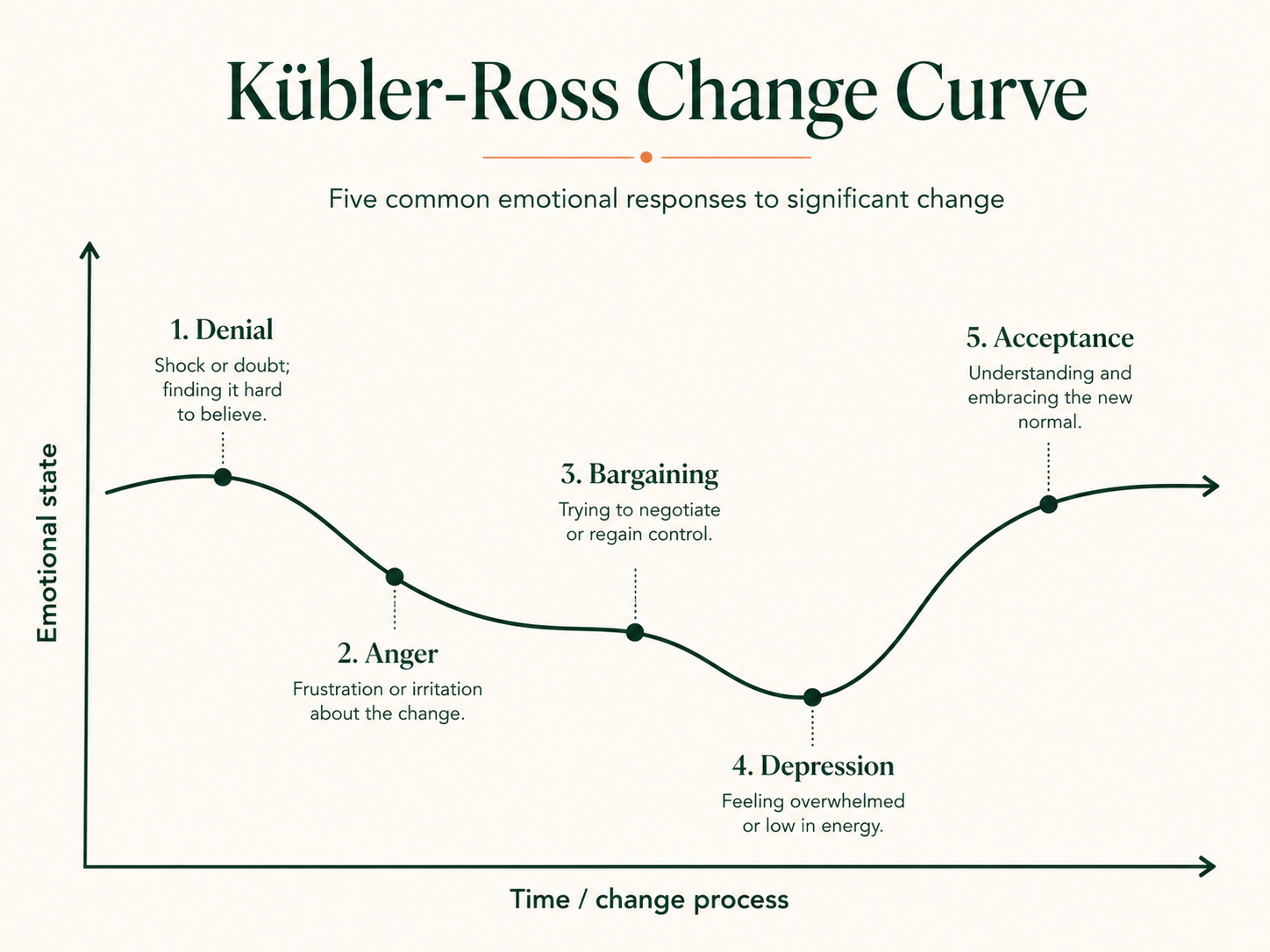
Strictly speaking the Kübler-Ross Change Curve is better understood as an emotional transition model, though it has been used successfully in business change for decades, not a full behaviour change model compared to the models I share below.
Important caveat on the Kübler-Ross Change Curve
The Kübler-Ross model is often shown as a curve in organisational change, but this is a later business application of work originally developed in relation to death, dying and profound loss.
It should not be used to suggest that everyone moves through fixed stages in a neat sequence. In practice, people may move back and forth, experience several emotions at once, skip some reactions entirely, or respond differently depending on their personality, context, culture, previous experience and level of support.
Used carefully, the model can help leaders normalise emotional responses to change. Used carelessly, it can oversimplify human experience and imply that people simply need to “move through the curve”. That is too crude for serious leadership or organisational work.
Trans-Theoretical Model (TTM):
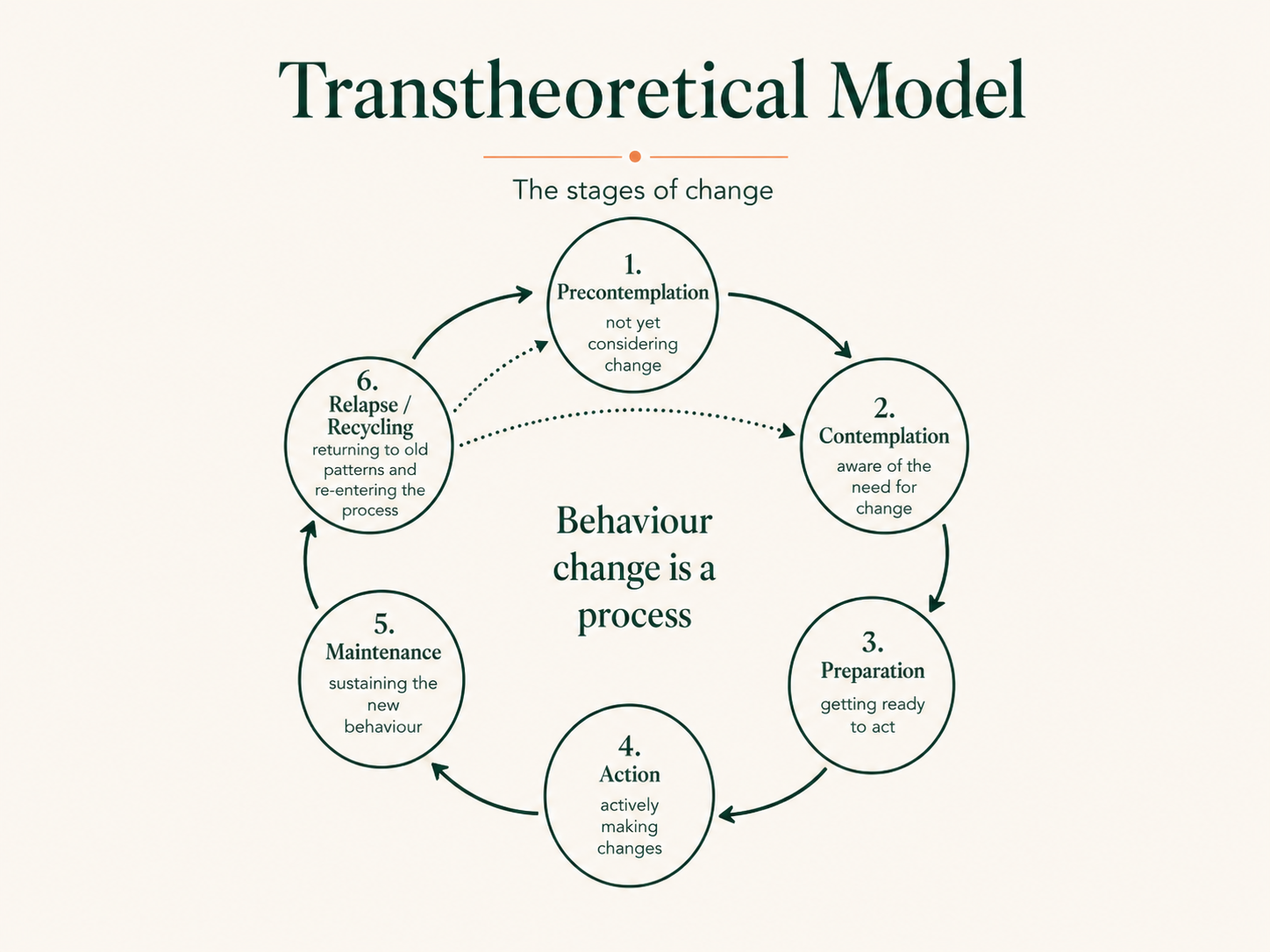
The Trans-Theoretical Model, developed by Prochaska and DiClemente (1977), outlines a framework for understanding behaviour change. It identifies five stages of change: pre-contemplation, contemplation, preparation, action, and maintenance. This model emphasizes that individuals progress through these stages at their own pace and highlights the significance of self-efficacy, decision-making, and supportive environments in facilitating successful behaviour change.
HAPA Behaviour Change Model:
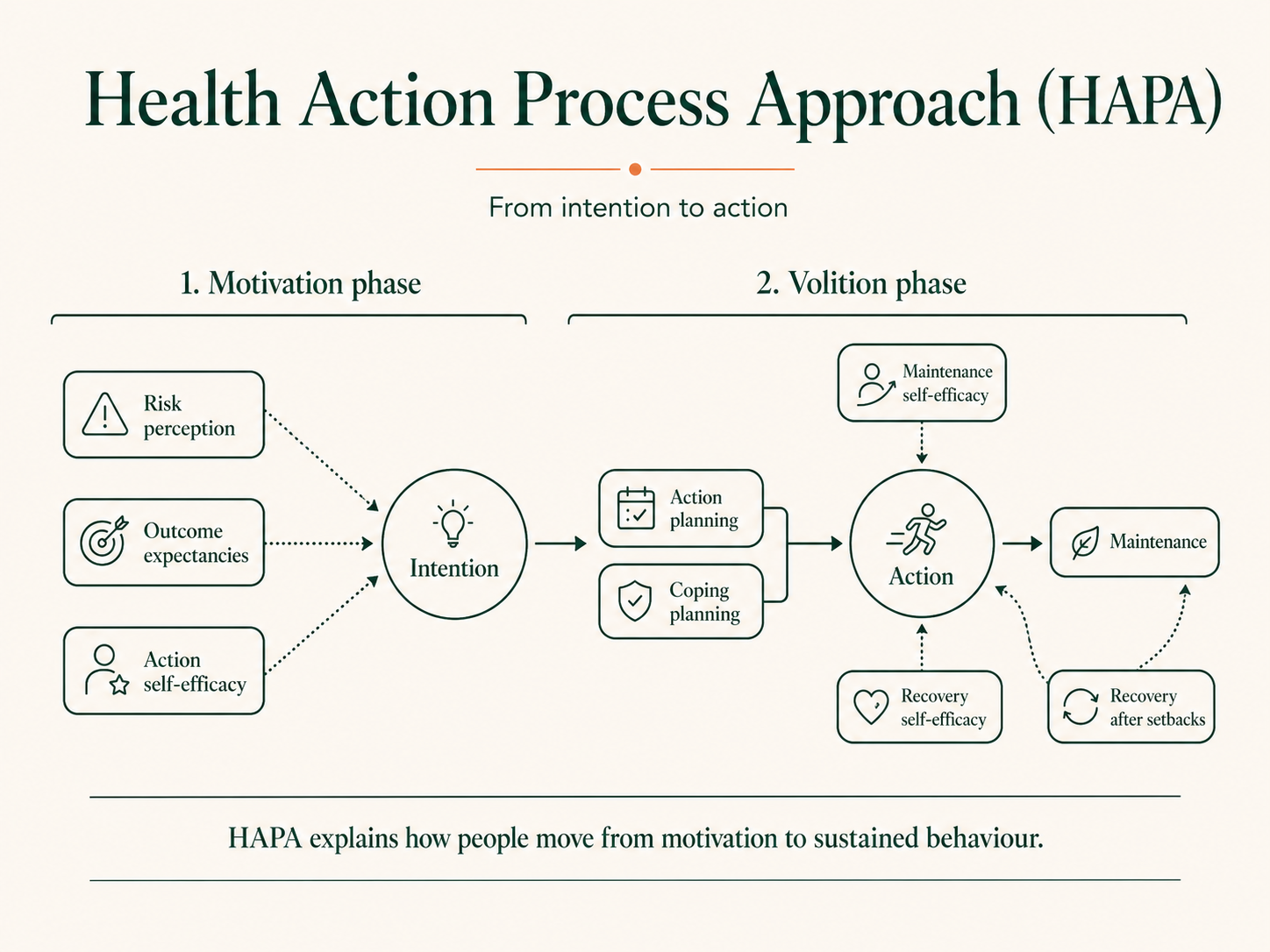
The Health Action Process Approach (HAPA) Behaviour Change Model integrates several psychological theories and provides a comprehensive framework for behaviour change (Schwarzer, 1992). It consists of two main phases:
the motivation phase and the
volition phase.
The motivation phase involves developing intentions and building self-efficacy, while the volition phase focuses on planning, action, and maintenance of the desired behaviour. This model emphasises the role of goal setting, action planning, and coping strategies in achieving sustainable behaviour change.
Next step
Reading behaviour change models is easy. Applying them is the hard part.
In 1:1 executive coaching, we translate insight into a practical plan: what’s driving the pattern, what to change first, and how to make it stick when you’re under pressure.
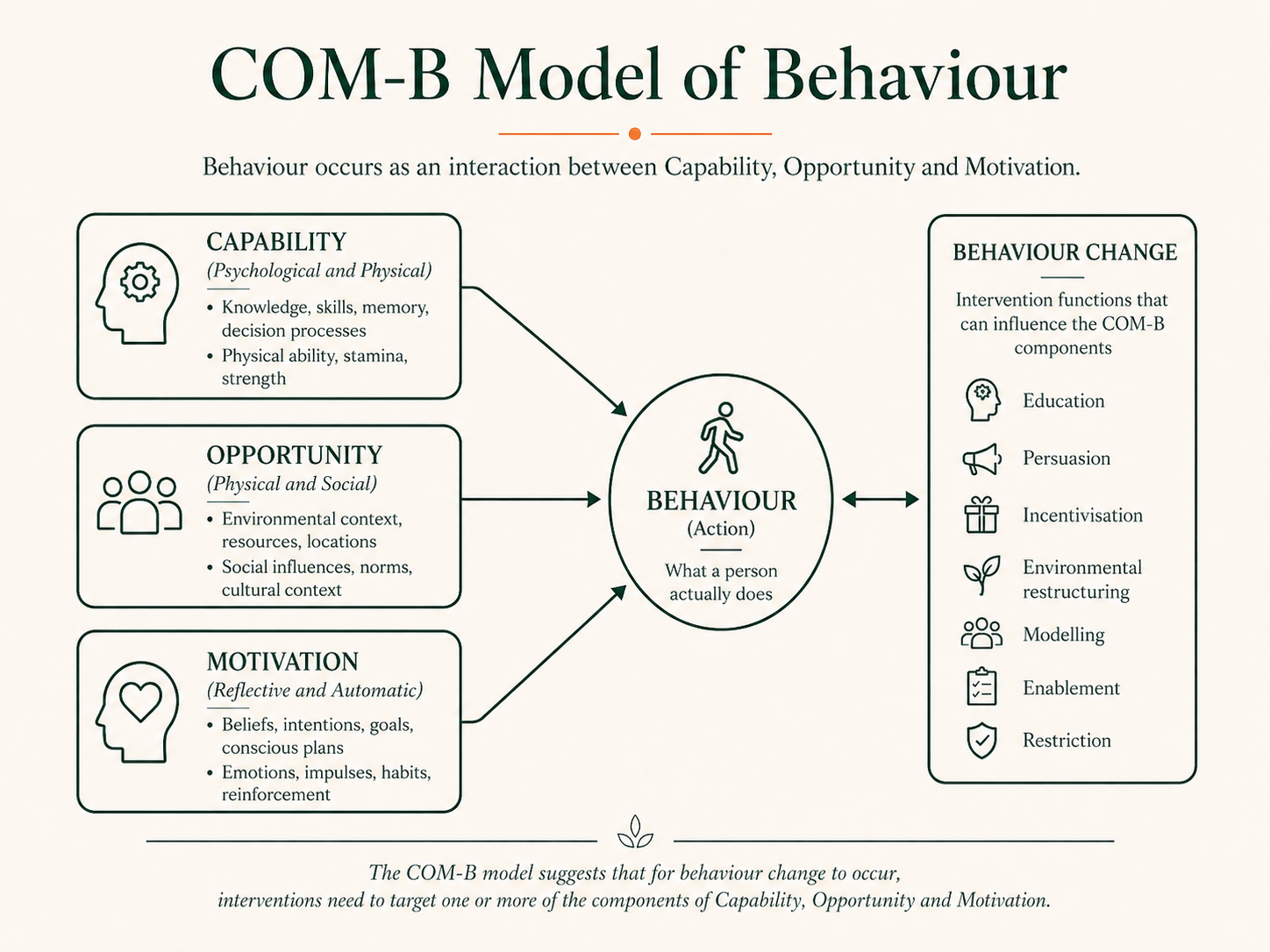
COM-B Model of Behaviour:
The COM-B Model of Behaviour, developed by Michie, van Stralen and West (2011), suggests that behaviour occurs through the interaction of three core factors: capability, opportunity and motivation. Capability refers to whether someone has the psychological and physical ability to perform the behaviour. Opportunity refers to whether the environment, resources and social context make the behaviour possible. Motivation includes both conscious intentions and more automatic processes such as habits, impulses and emotional responses.
This model is especially useful because it moves beyond the idea that behaviour change is simply about willpower. If a person is not changing, the issue may be a lack of skill, confidence, support, environmental fit or emotional readiness. COM-B helps identify what is actually blocking change, so that interventions can be better targeted.
Social Cognitive Theory:
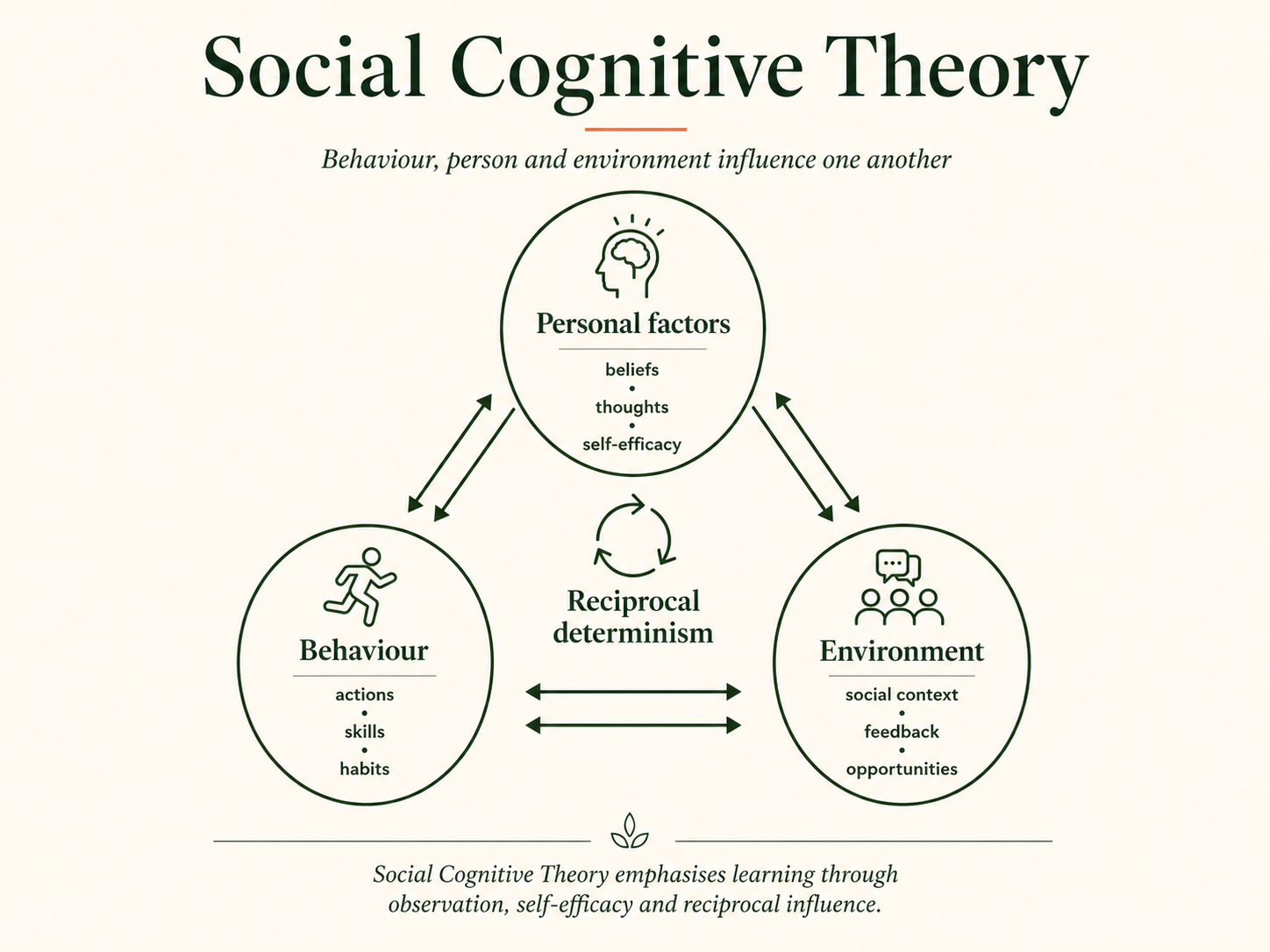
The Social Cognitive Theory, developed by Bandura (1976), emphasizes the reciprocal interaction between personal factors, environmental influences, and behaviour. It highlights the importance of
self-efficacy,
observational learning,
and social support
in driving behaviour change. This model suggests that individuals can learn from observing others and develop self-beliefs that influence their behaviour.
Theory of Planned Behaviour (TPB):
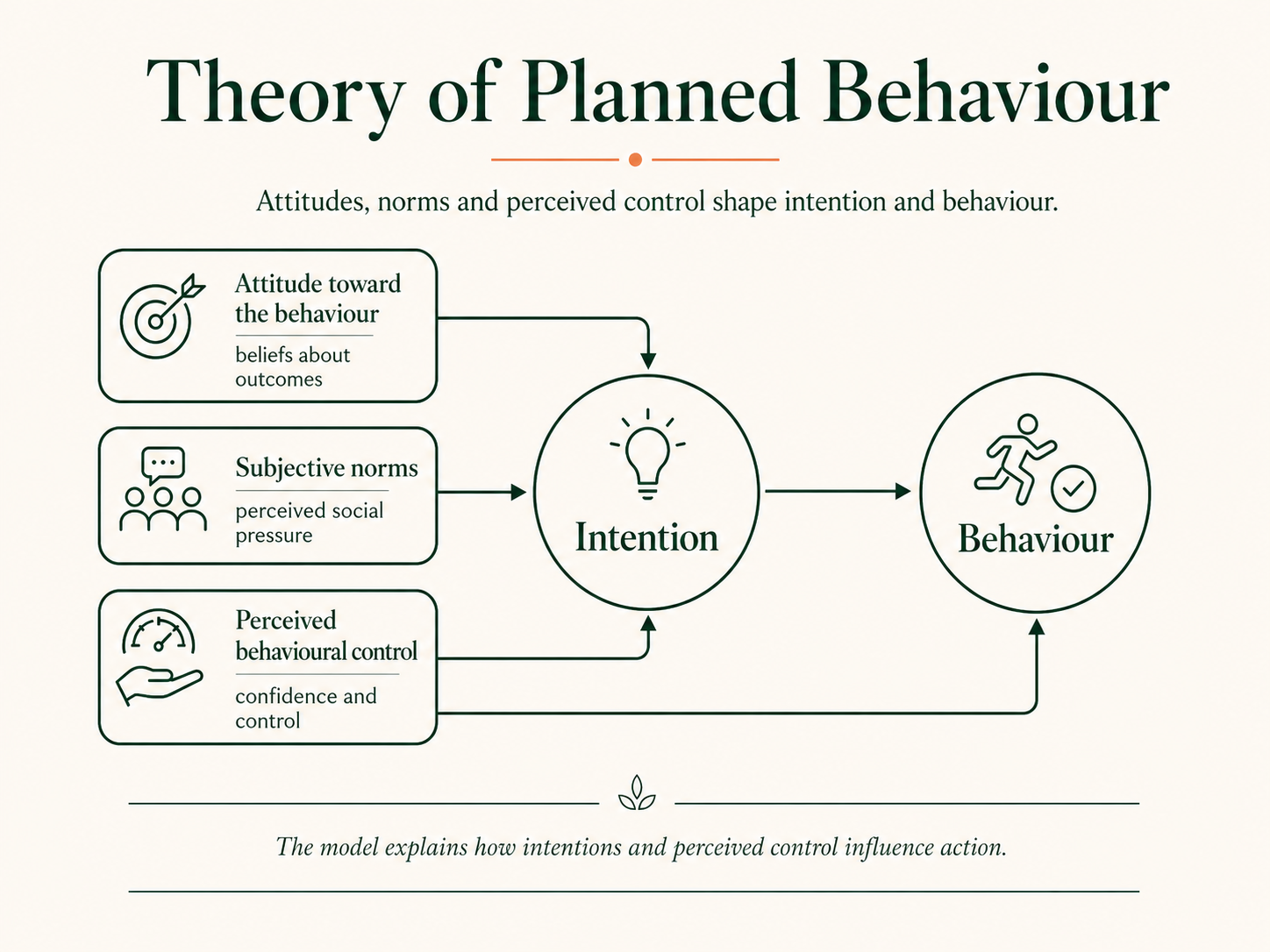
The Theory of Planned Behaviour, developed by Ajzen (1985), posits that behaviour is influenced by three main factors:
attitudes,
subjective norms, and
perceived behavioural control.
Attitudes refer to an individual's positive or negative evaluation of a behaviour, subjective norms relate to the perceived social pressure to engage in or avoid a behaviour, and perceived behavioural control refers to an individual's belief in their ability to perform the behaviour. This model highlights the importance of intention formation and perceived control in predicting and shaping behaviour.
Which Behaviour Change Model Should You Use?
The best model depends on the problem you are trying to understand.
Use the Kübler-Ross Change Curve when the main issue is emotional response to change, loss, disruption or uncertainty.
Use the Transtheoretical Model when the key question is readiness: is the person not yet considering change, considering it, preparing, taking action or trying to maintain progress?
Use HAPA when someone already has some intention to change, but needs stronger planning, coping strategies and self-efficacy to follow through.
Use COM-B when you need to diagnose what is blocking the behaviour: capability, opportunity or motivation.
Use Social Cognitive Theory when confidence, modelling, social learning or the wider environment are central to the behaviour.
Use the Theory of Planned Behaviour when intention, attitudes, perceived social pressure and perceived behavioural control are important.
The same is true when selecting development support: choosing between coaching, training, mentoring or a wider intervention should follow the diagnosis, rather than starting with a preferred method.
In real coaching and organisational work, these models can be combined. A leader may need to understand their emotional response to change, strengthen confidence, build a practical action plan and change the environment around the behaviour. No single model explains everything.
Conclusion
Incorporating these behaviour change models into your personal transformation journey can provide valuable insights and guidance. Remember, sustainable behaviour change takes time, effort, and commitment. It's essential to set realistic goals, develop supportive environments, cultivate self-awareness, and seek appropriate resources or support systems. With the right tools and a deep understanding of these models, you can navigate the complexities of behaviour change and unlock your full potential for personal growth and transformation.
Next step
Reading behaviour change models is easy. Applying them is the hard part.
In 1:1 executive coaching, we translate insight into a practical plan: what’s driving the pattern, what to change first, and how to make it stick when you’re under pressure.
FAQs: Top 5 Behaviour Change Models
-
The article summarises the Kübler-Ross Change Curve, the Transtheoretical Model (TTM), the Health Action Process Approach (HAPA), Social Cognitive Theory and the Theory of Planned Behavior.
-
Choose based on your goal and context. For readiness and motivation over time, use TTM. For intention, planning and action control, use HAPA. For learning from others and self-efficacy, use Social Cognitive Theory. For attitude, norms and perceived control, use the Theory of Planned Behavior. The Change Curve helps you normalise emotions during change.
-
TTM focuses on stages of readiness (pre-contemplation to maintenance). HAPA focuses on two phases: motivation (forming an intention) and volition (planning and enacting the behaviour with action and coping plans).
-
Yes. For example, use TTM to gauge readiness, HAPA to create action and coping plans, and Social Cognitive Theory to strengthen self-efficacy and leverage role models.
-
Define a specific behaviour, set a clear cue or context, create a small action plan with obstacles and coping plans, and track progress weekly.
📚References
Ajzen, I. (1991) ‘The theory of planned behavior’, Organizational Behavior and Human Decision Processes, 50(2), pp. 179–211.
Ajzen, I. (1985) ‘From intentions to actions: A theory of planned behavior’, in Kuhl, J. and Beckmann, J. (eds.) Action-control: From cognition to behavior. Heidelberg: Springer, pp. 11–39.
Bandura, A. (1977) ‘Self-efficacy: Toward a unifying theory of behavioral change’, Psychological Review, 84(2), pp. 191–215.
Bandura, A. (1986) Social Foundations of Thought and Action: A Social Cognitive Theory. Englewood Cliffs, NJ: Prentice-Hall.
Kübler-Ross, E. (1969) On Death and Dying. New York: The Macmillan Company.
Michie, S., van Stralen, M.M. and West, R. (2011) ‘The behaviour change wheel: A new method for characterising and designing behaviour change interventions’, Implementation Science, 6, Article 42.
Prochaska, J.O. and DiClemente, C.C. (1983) ‘Stages and processes of self-change of smoking: Toward an integrative model of change’, Journal of Consulting and Clinical Psychology, 51(3), pp. 390–395.
Schwarzer, R. (1992) ‘Self-efficacy in the adoption and maintenance of health behaviors: Theoretical approaches and a new model’, in Schwarzer, R. (ed.) Self-efficacy: Thought control of action. Washington, DC: Hemisphere, pp. 217–243.

Under the Surface
A monthly briefing on the hidden dynamics shaping senior leadership, teams and change…
Read next…