The Anthropological and Neuroscientific Roots of Teamwork
Teamwork is not just a set of behaviours we learn at work. It is built on ancient human wiring: how we bond, read intent, handle status, and decide who to trust.

Interdependence, trust, and the conditions that make teamwork easier.
This article explains the anthropology and neuroscience behind teamwork, and then translates it into practical implications for leaders and teams: what strengthens cooperation, what triggers defensiveness, and why “more communication” often makes things worse.
If your team is stuck in polite agreement, repeated decisions, or collaboration that collapses under pressure, this is often less about attitude and more about predictable human threat responses. The point of this article is simple: understand the wiring, then design the conditions where cooperation becomes easier (Tomasello et al., 2012; Dunbar, 2009).
Curious about the performance cost of poor teamwork? see the impacts of dysfunctional teams on organisational performance article.
Key takeaways from this article:
Why cooperation evolved, and what that means for modern work teams
How empathy and “reading others” affects collaboration (and misreads under pressure)
What biology suggests about trust, threat, and group behaviour
Practical leadership implications for creating conditions where teamwork is easier
You’ll leave with a handful of practical leadership moves to reduce defensiveness and improve decision clarity, trust, and follow-through.
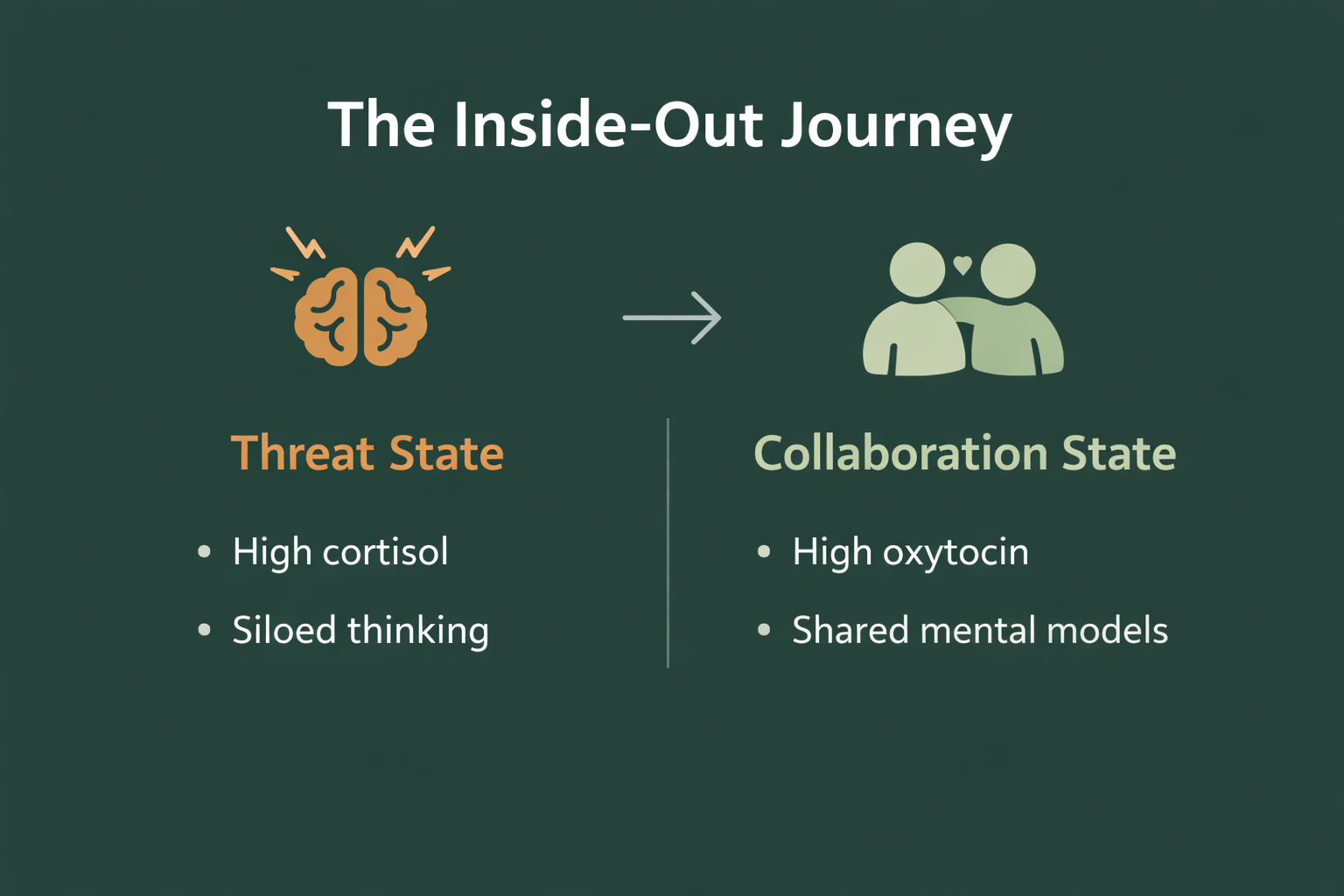
A simple inside-out model: reduce threat, increase clarity, and cooperation becomes easier.
Next step
Cooperation is not just a value. It is a pattern your team either reinforces or erodes.
Take the Leadership Team Performance Diagnostic to reflect on the conditions shaping trust, challenge, decisions and collective performance in your senior team.
The Evolution of Teamwork
1. Hunting and Gathering: A Neurological Perspective
Long before modern organisations existed, humans survived by cooperating in small groups to find food, share resources, coordinate effort, and manage risk. In foraging contexts, collaboration is not a “nice to have”, it is a practical solution to uncertainty: individuals specialise, coordinate, and rely on social relationships to secure calories and protect the group. This evolutionary pressure helped shape the social capabilities that still influence teamwork today, including attention to others’ intentions, sensitivity to reputation, and the ability to coordinate around shared goals. (Kaplan et al., 2000; Apicella and Silk, 2019)
2. The Social Brain Hypothesis
The "social brain hypothesis" suggests that the human brain evolved to handle the complexities of social interactions. Our ancestors needed to navigate intricate relationships within groups, which required advanced cognitive functions. This theory highlights the neurobiological basis of teamwork, emphasising the brain's adaptability and its capacity for empathy, cooperation, and communication (Dunbar, 1998; Dunbar, 2009).
3. Mirror Neurons and Empathy
Neuroscientists have explored mirror neurons, which fire both when an individual performs an action and when they observe someone else performing the same action (Rizzolatti and Craighero, 2004). This phenomenon is thought to underpin our ability to empathise and understand the intentions of others. The extent to which mirror neurons explain empathy in humans is debated.
(Hickok, 2014). Mirror neurons likely played a significant role in the development of teamwork, enabling early humans to mimic and learn from each other's actions.
If you’re interested in how this shows up in real teams, read Group Dynamics and High-Performing Teams.
The Role of Leadership from a Neurological Perspective
Leadership, a critical aspect of teamwork, also has neurological foundations. Studies in neuroscience have identified specific brain regions associated with leadership qualities, such as the anterior cingulate cortex, responsible for decision-making and conflict resolution (Botvinick, Cohen and Carter, 2004; Forbes and Grafman, 2010). Effective leaders are often those who can navigate these neural pathways to foster cooperation and motivate group members.
Teamwork in Contemporary Society: A Neurobiological Legacy
In modern society, teamwork continues to shape our lives in profound ways. Neuroscience research has illuminated the importance of oxytocin, often called the "love hormone" or "trust hormone," in facilitating social bonds and collaboration (Kosfeld et al., 2005; Shamay-Tsoory and Abu-Akel, 2016). This biological insight reinforces the enduring significance of teamwork in our lives.
What this Means for Leaders and Teams
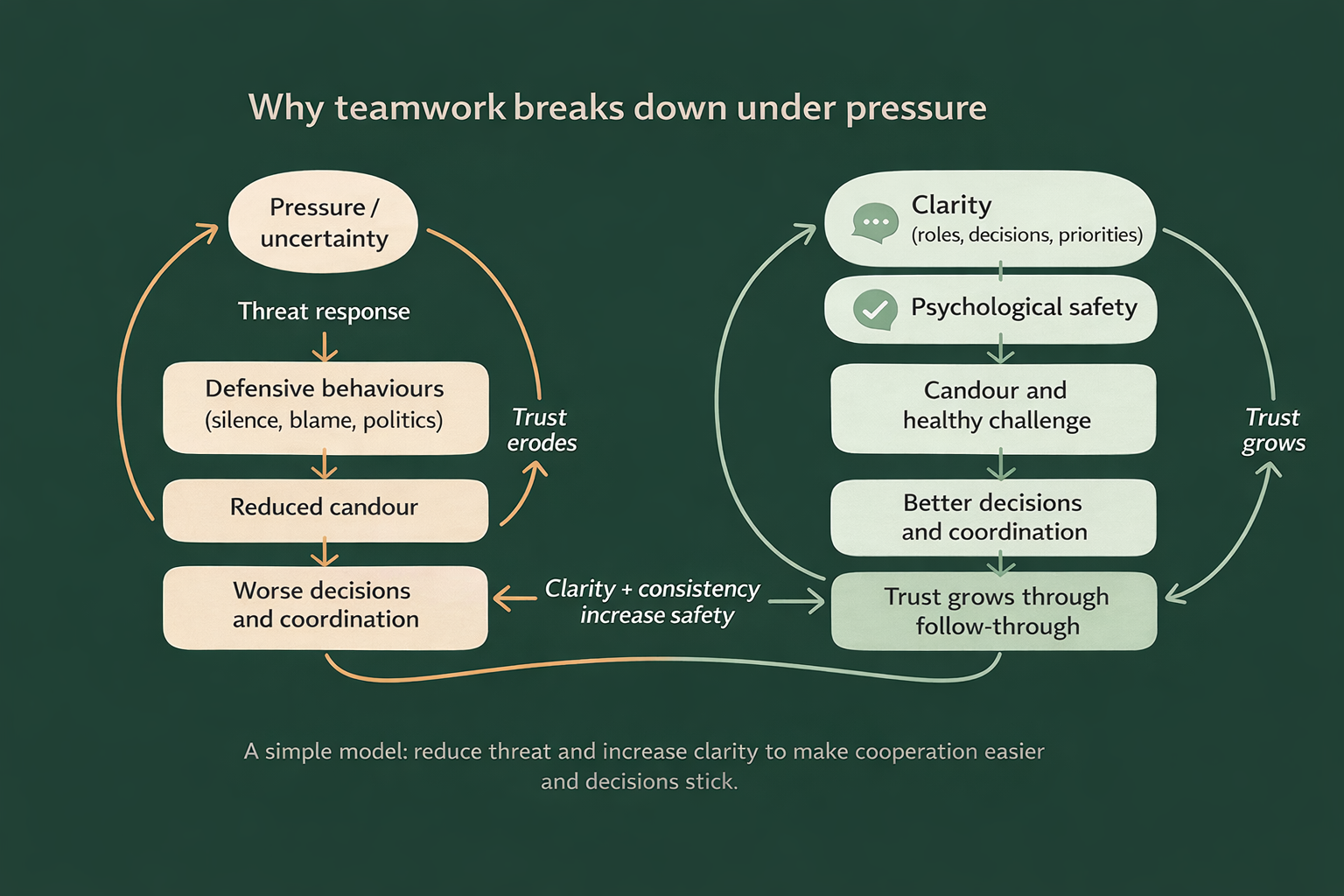
If teamwork is rooted in human wiring, then leadership is less about “motivating collaboration” and more about reducing threat and increasing clarity so cooperation becomes the default.
Make decisions stick. Run meetings to end in clear decisions and commitments: decision, owner, next step, date. If decisions keep getting reopened, you have a trust and governance problem, not a communication problem.
Lower threat without lowering standards. Psychological safety is created when people can raise risks and disagree without punishment or humiliation (Edmondson, 1999). Keep standards high by being explicit about what “good” looks like and closing the loop when commitments slip.
Clarify roles and decision rights. Role ambiguity breeds politics and resentment, especially in matrix organisations. Define who decides, who contributes, and who is accountable for outcomes.
Normalise healthy challenge. Humans infer intent fast, and under pressure we misread each other. Use simple prompts like: “What are we assuming?”, “What’s the risk if we’re wrong?”, and “What evidence would change our minds?”
Build trust through reliability. Trust grows less from bonding exercises and more from repeated follow-through, fairness, and fast repair when things go wrong (Mayer, Davis and Schoorman, 1995).
Done well, these small shifts change the team’s daily experience: less avoidance, fewer side conversations, faster decisions, and stronger execution.
Conclusion: The Anthropological and Neuroscientific Roots of Teamwork
Teamwork is not merely a cultural or social construct; it has deep roots in our biology and neuroscience. Our evolutionary history demonstrates that our brains are wired for cooperation, empathy, and leadership, making teamwork an inherent part of our nature. As we navigate the complexities of the modern world, understanding these biological aspects of teamwork can deepen our appreciation for its importance in achieving common goals. So, the next time you find yourself in a team, remember that you are tapping into a rich neurological legacy that spans the entirety of human existence.
Curious about the performance cost of poor teamwork? see The impact of dysfunctional teams on organisational performance.
Next step
Which neurochemical state is your team currently operating in - survival or synergy?
In a few minutes you can skim the Team Coaching & Development page and see the kinds of teams I work with, the process we follow, and the outcomes senior leaders typically get – before you decide whether it’s worth a conversation.
📚 References
Apicella, C.L. and Silk, J.B. (2019) ‘The evolution of human cooperation’, Current Biology, 29(11), pp. R447–R450.
Botvinick, M.M., Cohen, J.D. and Carter, C.S. (2004) ‘Conflict monitoring and anterior cingulate cortex: an update’, Trends in Cognitive Sciences, 8(12), pp. 539–546.
Dunbar, R.I.M. (1998) ‘The social brain hypothesis’, Evolutionary Anthropology: Issues, News, and Reviews, 6(5), pp. 178–190.
Dunbar, R.I.M (2009) ‘The social brain hypothesis and its implications for social evolution’, Annals of Human Biology, 36(5), pp. 562–572
Edmondson, A. (1999) ‘Psychological safety and learning behavior in work teams’, Administrative Science Quarterly, 44(2), pp. 350–383.
Forbes, C.E. and Grafman, J. (2010) ‘The role of the human prefrontal cortex in social cognition and moral judgment’, Annual Review of Neuroscience, 33, pp. 299–324.
Hickok, G. (2014) The Myth of Mirror Neurons: The Real Neuroscience of Communication and Cognition. New York: W.W. Norton & Company.
Kaplan, H., Hill, K., Lancaster, J. and Hurtado, A.M. (2000) ‘A theory of human life history evolution: diet, intelligence, and longevity’, Evolutionary Anthropology, 9(4), pp. 156–185.
Kosfeld, M., Heinrichs, M., Zak, P.J., Fischbacher, U. and Fehr, E. (2005) ‘Oxytocin increases trust in humans’, Nature, 435(7042), pp. 673–676.
Mayer, R.C., Davis, J.H. and Schoorman, F.D. (1995) ‘An integrative model of organizational trust’, Academy of Management Review, 20(3), pp. 709–734.
Rizzolatti, G. and Craighero, L. (2004) ‘The mirror-neuron system’, Annual Review of Neuroscience, 27, pp. 169–192.
Shamay-Tsoory, S.G. and Abu-Akel, A. (2016) ‘The social salience hypothesis of oxytocin’, Biological Psychiatry, 79(3), pp. 194–202.
Tomasello, M., Melis, A.P., Tennie, C., Wyman, E. and Herrmann, E. (2012) ‘Two key steps in the evolution of human cooperation: the interdependence hypothesis’, Current Anthropology, 53(6), pp. 673–692.
FAQs: The Science of Teamwork
-
The science of teamwork explains how human cooperation is shaped by evolution and the brain. It covers how we build trust, read intent, handle status and threat, and coordinate action in groups, especially under pressure.
-
It suggests humans evolved cognitive capacity for social living, including managing relationships and group belonging. In workplaces, this shows up in how strongly trust, reputation, inclusion, and “who’s in the group” influence collaboration.
-
Mirror neurons are linked to understanding others’ actions, which can support coordination and learning. However, empathy is more complex than one mechanism, so it is better to treat this as one contributor rather than the full explanation.
-
Oxytocin is associated with social bonding and can influence trust in certain contexts, but it is not a simple on switch. Trust in teams is built more reliably through fairness, competence, and consistent follow-through.
-
Stress increases threat responses, narrows attention, and makes people more defensive and less curious. That can reduce candour, increase misread intent, and drive avoidance or politics, unless leaders create clarity and psychological safety.
-
Make decision-making and accountability explicit (decision, owner, next step, date), reduce ambiguity in roles, and normalise early risk-raising. These small operating norms often improve trust and execution faster than “more communication”.


Under the Surface
A monthly briefing on the hidden dynamics shaping senior leadership, teams and change…
Read next…